
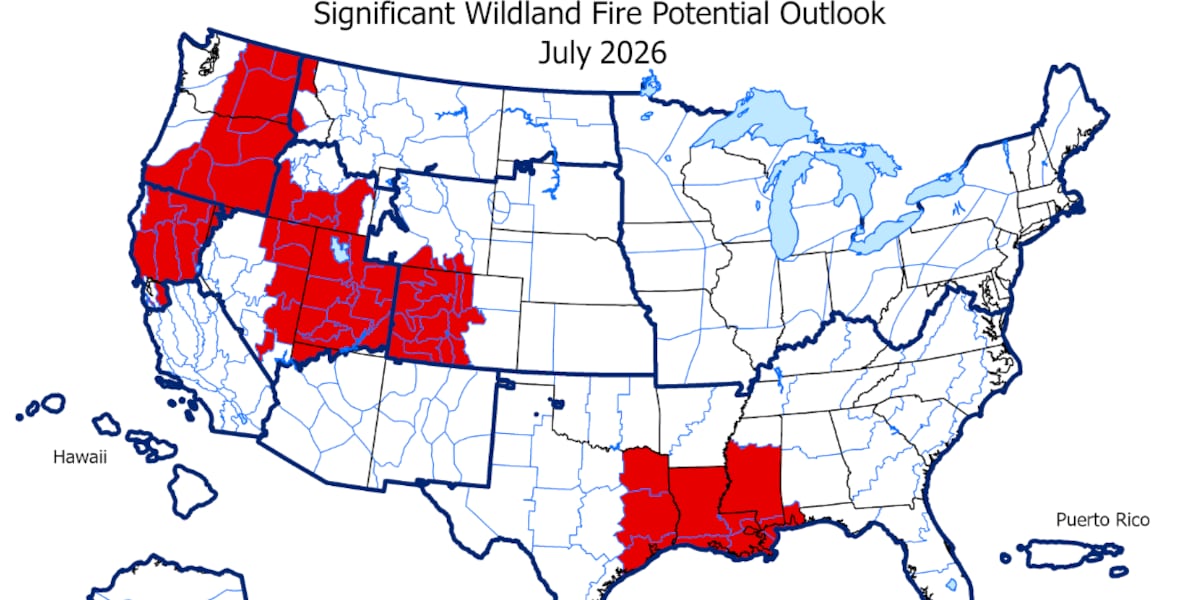
RENO, Nev. (KOLO) – Fire activity increased across the U.S. in March, and by July, above normal fire potential will include much of eastern Nevada and northern California, according to a Wednesday, April 1, Predictive Services National Interagency Fire Center report.
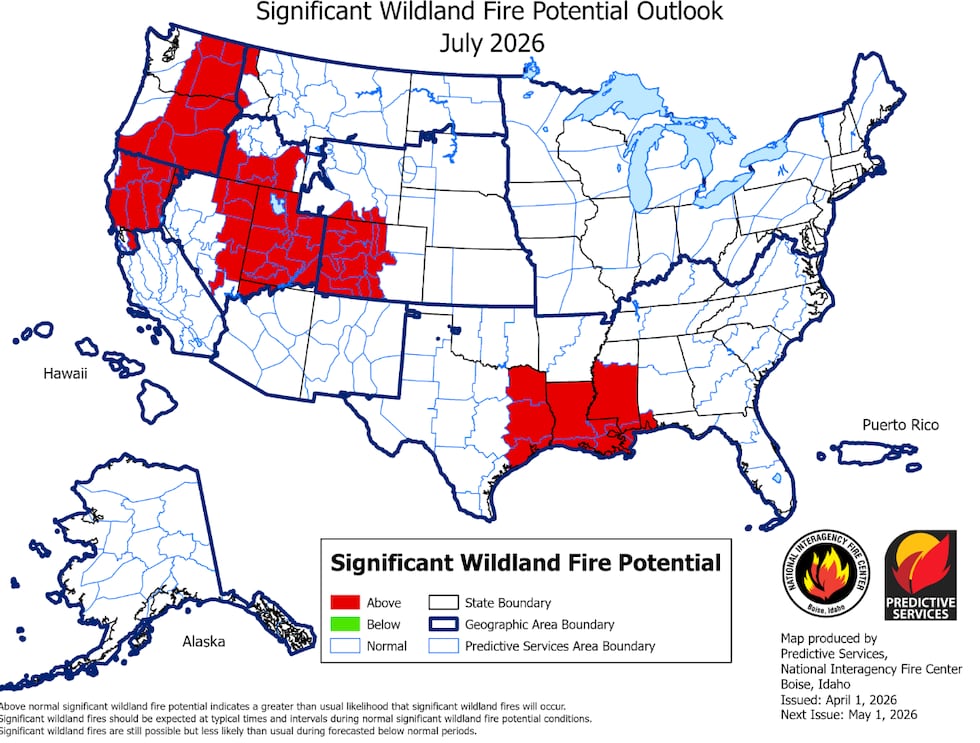 In July, California and Nevada are at a heightened risk, the predictive report said.(National Interagency Fire Center)
The National Significant Wildland Fire Potential Outlook period runs from April through July.
Notable increases in fire activity were observed in the Southern and Rocky Mountain areas, with more modest increases in the Southwest, California, Great Basin, Northern Rockies, and Eastern areas.
Due to the increase in activity, the National Preparedness Level increased to two on a scale of one to five on Friday, March 20, with the Southern area at a geographic area Preparedness Level of three.
As of Tuesday, March 31, 1,615,683 acres have burned across the country, which is 231% of the previous 10-year average, the report said.
So far in 2026, 16,746 wildfires have been reported, which is significantly above average at 168%, the report said.
March precipitation was below normal across most of the U.S., with below normal precipitation observed across California, the Southwest, Great Basin, and southern High Plains, with many areas receiving less than 25% of normal precipitation, according to the report.
Above normal precipitation happened in most of Washington, the northern Rockies, in addition to the Great Lakes southward into the Ohio Valley.
Localized areas of above normal precipitation also occurred in South Florida.
Across the country drought increased with more than 56% of the U.S. impacted, the report said.
Drought persisted, intensified, or developed in much of the western U.S. into the central and southern Plains, and lower Mississippi Valley.
Drought improvement was limited to smaller areas, primarily in the mid-Mississippi Valley, Great Lakes, and Northeast.
Climate Prediction Center and Predictive Services outlooks issued in late March forecast temperatures that are likely to be above normal across most of the U.S. in April, focused on the Great Basin and Southwest, the report said.
Precipitation is likely to be below normal in most of the West, and Florida, with above normal precipitation expected in the Mississippi Valley to the Great Lakes and Mid-Atlantic.
From May to July, temperatures are likely to be above normal for most of the U.S. except the northern half of Alaska and the Upper Midwest.
Precipitation is likely to be below normal across the northern half of the West to the central Plains, with above normal precipitation likely in southern Arizona and New Mexico, as well as most of the East and Gulf Coasts.
Above normal significant fire potential is forecast for April across much of the central and southern High Plains into most of New Mexico and southeast Arizona.
Above normal potential is also forecast across South Texas and much of the Southeast.
In May, normal potential will return to the Plains and most of the Southeast, but above normal will persist for the southeast Atlantic Coast and Florida.
Above normal significant fire potential will also expand across the Southwest into far West Texas and extreme southern Utah, with another area of above normal potential forecast for the Sacramento Valley and East Bay, the report said.
In June, above normal potential will continue in much of the Southwest, while also expected into much of southern Nevada, southern Utah, and the Colorado West Slope.
Above normal potential will also expand across much of northern California and the Inland Northwest.
In the Southeast, above normal potential is forecast to persist for South Georgia and Florida, while also expected for parts of East Texas and Louisiana.
In July, normal significant fire potential will return to South Georgia and Florida as the wet season emerges, but above normal potential is expected to expand to East Texas and much of the Lower Mississippi Valley.
In the West, the Southwest will return to normal due to the onset of the monsoon, the report said.
Above normal fire potential will cover a larger area including Utah, much of eastern Nevada, much of central and western Colorado, southern Idaho, northern California, the Inland Northwest, and portions of southwest Oregon and the Idaho Panhandle.
Copyright 2026 KOLO. All rights reserved.