
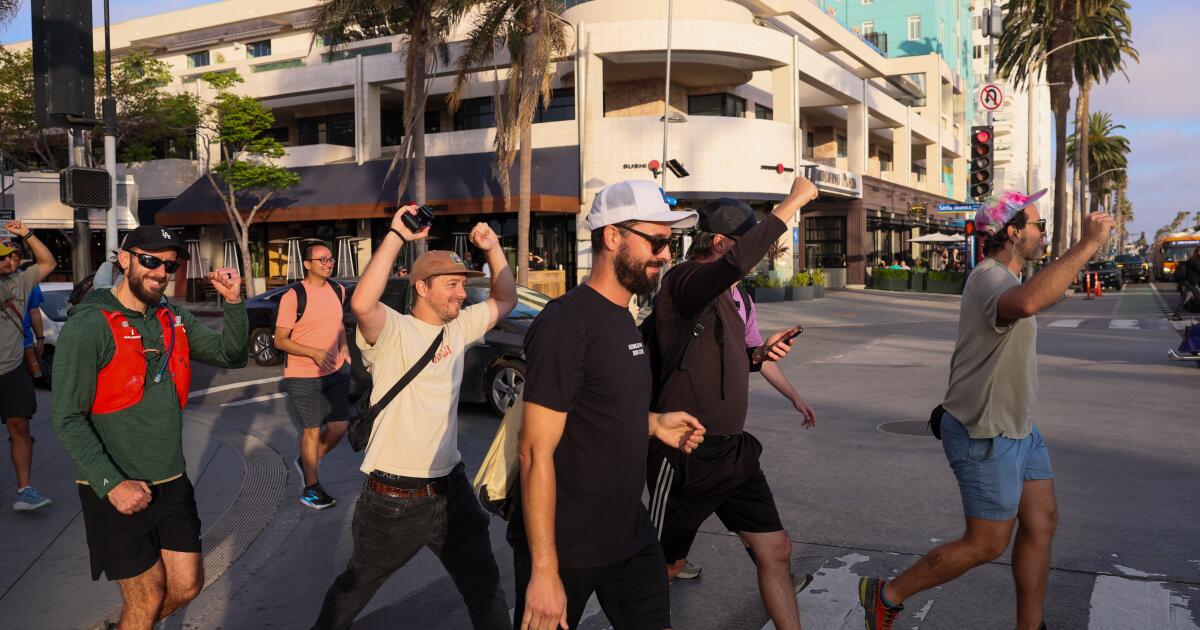
We set off from Silver Lake on a sizzling spring Sunday. Nine hours later, we reached the sand in Santa Monica.
This was the fifth annual walk I’ve organized with a growing group of friends. We began in 2022 with Wilshire Boulevard, a smooth 16-mile journey. In 2023, we scaled all 25 miles of Sunset Boulevard. In 2024, we somehow walked all 28-plus miles of Western Avenue. And, last year, we stepped back to complete Pico Boulevard’s 15.5-mile length.
A vote landed us on Santa Monica Boulevard for this year’s walk, held on Sunday. On that day, we were not the only ones walking Los Angeles. Our journey began at Sunset Junction, the intersection of Sunset and Santa Monica. Surprisingly, we met two friends also beginning a walk to the water there, though they were headed down Sunset.
No matter what route you take, it always feels a little like magic to reach the ocean on your feet from the inland slices of Los Angeles. And Santa Monica makes for the most accessible path. If you’re curious about long walks but nervous about the time they take or the blisters they make, consider completing all 14.5 miles of Santa Monica Boulevard. It’s rewarding.
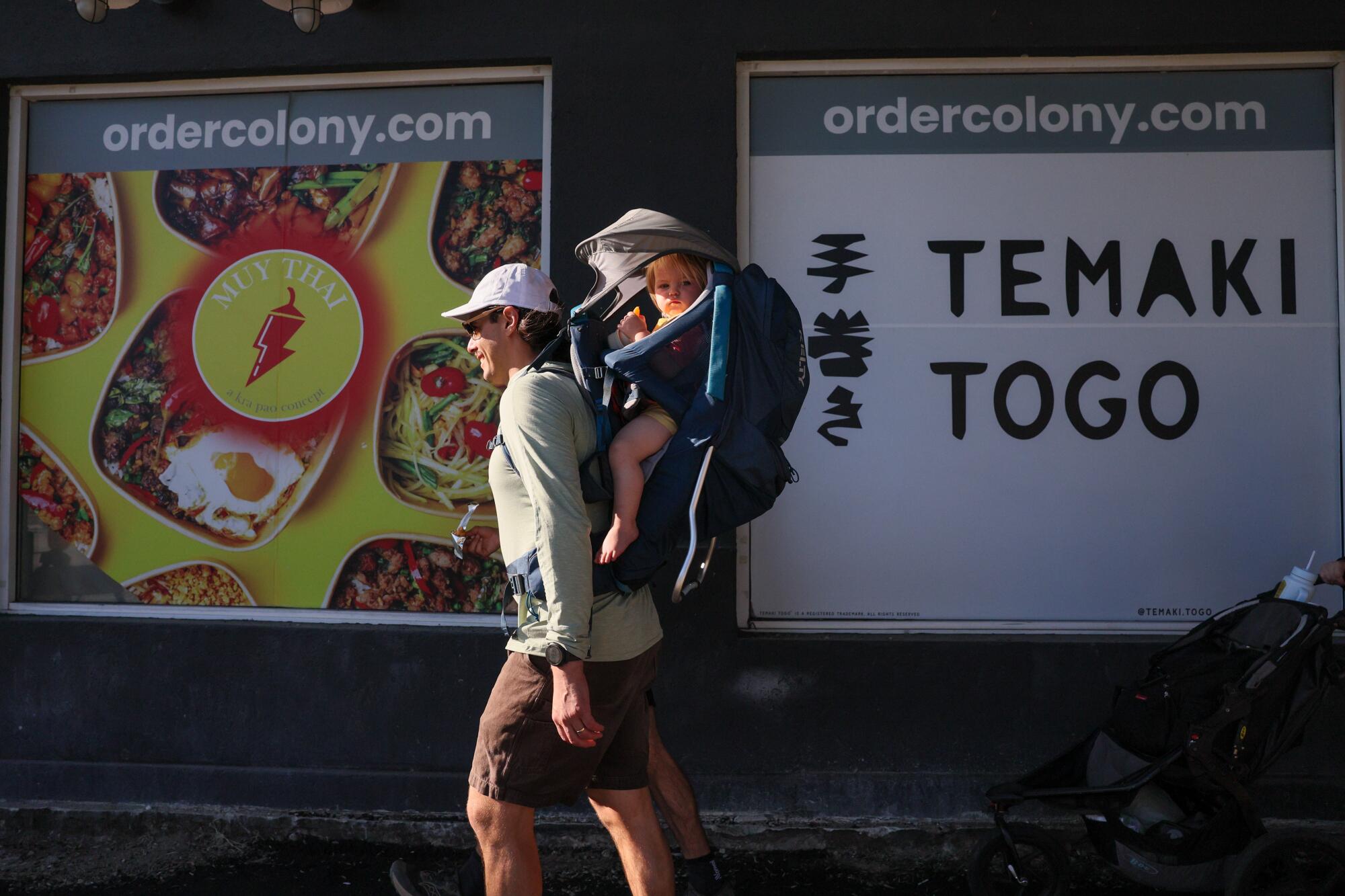
Jake Gallegos carries daughter Margot Gallegos on his back during a long walk along Santa Monica Boulevard.
(Ronaldo Bolanos / Los Angeles Times)
Only a few blocks after we began, we reached Vermonica, an art installation celebrating L.A.’s history through a century of streetlights. The artist, Sheila Klein, came up with the idea after the 1992 riots, calling it an “urban candelabra” and a “drive-by museum.” Most of us had driven by it before; many of us had never noticed it. Perhaps it’s best appreciated as a walk-by museum.
Soon, we crossed the 101 Freeway. Much of Hollywood felt oppressive, and not just because of the day’s encroaching 87-degree heat. There are entire blocks where it feels like nothing is alive. Hollywood Forever Cemetery’s manicured landscaping is the lone respite.
A decade before he became the first person to win four Oscars for the same film, director Sean Baker was living near Santa Monica’s intersection with Highland. He thought the chaos there would be “ripe for a film.” The resulting work, 2015’s “Tangerine,” largely set on the street in the world of trans sex workers, became his breakout. Many of us stopped at the donut shop, now modernized and owned by actor Danny Trejo, featured throughout the movie.
That part of our city is changing, slowly. Most of what once made up the city’s Theater Row is no more, though a handful of spaces are surviving.
We felt palpable relief when we reached La Brea Avenue and entered the friendly confines of West Hollywood. The contrast in tree coverage between the Hollywoods is striking. The nearly five-mile section of Santa Monica Boulevard between La Brea and Wilshire might be the most crowd-pleasing pedestrian stretch of any street in this region.
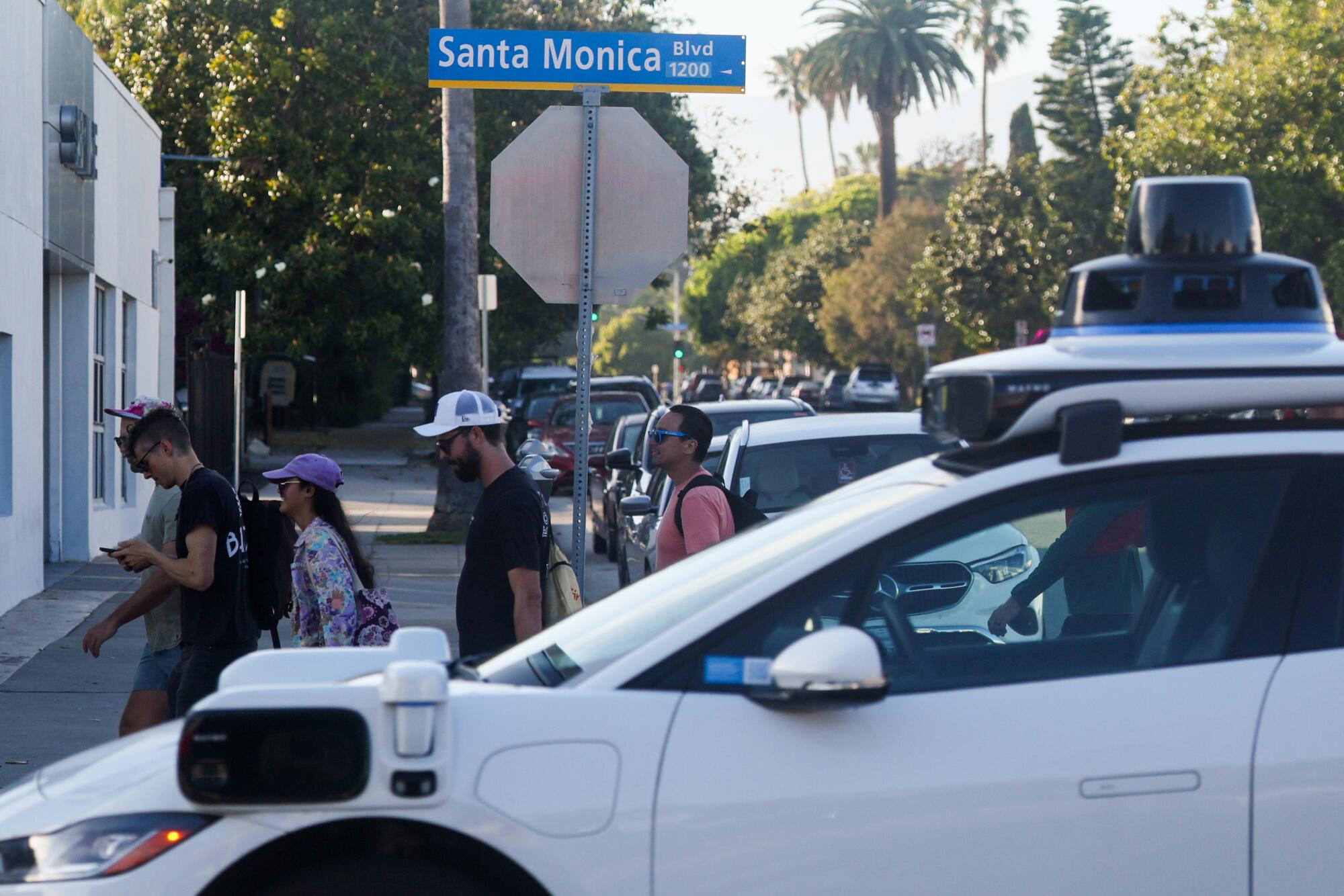
Driverless in more ways than one: A group of friends decided to walk all of Santa Monica Boulevard in a day, passing a driverless Waymo along the way.
(Ronaldo Bolanos / Los Angeles Times)
West Hollywood, of course, has been rated California’s best walking city, and Plummer Park and West Hollywood Park both offer green space, tables and public restrooms. Beverly Gardens Park, restored in 2019, functions like an allée, set back from the street and lovingly shaded.
The next few miles of Santa Monica are less welcoming. A $10-billion project has blocked off the north side of the sidewalk in western Beverly Hills. The most eye-catching sight until you cross the 405 and reach Sawtelle is the LDS Church’s Los Angeles California Temple. When it was completed on its 24-acre site in 1956, it became for many years the church’s largest temple. The structure looms over the street but is fenced off and inaccessible from Santa Monica itself.
You will always find the unexpected on an urban walk. Even on a street as famous as Santa Monica, even with our group’s collective centuries of living here, we encountered places we did not know or forgot were here. In Virgil Village, a small billboard still stands promoting the 2010 Census. The owner of the building has declined to take it down for 16 years now because he likes the Picasso-esque artwork it features.
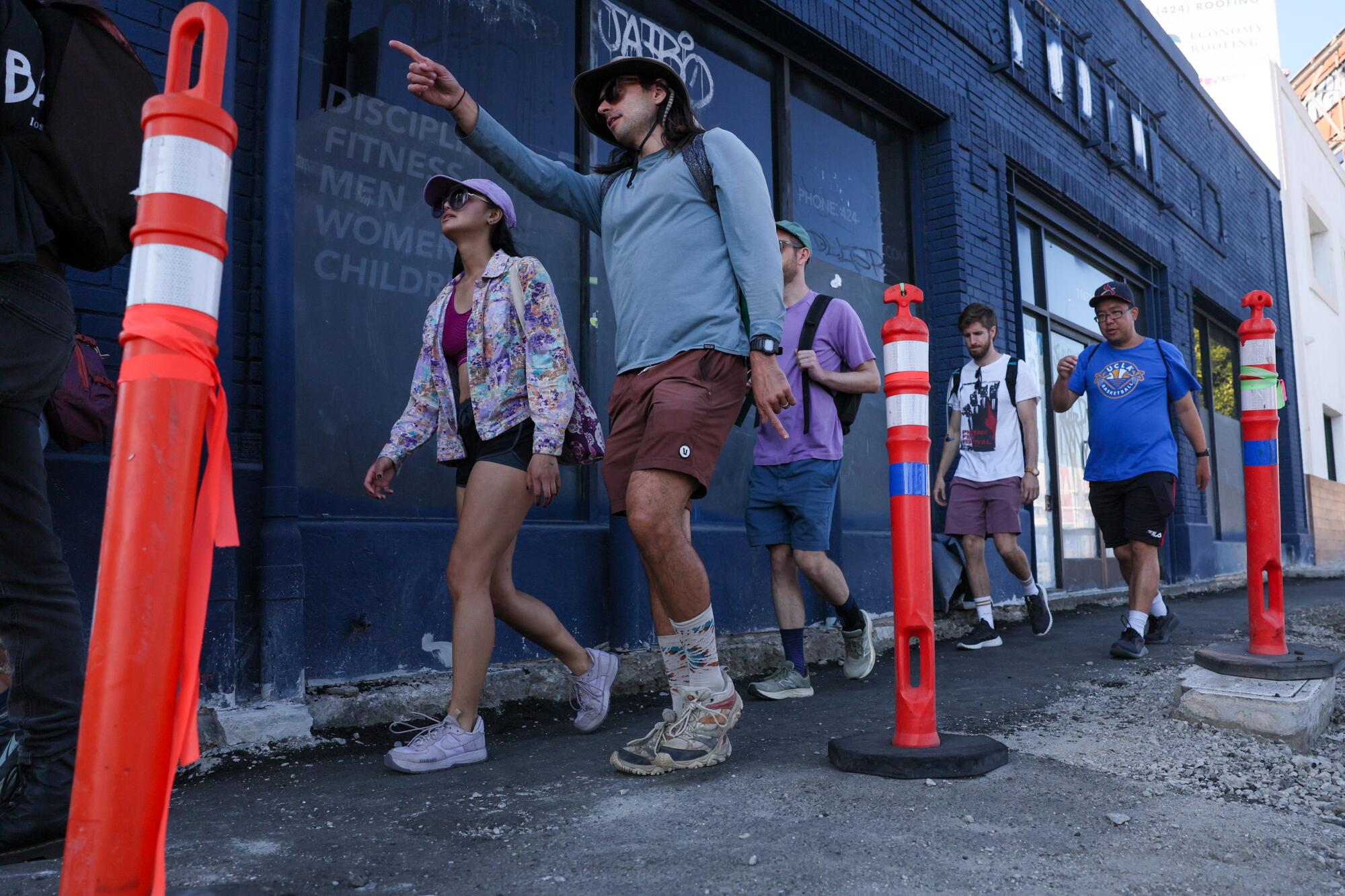
Although Santa Monica Boulevard is a fine street for beginner long-haul walkers, the sidewalks aren’t perfect, with construction popping up.
(Ronaldo Bolanos / Los Angeles Times)
Tucked behind construction in West Hollywood was the 80-year-old Tail o’ the Pup hot dog stand, an icon of the California Crazy programmatic architectural movement. The stand is shaped like a mustard-laden hot dog. Designed before World War II by a progenitor of Streamline Moderne style, it was in storage in Torrance from 2005 to 2022. New owners then plopped it back onto the street as part of a building that once served as the Doors’ studio.
The best part about these walks, the reason we keep coming back, is the window into humanity they open. Some moments feel like the eccentricities of HBO’s “How To with John Wilson” brought west from New York. Near the 405, we saw a man biking with what looked like a cello on his back. The cello was cased. He was not wearing a helmet. Remember that excavated, stalled development in West Hollywood that became a lake in 2024? It’s dry now, but still a striking, massive hole.
Sometimes, meeting new people in Los Angeles can feel like filling that crater: nearly impossible. Walking among each other forces us to talk. It’s not that every interaction goes well, but that more than enough do to render them worthwhile. And walking and talking feels better than driving and honking.
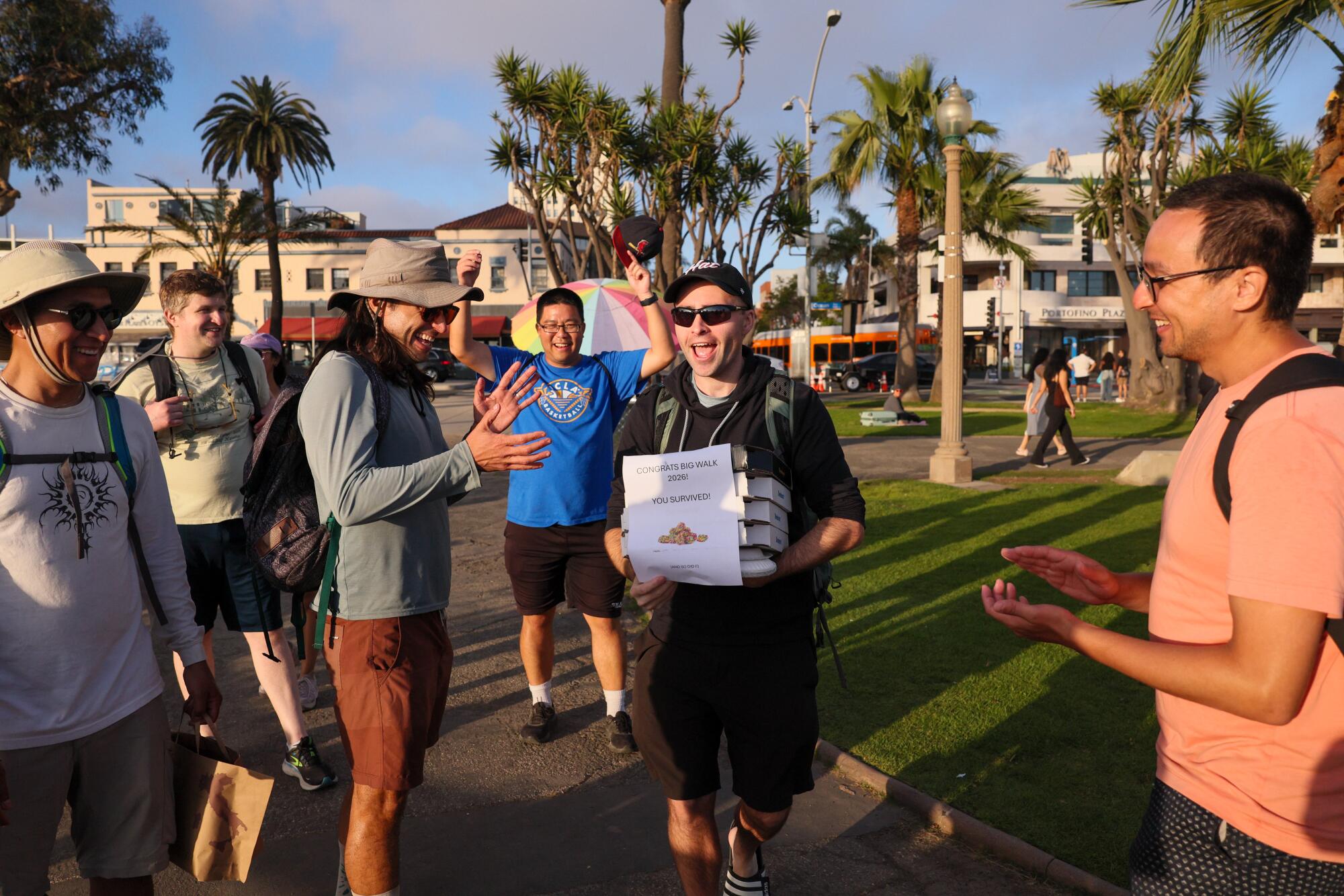
Brian Cudina, center, brings pizza to celebrate the completion of the “big walk” led by Pedro Moura, clapping to the left.
(Ronaldo Bolanos / Los Angeles Times)
On this walk, I ran into a middle-school friend I had not seen since we were zoned to different high schools 22 years ago. He had three days earlier returned to Los Angeles after years away. We also encountered two presumptuous, apparent Angelenos. They eyed our group as they walked by, then smiled and told the folks in the back, “Welcome to Los Angeles.”
Fair enough. With our backpacks and sun hats, we did look like tourists. But residents walk here too! And plenty of us see the appeal. In Century City, an Eataly employee told one of our walkers while shucking oysters that he believed walking was in his DNA, after his mom walked to Los Angeles from her native El Salvador.
Our group was large enough to prompt plenty of questions from passersby about the nature of our endeavor. We began with 32 people and soon grew to 35, including one infant and one toddler. Twenty-five of us celebrated at the Pacific Ocean once we finished. Everyone, we realized, has at least a slightly different experience on these walks. Nobody notices all the same people or places.
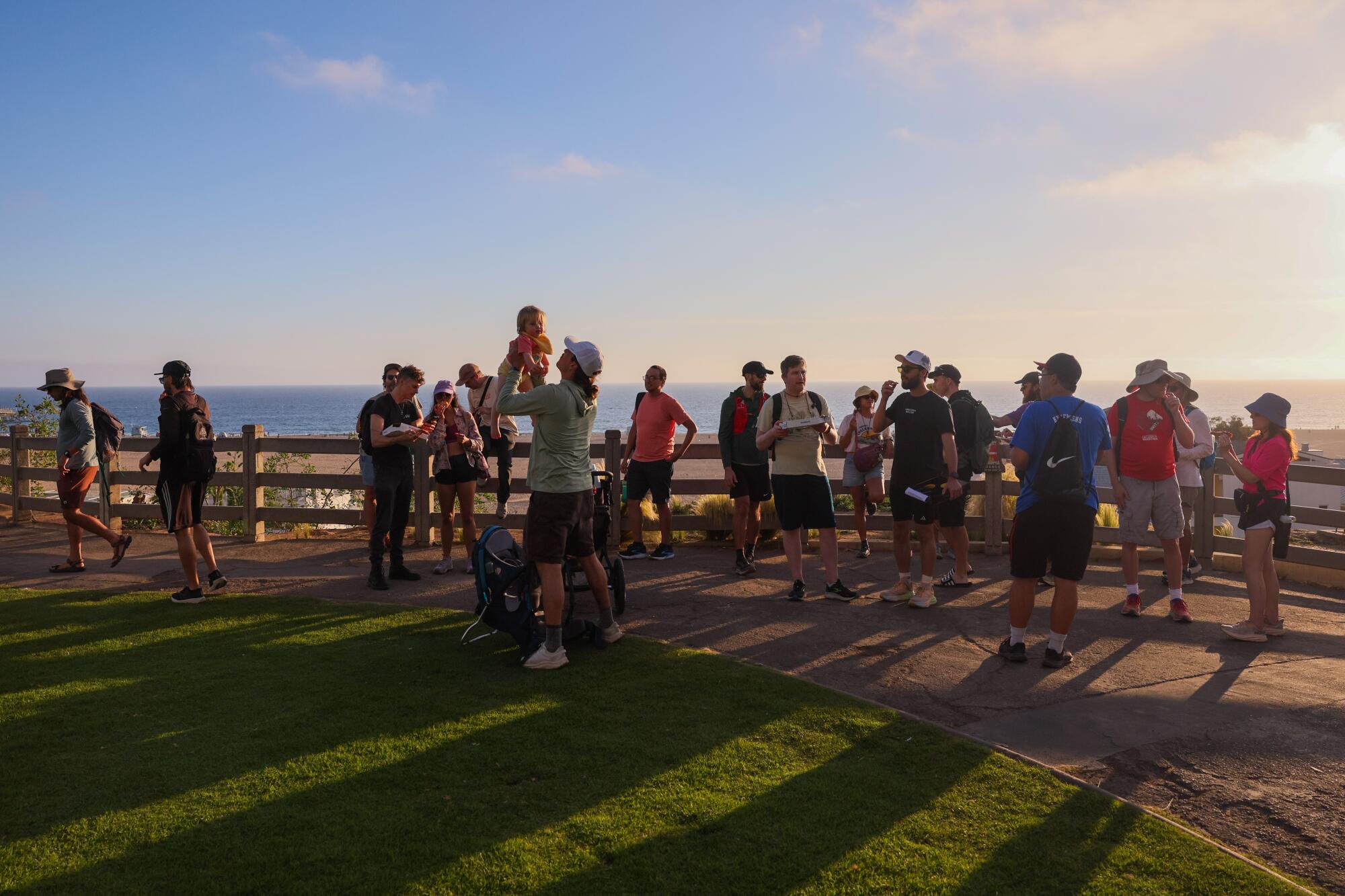
Twenty-five of the 35-person walking crew, which included a baby and a toddler, made it to the end.
(Ronaldo Bolanos / Los Angeles Times)
On May 31, fewer of us will gather for another, longer walk, this time of Atlantic’s 25 miles. Atlantic begins at the Alhambra In-N-Out as an avenue but ends, near the Pacific in Long Beach, as a boulevard. It passes through about a dozen cities.
As a pedestrian experience, we expect it to be about the opposite of Santa Monica — unwieldy, at times unwelcoming, and excessively industrial. But it, too, promises to be an ephemeral window into Los Angeles.