
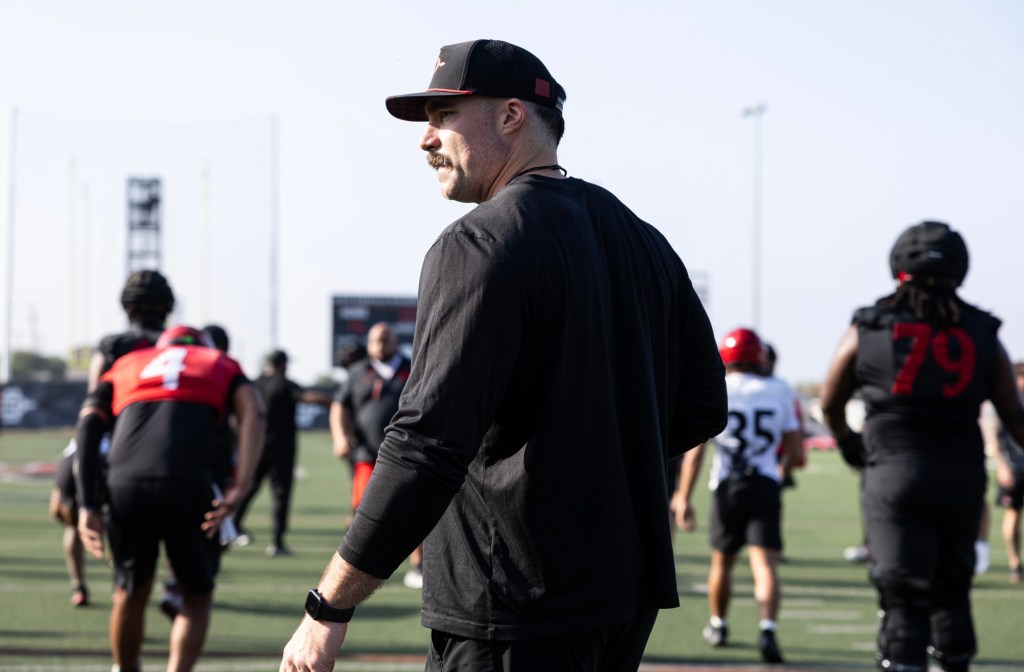
While recent additions to San Diego State’s football staff coincide with this year’s move to the Pac-12, the personnel moves are as much a reflection of SDSU coach Sean Lewis’ intent to keep the program on an upward trajectory.
Among the new positions added in the program was an additional strength and conditioning coach. The role has been filled by Sam Brenner, who, among other responsibilities, brings expertise with interpreting the data collected from players’ wearable devices.
Football players now wear devices that collect data to help maximize performance and minimize injuries. At least they do during strength and conditioning and at practice, which resumes Tuesday after taking this week off for spring break.
Brenner is an Oceanside High School graduate who was an offensive lineman at Utah and played briefly in the NFL with the Miami and Denver organizations. He returned to college at Point Loma Nazarene University, attending the Master of Science-Kinesiology program with an emphasis on sports performance. Brenner was on staff at Auburn last year before coming to SDSU.
“He has great knowledge about sports science and some of the tools that we’ve had in the past few years in terms of GPS wearables and velocity systems and the way we can use analytics even better,” Lewis said, “and the data to help us guide that development for our players.”
The wearables are worn by SDSU’s top 50 players. The devices, which are located in the shoulder pads, use GPS tracking and sensor technology and monitor biometrics.
“We have been able to utilize them to the best of our knowledge and expertise with all the data,” Lewis said. “It’s kind of like your dashboard, especially on these modern cars, where you get so much information, so much feedback, But if you don’t know what it means, it’s useless.
“So we have, at the 30,000-foot level, (learned) how to use that data to help stave off injury, help structure our practices and everything as we’ve gone through the year.”
SDSU has collected data through nine weeks of strength and conditioning and three spring practices. How can that be used? One example: tracking a player’s top speed and comparing conditioning workouts to practices. If there’s a drop off, it could indicate that a player who says he’s good, actually may be — consciously or unconsciously — trying to guard and protect himself from injury.
From a team standpoint, the data helps determine intensity of workouts in order to maximize results.
“Having that data point so that if we have high intensity or high volume days, let’s not stack too many of them back-to-back-to-back so that leads to burnout and soft tissue injuries,” Lewis said. “So we can strategically get the work done that we need to do in an efficient way and have some science now really back it up.”
Quality control
SDSU has filled quality control positions with Parker Houston, a former SDSU tight end and graduate assistant, and former Power Four assistant coach AJ Cooper.
“So we dissolved two positions in graduate assistants and took those positions and made then quality control,” Lewis said. “That’s given us more flexibility to hire people with greater experience, allowing us to tap into a wider pool of talent.”
Houston spent the past two years as a graduate assistant before moving into the offensive quality control position last month.
Cooper, who fills the new defensive quality control position, is a former tight end at North Dakota State who most recently coached linebackers at Arizona State. Lewis said Cooper “brings his wealth of and depth of knowledge and is going to help us in a lot of different ways.”
The Aztecs also added a special teams analyst in Pierre Cormier, who returns to SDSU after serving as a graduate assistant for the Aztecs in 2021. Cormier was a star running back at Madison High School who led the Warhawks to a 2012 state championship. He attended Arizona, where he joined the coaching staff after graduation.
Assistant GM
The Aztecs are in the process of adding an assistant GM this year.
“To continue to be able to expand with what we need to be able to do from an evaluation standpoint,” Lewis said. “With the year-round workload that is on the staff, to be able to have another qualified and experienced person on staff to vet through the numerous people that are out there in the portal.”
Lewis added that he wants to view the program through a “Power Four lens as we continue to elevate our experience” and “build out a more robust college scouting department.”
Spring practice continues
The Aztecs will practice three times a week over the next four weeks, culminating May 2 with the Spring Game on campus at the SDSU practice fields. Lewis said it will be a traditional spring game with blocking and tackling, as opposed to the skills events conducted last year. A family fair is also planned with activities for fans and interactions with players.