
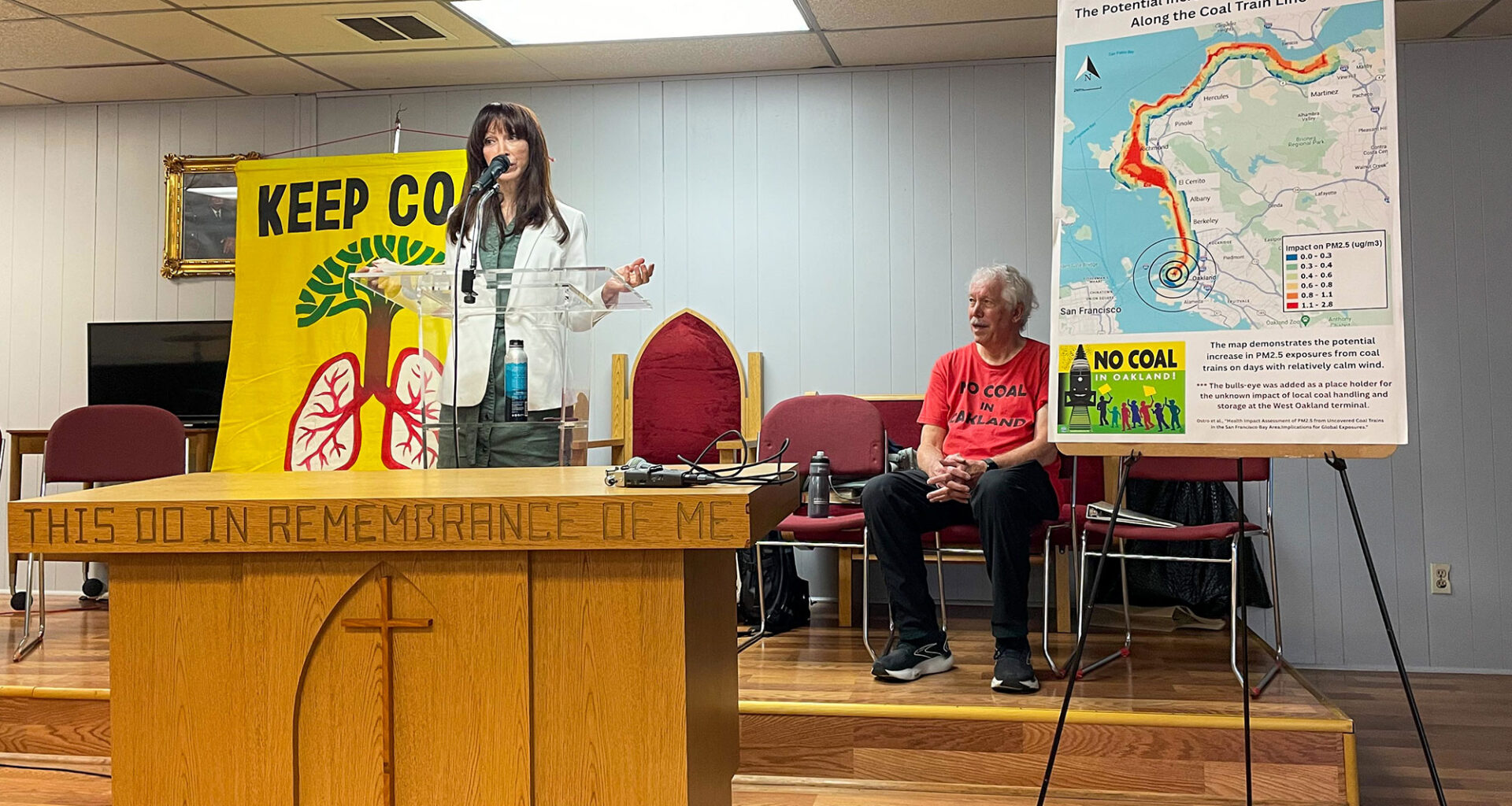
A coalition of community organizations on Wednesday demanded strict environmental regulations for a planned bulk commodity terminal in West Oakland. Those concerned said that the processing of coal at the terminal will cause air pollution due to coal dust, potentially leading to adverse public health outcomes.
At a news conference, members of the Keep Coal Out of Oakland Coalition announced that they have submitted an open letter to the Bay Area Air District, calling for a cap on the quantity of coal passing through the terminal, stringent emission limits to mitigate coal dust, and air quality monitoring.
The letter was signed by 40 organizations and more than 1,000 individuals.
The contentious Oakland Bulk and Oversized Terminal, or OBOT, is a proposed facility that will receive bulk commodities — raw materials like iron ore, cement, and coal that are shipped in large quantities — from all over the country, before being exported via sea. It will be located at the former Oakland Army Base near the Bay Bridge in West Oakland.
As part of its operations, the OBOT will receive unprocessed coal brought in via a railway route that runs along the coast of the East Bay, from Martinez to Oakland.
“We don’t want to perpetuate this legacy of putting pollution burdens on people of color and practicing environmental racism. And the stakes are life and death … not just in West Oakland, but in Berkeley, in Martinez, in all these communities that are along the route of this train.”
Veronica Eady, West Oakland Environmental Indicators Project
On Wednesday, members of the Keep Coal Out of Oakland Coalition said that the trains carrying unprocessed coal will release coal dust into the air along the route, leading to increased ambient PM2.5 levels in the region. PM2.5 is a measure of pollution that indicates the quantity of fine, inhalable particulate matter in the air.
A 2023 study cited in the coalition’s open letter found that the PM2.5 pollution caused by the coal trains could cause lung disease, stroke, cardiovascular disease, asthma, and premature mortality along the proposed rail corridor.
“To describe PM2.5, to describe coal dust — this is a devil’s brew of toxins,” said Dr. Janice Kirsch, a member of the nonprofit 350 Bay Area, which is a signatory on the letter, at the news conference. “The particles actually carry within them — like Trojan horses — metals and volatile organic compounds, and they affect every organ in the body,” Kirsch added.
High stakes for the community
Ted Franklin, representing another signatory group, No Coal in Oakland, said that the responsibility falls upon the Bay Area Air District to protect the residents of Oakland and other East Bay cities from the pollution caused by the coal trains, which he said could be running by 2028.
Veronica Eady, executive director of the West Oakland Environmental Indicators Project, added that low-income and immigrant families will bear a disproportionate share of the public health burden from the coal trains, harkening back to the redlining policies from the previous century that have shaped Oakland’s demographics today.
“We don’t want to perpetuate this legacy of putting pollution burdens on people of color and practicing environmental racism,” Eady said. “And the stakes are life and death… not just in West Oakland, but in Berkeley, in Martinez, in all these communities that are along the route of this train.”
The transport of coal to the terminal has been the subject of a protracted legal battle between developers and the city of Oakland. The saga began in 1999 when the Oakland Army Base closed and the city obtained rights to 370 acres at the location.
The city spent years planning for its development, and in 2012, it signed a lease and development agreement with Oakland Bulk & Oversized Terminal, LLC and affiliates (OBOT) to develop the site as a bulk commodity terminal.
As the project progressed, the community raised concerns about coal products being shipped into Oakland, prompting the City Council to pass a resolution expressing opposition to coal being shipped into the city in 2014. Public hearings about the safety of transporting coal into and out of the city followed in 2015 and 2016, and in 2016, the City Council adopted an ordinance that effectively prohibited bulk commodity facilities from processing coal.
OBOT then filed suit against the city, arguing that Oakland’s regulation of their operations would violate the terms of the development agreement. The conclusion to the protracted legal battle came in June 2025, when California’s First Appellate District Court of Appeals upheld an earlier Alameda County Superior Court ruling in favor of the developers. Two months later, in September, the California Supreme Court also declined to review the ruling, clearing the way for the development of the terminal.