
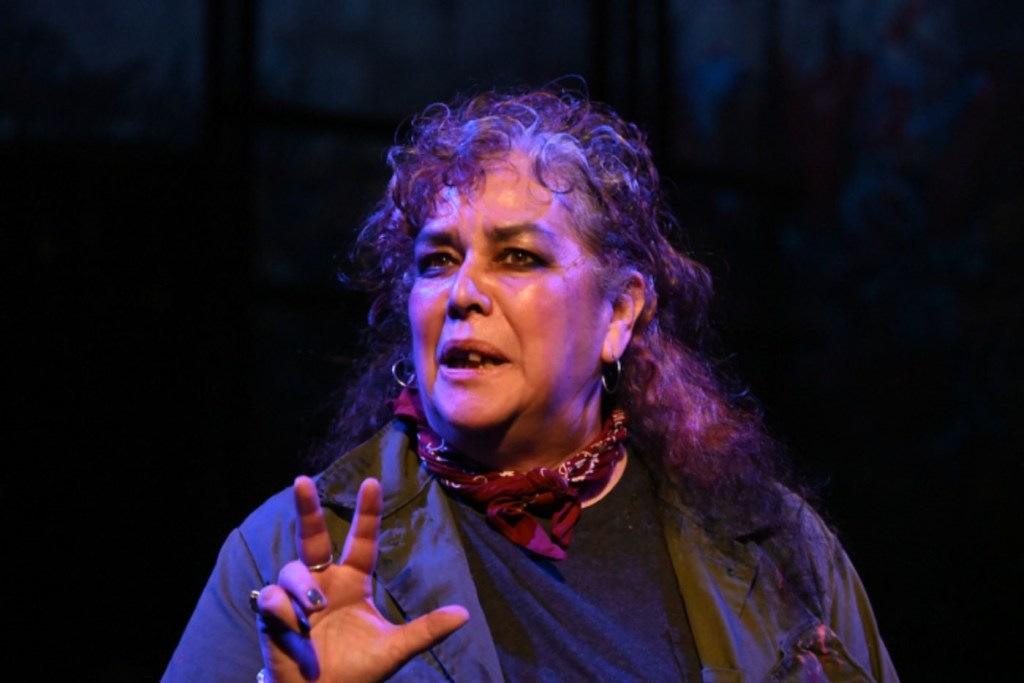
New York City of the 1970s was a scourge of epic proportions. The grime and the underbelly bubbling up from the scorching pavement made Gotham quite the menace, for those who chose to see it that way.
Now throw into that same zeitgeist a murderous king drunk on newly acquired status, along with his capricious wife who yearns for the benefits of unchecked power, and three of the wildest witches predicting all this destruction. That’s the ‘Macbeth’ unfolding these days onstage at Magic Theatre.
The company’s highly transformative space takes on the form of urban filth in its presentation of a modern-verse-translation of Shakespeare’s drama by New York native Migdalia Cruz. In this version of the Scottish play, violence is the city’s middle name. Anger means metal baseball bats smashing against walls, and cries landing hard upon the audience’s collective ears.
Play On Shakespeare, which funds and supports modern verse translations of the Bard’s plays through a vast collection of nationally produced playwrights, is partnering with Magic for Cruz’s version. The result is Shakespeare’s shortest tragedy, whittled down further to a 95-minute traversing through chaos, directed with firm, gritty resolve from Liam Vincent.
Macbeth (Catherine Castellanos) and his trusty comrade Banquo (Nora el Samahy) stumble upon the three ghastly and haggard witches (Kina Kantor, Danny Scheie and Juan Amador), who make him aware of a prophecy that will see him as king. As the prophecy goes into hyper drive, certainly encouraged by Lady Macbeth (Sarah Nina Hayon) and her own lust for status, the story’s violence begins to ramp up as Macbeth’s mind takes the wheel. It is only a matter of time before the popular King Duncan (Brian M. Rivera) is destroyed due to another’s blind ambitions.
By the sheer nature of the play’s tight runtime, everything is compacted, the cast’s urgency levels careening towards the heavens. The cast themselves function on rich levels of moral bankruptcy, but with necessary levity sprinkled through the story.
The technical aspects are impressive, with haunting and random sounds from designer Matt Stines creating a harrowing urban jungle. Justin Partier’s lighting design is full of flickering fluorescents and metaphoric reds, on top of Carlos-Antonio Aceves’s scenic design that is full of cold bars and newspapers pasted all over.
While Castellanos represents the grounded piece that everyone revolves around, Vincent’s staging is in constant motion, the characters understanding that staying in one place in such a violent world could mean their untimely end. Castellanos builds a Macbeth who grunts and snarls, constantly pacing the boards with eyes focused forward for the next move as well as behind for danger that lurks nearby.
Hayon’s Lady Macbeth is unsettled, processing what these premonitions mean for her personally. It is often wine o’clock for her, as she rocks a thin, leopard print dress that screams “party time.” Yet it is her moments of encouraging Macbeth to screw his courage to the sticking place that sets the dastardly deeds in motion. El Samahy provides two wonderful contrasts between a Banquo who is wronged, and the other role of the doctor who observes Lady Macbeth’s mental spiral.
The ensemble cast is where Vincent does his best work, having some terrific talent to shape in multiple roles. Kantor easily transforms from wicked witch to pipsqueak with an NYU ballcap and cashmere sweater vest, applying vastly different intentions on each character. Scheie is a delight as a fellow witch, and as one of the funniest characters in Macbeth, the drunken porter who revels in highbrow jokes of the knock knock variety. And Amador moves swiftly as the brutalized Macduff, processing the slaying of his family before battling Macbeth in order to restore order to Scotland.
In Hector Lavoe’s signature tune “El Cantante,” used effectively in this production, Lavoe speaks of the duality of being a pained entertainer who must wear a joyful mask. Macbeth isn’t much different, understanding that his time on the stage is limited and his mask will one day no longer matter. In his world, he is simply a poor player who understands that in an hour’s time, he will be heard from no more; a useful idiot until he is no longer useful, but with a lot more literal blood on his hands.
David John Chávez is a former chair of the American Theatre Critics/Journalists Association, a 2020 O’Neill National Critics Institute fellow, and a two-time juror for the Pulitzer Prize for Drama (2022-’23). @davidjchavez.bsky.social
‘MACBETH’
Adapted by Migdalia Cruz from William Shakespeare, presented by Magic Theatre
Through: April 12
Where: Fort Mason Center for Arts & Culture, Building D, 2 Marina Blvd., San Francisco
Running time: 95 minutes, no intermission
Tickets: $35-$75; magictheatre.org