
It’s a sunny Thursday afternoon
as a middle-aged woman walks into Bizarro World, a comic book shop in Davis. In the front
are brand-new releases, freshly sealed trading cards and the
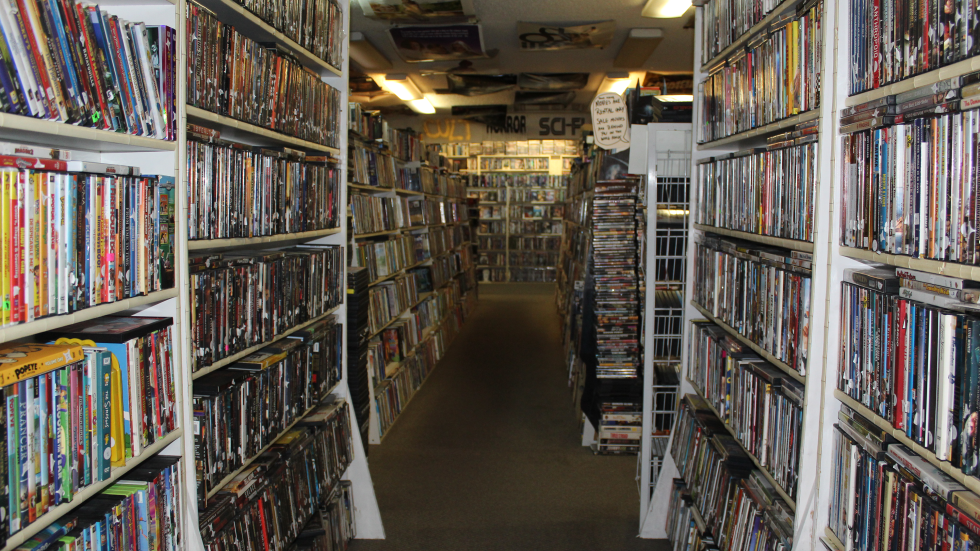
latest games. In the back is a time machine. There, it’s the year
2003. DVDs are the dominant medium, and this rental store has
them lined on shelves by the thousands.
Amazed, the woman tells an
employee, “It’s just like the old days.” Owner Dan Urazandi,
overhearing the two during our interview, turns to me and says,
“Those sorts of conversations are every day here.”
Today, the last Blockbuster is a
tourist attraction in Oregon. The chain, which peaked at 8,000
video rental stores worldwide, filed for bankruptcy in 2010 and
closed its remaining locations over the next four years.
Blockbuster’s killer, streaming giant Netflix, ended its
DVD-by-mail rental service in 2023. Redbox, with its red DVD
rental kiosks, ceased a year later. As for private businesses
that rent out DVDs, only one appears to remain in the greater
Sacramento region.
“The industry collapsed on
itself. Nobody would think of doing it. Who could possibly invest
money into that? That would be crazy, right?” says Urazandi about
operating a DVD rental store in the present day.
Urazandi started Four Star Movies
about 15 years ago as an adjacent business to Bizarro World. He
has 30,000 different titles available for rent on DVD, Blu-ray
and even VHS. Demand petered out over the years as streaming
became more popular. Urazandi thought he’d close eventually, but
upkeep costs were low, so he kept the rental service going. Then,
a few years ago, demand plateaued. Now it’s slightly growing.
“We’ve passed the low point,” Urazandi says. “I think it could be
something that becomes more viable.”

Dan Urazandi started Four Star Movies about 15 years ago as an
adjacent business to Bizarro World.
‘I loved
it’
In 2011, a year after filing for
bankruptcy, Blockbuster closed its Davis store. An independent
shop in town called 49er Video also closed that year. At that
time, Urazandi had operated his comic shop for two decades and
had moved into a property with more space than he knew what to do
with. He tried running an arcade in his back room with video
games, air hockey and pinball. It was a great spot for his son’s
birthday parties, but otherwise proved unpopular. Plus, the
machines were too expensive for him to maintain.
Urazandi needed another idea and
saw the loss of two video rental stores in town as an
opportunity. Thus, Four Star Movies was born. He bought shelves
from the defunct 49er Video and began his rental service with a
few thousand films. People still wanted DVDs, especially the
elderly who weren’t used to streaming. It wasn’t lucrative, but
it was sustainable back then. Urazandi liked movies and wanted to
keep the business going as the market turned, even though he
received snide comments online, like “where’s your horse and
buggy?”
The last DVD rental store in
Sacramento proper, Awesome Video, closed in 2018, but smaller
mom-and-pop shops in the rural edges of the Capital Region lasted
slightly longer.
Pine Grove Video in
Amador County held on for over a decade and a half before closing
in 2022. Owner Ray Jennings says, “I lost more money than anybody
else doing DVDs in the final five years of the business.” Despite
financial pressure, he continued out of a love for his customers,
who often stopped by just to chat.
“I loved it,” Jennings says.
“There’s the problem, you know. They say if you do what you love,
the money will come. That’s not necessarily true, but at least
you’re doing what you love.”

Ray Jennings operated one of the last video rental stores in the
Capital Region. It closed in 2022. (Courtesy of Ray Jennings)
Before opening the shop, Jennings
mostly worked as a local entertainer, spending time as a birthday
clown, juggler, magician, musician and Elton John impersonator.
Husband and wife Gary and Pam Reeder started Pine Grove Video in
2006 with around 1,200 DVDs in stock. The owners decided to sell
it after six months because they had to take over another family
business. At that time, Jennings worked as a mortician and was a
frequent customer. He bought the shop after he overheard that it
was for sale.
In the early days, Jennings says
business was good. He contacted a distributor and eventually grew
his catalog to 10,000 titles. He attributed success to the
location. The shop was in a rural area with an older population
used to DVDs and with poor internet access. “I’m not sure which
was faster at that time here, technologically speaking, whether
it would have been the internet or using smoke signals,” Jennings
says. Business peaked about six years later.
Jennings wanted to continue for
as long as possible. He launched several side hustles just to
keep the lights on. Along with movie rentals and sales, he sold
snacks, take-and-bake pizzas and his wife’s homemade brownies. He
operated disk-repairing machines and rented out the recording
studio he initially installed in the property for personal use.
Then he became proficient at buying items at estate sales and
reselling them on eBay. Redbox coming to Pine Grove was the first
nail in the coffin. The final nail was COVID-19. It was too much
for Jennings. He sold off his inventory and closed shop in
2022.
DVD “was a great medium for
entertainment, I thought it really was,” Jennings says. “In its
time, it was perfect. And I was obviously sorry to see it go,
hoping it comes back.”
‘I’m hanging
on’
Some signs point toward a DVD
extinction. Brendle Wells is a librarian at the Sacramento Public
Library responsible for its movie selection. Pre-pandemic, she’d
order 50 copies of the latest Marvel blockbuster. Now she
typically orders 30. Overall demand for physical movies is
decreasing, but people still turn to the library for films that
aren’t available on digital platforms (or ones they aren’t
willing to pay for). So far this year, members have checked out
DVDs over 30,000 times, though the library also offers the
streaming service
Kanopy.
Just as with VHS tapes, Wells
believes there could come a time when the library no longer
offers DVDs if they are discontinued. Apple TV is known for
having the vast majority of its original content exclusive to the
online service. It’s possible other streamers could eventually
follow suit. “There are a number of entertainment companies that
just don’t put their product out on physical media anymore,”
Wells says. “So it may not be that there’s no more demand, it
just may be that there’s no more product.”
There are signs of a DVD revival.
The Digital Entertainment Group, a trade association,
released
a report in
February that found “spending on
all physical formats, including DVD, Blu-ray and 4K UHD showed
some resilience.” Last year, overall sales dropped by nearly 10
percent, but spending on premium and less common 4K Ultra HD
Blu-ray rose by 12 percent compared with 2024. It shows people
are willing to spend more for quality physical media. Urazandi
says people increasingly want true ownership of a movie that
isn’t tied to an internet connection or a monthly
subscription.
“People started to think, you
know, having an actual physical copy of things has real value,
makes sense,” Urazandi says. “The same trends that brought young
people back into records brought them back into buying CDs and
DVDs.”
One local retailer says there’s a
growing demand for an older, discontinued format: VHS. Guy Rogers
owns
Sparky’s Retro Resale,
a vintage collectibles shop in Sacramento. He sells action
figures, comic books and old media. In 2024, after he first
opened, Rogers sold a few VHS tapes a month. Today, he’s selling
a few hundred a month. Sales increased drastically after he grew
his inventory. “We got a really nice collection, and from there,
it just snowballed,” he says. Last year, Sparky’s sold roughly
1,200 DVDs and Blu-rays and 1,400 VHS. Demand for the analog
format is holding steady, if not growing. “It’s really, really
popular right now,” Rogers says.

These days, Guy Rogers sells more VHS tapes than DVDs at Sparky’s
Retro Resale. He recently installed two spinning racks to hold
part of his growing inventory.
So who’s buying all these tapes?
Horror fans, mostly. Not every film made its way onto DVD or
streaming, so sometimes VHS is the only way to watch them. Rogers
says some people collect their favorite films in every format.
Others enjoy the old analog look of VHS played on CRT TVs. Some
people prefer the tactility of physical media, just like with
vinyl. Nostalgia is a factor, but it isn’t the only one.
Young parents are a growing
market. Rogers says they want more control over what their kids
watch. Some consumers are experiencing streaming fatigue. They’re
tired of paying for multiple services to see all their favorites,
with the chance that titles could be removed or censored. Plus,
all that choice can be overwhelming. A self-curated VHS or DVD
collection can cut down on the hassle. “It’s a way to contain the
information overload,” Rogers says.

Dan Urazandi runs possibly the last video rental store in the
Capital Region, with more than 30,000 titles in his collection.
The
quality of VHS is often worse than that of DVD. That’s a selling
point to some, Urazandi says. A grainy horror film is scarier
than an enhanced version showing the strings puppeteering the
fake monster. “It doesn’t explain why you would watch a rom-com
on VHS now,” he says. A decade ago, it was mainly “hipsters” who
enjoyed the outdated format, but Urazandi has recently seen it
grow in popularity among other young adults. Regardless of why
people want a movie in any physical format, he isn’t going to
stop selling or renting them anytime soon.
“Why am I still doing it? I’m a
nostalgist and an archivist and kind of a fool,” Urazandi says.
“I hang on to things that are obsolete, and I distrust things
that are novel. And that’s just been my way my whole life, and it
has served me well in the business that I chose to go into, and
I’m hanging on.”
Never miss a story: Get Comstock’s weekly newsletter delivered to your
inbox.