
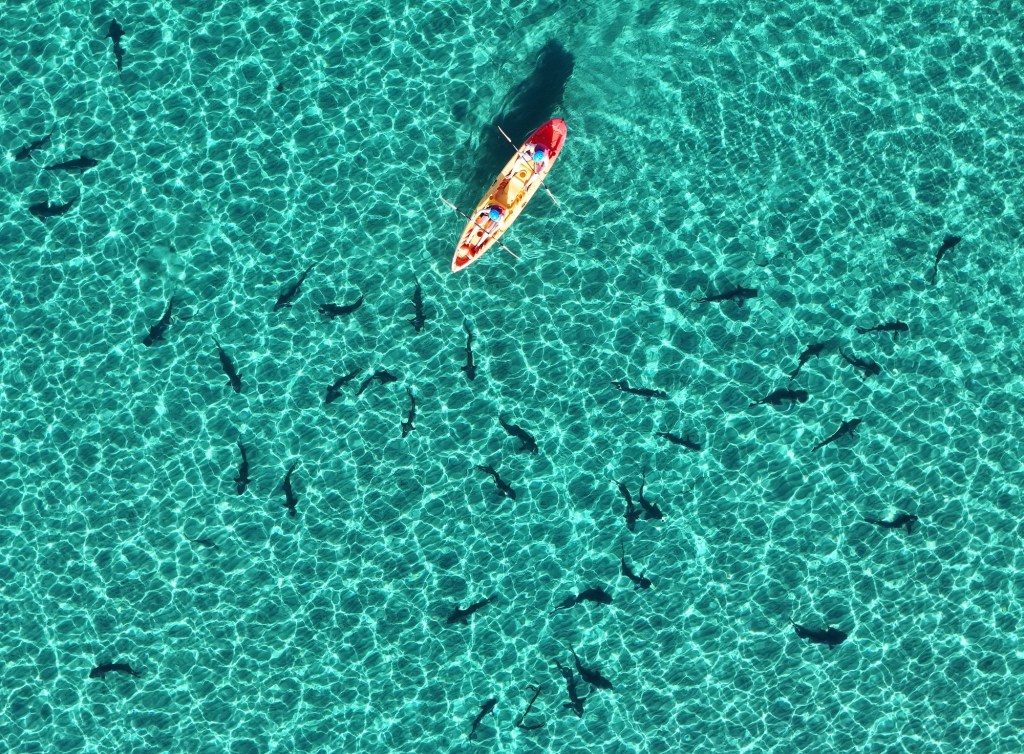
More than a dozen dead juvenile leopard sharks found on a La Jolla beachside trail likely were put there by humans, according to a local marine expert.
People walking on a path near Black’s Beach in late March saw the dead sharks lined up along the trail far from the shoreline, some covered in sand and others laid out on rocks.
One of the hikers, Emily Dean, told local news outlets that she believes the sharks were intentionally removed from the water and looked like they were left out to dry. She told CBS-TV/8 that the experience was deeply upsetting to her.
Dean could not immediately be reached for further comment.
Though some sharks may beach themselves, “there is nothing about this [situation] that seems like something that would happen to the sharks naturally without human intervention,” said Brent Fish, an aquarist at Birch Aquarium in La Jolla. “They were pretty far up away from the water, and that is not an area they would find themselves in naturally. So it seems it was human intervention that caused it, and that is really tragic to see something like that happen.”
Leopard sharks — which can range from 4 to 7 feet long when fully grown — are common in the area, mostly in warmer months. They congregate in the waters off La Jolla Shores because the kelp forest provides a source of food and shelter.
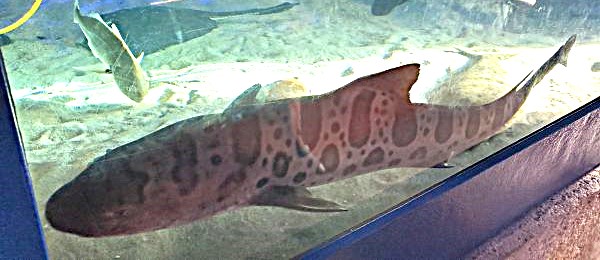 A leopard shark swims at Birch Aquarium in La Jolla. (Ashley Mackin-Solomon)
“You’ll see pretty consistent annual activity from them when the water starts to get really warm, and a lot of that has to do with the fact that a lot of pregnant females will come in because they enjoy the cover of the sea grass beds and the warmer waters,” Fish said. “That makes it a better environment for them to give birth to their pups.”
He called the kelp off La Jolla Shores “a really important biodiversity hot spot” and said leopard sharks are “a very important part” of the local ecosystem.
“They clean out some of the … fish that could spread disease and harm the greater ecosystem. Their role as a predator helps control that and keeps things in balance,” Fish said.
“They are toward the top of the food chain as predators, but they are also scavengers and will clean up some sick or diseased fishes or invertebrates because they are not fast predators that will chase down fast-swimming fish. They are benthic, [meaning] they live closer to the bottom.”
Leopard sharks are known to gather in two local marine protected areas, or MPAs, where there are legal restrictions on human activities. These sharks are believed to have come from there.
The Matlahuayl State Marine Reserve is off La Jolla Cove and The Shores, and the San Diego-Scripps Coastal State Marine Conservation Area is just north of Matlahuayl.
La Jolla marine protected area is ‘one of the most poached’ in California, group says
In the Matlahuayl reserve, it is illegal to injure, damage, take or possess any living, geological or cultural marine resource, according to the California Department of Fish and Wildlife.
The same goes for the San Diego-Scripps conservation area, except for the recreational taking of coastal pelagic species (northern anchovy, Pacific sardine, Pacific mackerel and jack mackerel) by hook and line only.
“It’s important for people to know that leopard sharks are safe to be swimming around, but it is equally important for people to know that you are entering their home,” Fish said. “That is their place and people should be respectful of that and keep a safe distance.” ♦