
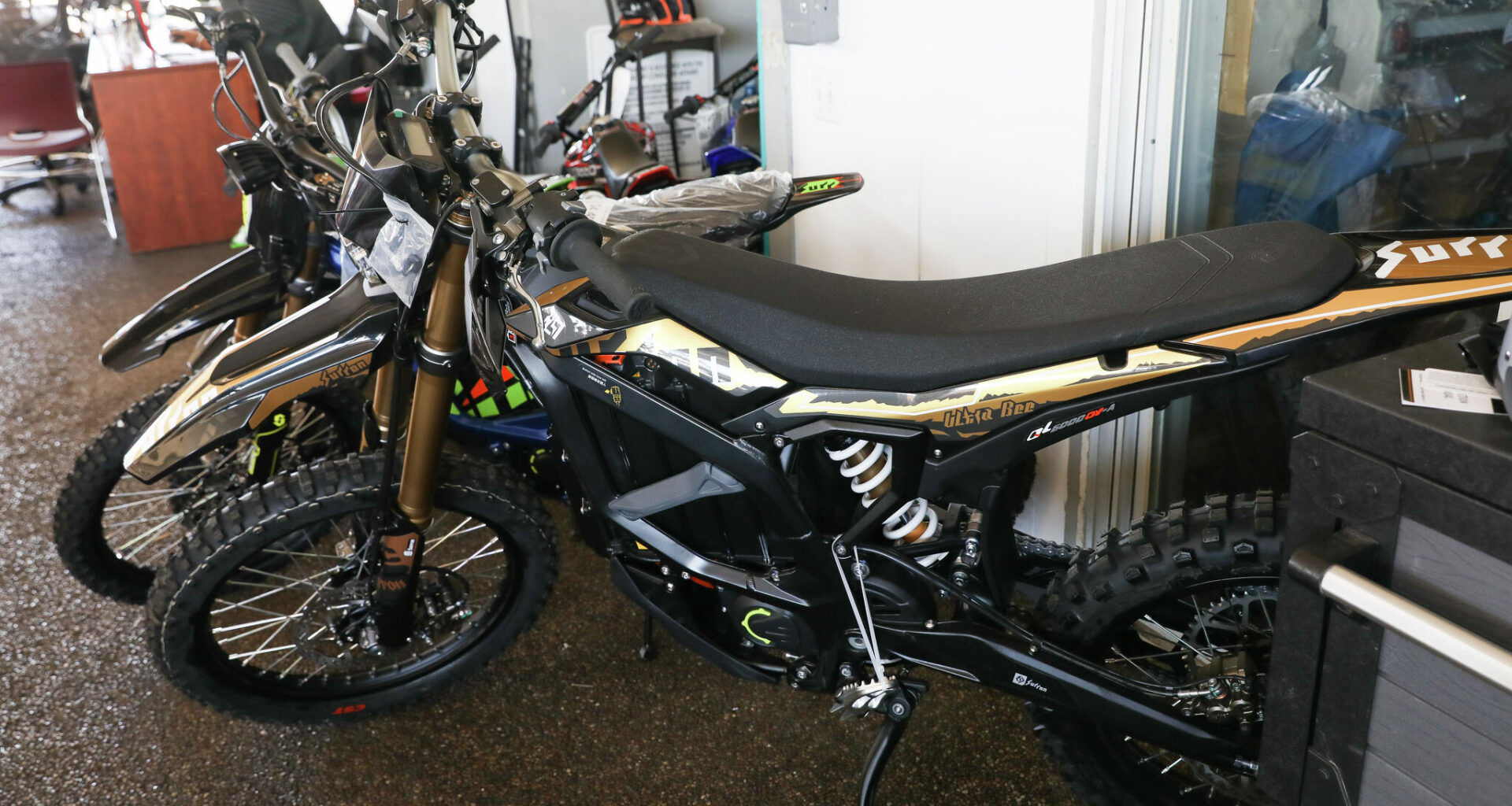
Safah “Sean” Shirzad, manager at Scooter Importer, wheels a Sur-Ron Ultra Bee to the lot at the store for a photo on Thursday, April 2, 2026, in Alameda. Shirzad said he advises his customers that e-motos are not street legal, but he’s not sure whether the information lands.
Lea Suzuki/S.F. Chronicle
Eric Harr pulled his Toyota Tacoma up to a storage unit in Berkeley, his eyes raking the lot warily, a pocket knife hidden in his sock for self-defense. He told his teenage son Turner to wait in the truck.
The Marin dad had never made a transaction like this.
As the electric gate slid open, a lanky college student emerged, tugging a shiny two-wheeled vehicle. There it was: The 2025 Sur-Ron Ultra Bee e-motorcycle. Turner had pined for the bike, a hard thing to find in their area as officials crack down on devices like it.
Article continues below this ad
So-called “e-motos” like the Sur-Ron, sometimes marketed as and confused with e-bikes, have become a flashpoint on Bay Area streets and bike paths, where the off-road vehicles aren’t allowed, yet are now common. But for many suburban teens like Turner, they’ve also become a coveted means of transit and status symbol.
Sur-Ron’s Ultra Bee, front to back, Light Bee, and Hyper Bee are seen at Scooter Importer on Thursday, April 2, 2026, in Alameda. The e-motos are increasingly seen on Bay Area bike paths and streets, where they aren’t legal to ride.
Lea Suzuki/S.F. Chronicle
So Harr had scoured Facebook Marketplace to find the student in Berkeley, who shipped them in from Southern California to meet demand from affluent Bay Area parents. Harr had to admit it looked beautiful, like a futuristic motorcycle. The frame had a glossy black sheen, with foot pegs instead of bike pedals, and a motor that could reach speeds of 50 miles per hour with the twist of a throttle — far faster than the maximum speeds for street-legal e-bikes.
San Francisco Chronicle Logo
Make us a Preferred Source to get more of our news when you search.
Add Preferred Source
Harr opened the Venmo payment app on his phone and transferred $4,700, plus a $100 tip, to the seller’s account. Driving back home with his prize in the bed of the pickup, he felt buoyant. It was the Sunday before this past Christmas, and he’d pulled off the “softy Marin” person’s version of a drug deal.
Article continues below this ad
That’s where the trouble began.
With the Sur-Ron, then-15-year-old Turner found new freedom. He gratified his parents by riding to school and arriving to first period on time. But he also barrelled through stop signs, popped wheelies on their quiet residential block and zoomed away when police officers tried to pull him over. Harr quickly realized not only that his son had been branded a teenage hellion, but that the e-moto had landed them in a culture war.
“Neighbors said, ‘Your son is terrorizing the neighborhood,’” Harr recalled. He sat his son down for a talking-to about safety and personal responsibility.
Turner’s behavior improved. But the battle over e-motos had just begun to heat up.
“This seems like a problem”
Cyclists who regularly ride down trails like the Ohlone Greenway in El Cerrito or the Mill Valley-Sausalito path in Marin say the e-motos popped up about three years ago, standing out from the spandex crowd or the parents hauling kids on matronly cargo bikes. To those who embraced cycling for environmental health reasons, these new e-motos are, to a typical e-bike, what a CyberTruck is to a Prius.
Article continues below this ad
“These things are like Frankensteins,” said Warren Wells, policy and planning director for the Marin Bicycle Coalition. “They’re not clearly an e-bike, they’re clearly a bike, they’re not clearly a car. They don’t fit cleanly into the motor vehicle code.”
Typically, their motors far exceed the legal limit of 750 watts for an electric bicycle, propelling riders to neck-snapping speeds. (Dealers pin the maximum velocity at 40 miles per hour, though teens who spoke with the Chronicle bragged they could hit 70 miles per hour on open road.) The sharp, slender tails jut out like meteor contrails, giving each machine the look and feel of a true motorcycle. Yet they generally lack the brake lights, mirrors, turn signals and other features that motorcycles need in order to comply with state law.
Throttle-assisted e-bikes in Marin County in 2025. Some of these bikes occupy a gray area between legal e-bikes and faster e-motos, which aren’t legal to ride on the street.
Stephen Lam/S.F. Chronicle
“They’re the ones blowing past stop signs and not looking to see if any cars are coming,” said Roger Thilmony, who was riding his traditional bicycle to work last Wednesday on the Ohlone Greenway. On weekday mornings this tree-lined bike and pedestrian path showcases a panoply of micro transportation modes.
“Acoustic” bicycles like Thilmony’s wobble beside “Class 1” pedal assist e-bikes, whose motor only operates when the rider is pedaling. “Class 2” e-bikes whizz by just as fast without pedalling, spurred by throttles. Even faster “Class 3” pedal-assists, whose motors reach 28 miles per hour, have become more common on the path in recent years. Weaving around all these bikes are dog walkers, e-scooters and joggers all gingerly looking out for the next blisteringly fast middle- or high-school student on an e-moto.
Article continues below this ad
“Definitely a lot of cities are grappling with these devices,” said El Cerrito Mayor Pro Tem Rebecca Saltzman, whose constituents have expressed anxiety about kids and grownup adrenaline junkies speeding on the Greenway.
Wells, of the Marin Bicycle Coalition, remembers his first e-moto sighting. In late 2023, he was sitting at a San Anselmo cafe when a group of teens peeled into the parking lot. One had what looked to Wells like a dirt bike: thick tires, suspension, a frame fit for Batman.
“I clocked the label on the side, ‘Sur-Ron,’” Wells recalled. “And I thought, ‘Oh, this seems like a problem.’”
Before long teens were crashing their e-motos, often with devastating consequences. A 16-year-old boy in Half Moon Bay died after ramming what police described as an “electric motorcycle” into a box truck in February. In Walnut Creek, a boy riding a Sur-Ron Light Bee collided with a minivan last year and came away with severe injuries. (Prosecutors haven’t publicly disclosed the extent of the trauma, though they said the boy needed hospital treatment.) His parents now face child abuse charges.
Police have begun pulling over and seizing the e-motos. In the small East Bay community of Albany, officers said they impounded seven of these vehicles between October and December of last year. They cited riders for infractions that ranged from not wearing a helmet, to not carrying a valid driver’s license, to evading a peace officer. Several of the people ticketed were minors. One of them, a high school sophomore, told the Chronicle he had to pay $1,000 to retrieve his bike.
Article continues below this ad
Hitting the brakes?
Panic over e-motos soon reached the state capitol, where legislators are currently pushing nine bills to clamp down on e-bikes and motorcycle-type vehicles. Wells and other cycling advocates support at least one of those efforts, Senate Bill 1167, which would bar manufacturers and retailers from advertising lightning-fast e-motos as e-bikes. Other legislation is more sweeping, and could apply to more bikes that are currently legal. For example, the California Bicycle Coalition opposes bills aimed to set speed limits on bike trails or constrain Class 1 and 2 e-bikes to a maximum speed of 16 miles per hour.
Students retrieve their e-bikes in Marin County in 2025, where throttle-assist e-bikes are restricted to riders over 16. Some think restrictions on e-bikes and faster e-motos are necessary, though others say they can risk going too far.
Stephen Lam/S.F. Chronicle
Meanwhile, four members of Congress — including Rep. Jared Huffman, D-San Rafael — are pressing tighter federal standards for e-bikes and e-motos. Cities in Marin County launched their own crusade last year, with ordinances banning kids under 16 from riding Class 2 e-bikes.
Some cyclists and parents believe the backlash has gone too far.
“It reminds me of the argument we had about e-scooters in San Francisco ten years ago,” said Chris Hilsenbeck, a father of two in Fairfax whose son rides a legal electric mountain bike. Hilsenbeck and other parents worry that legitimate outcry over kids riding the equivalent of motorcycles will have a chilling effect on bikes that are actually a practical, eco-friendly form of transport.
Much contention now centers on gray area bikes, like the trendy Super73 e-bikes, which Wells and other advocates would classify as a type of e-moto. They fall within that category, Wells said, because Super73 riders find ways to unlock the controllers and achieve speeds higher than 20 miles per hour on throttle power alone.
Concern over Super73s led to the spate of regulations in Marin last year, frustrating parents who had already bought Class 2 e-bikes for their kids under 16. Now, many of those two-wheelers are just sitting in garages, said San Anselmo dad Ryan Grabenkort. His son and daughter used to ride Class 2 e-bikes to school, friends houses and jiu jitsu practice. In Grabenkort’s view, the bikes spared him the burden of pick-ups and drop-offs, and made a free-range childhood more attainable.
“So you had all these Marin kids who were riding (Class 2) e-bikes to school, and they hadn’t purchased a $2,000 a year bus pass,” Grabenkort said. “And then suddenly it’s like, ‘You can’t do that any more.’”
Workarounds
Whether heightened regulations will curb the larger e-bike and e-moto market is unclear. One power sports chain store manager said he just began stocking Sur-Rons at shops in Alameda and Hayward. When he promoted them on Facebook Marketplace, prospective customers flooded him with requests.
“I got messages from kids as young as nine,” said Safah “Sean” Shirzad, manager of Scooter Importer, though he has yet to sell anyone so the electric motorcycles. He said when prospective customers enter his store, they never ask for an “e-moto.” Instead, they name-check the splashiest brands: Sur-Ron. Talaria. Super73. Arctic Leopard.
A lot of otherwise reasonable parents get snookered into buying these products, said attorney Dan O’Malley. He represents the Benicia dad who pleaded not guilty to child abuse, after his son smashed a Sur-Ron into the side of a van making a left-hand turn in Walnut Creek. O’Malley disputes prosecutors’ claims that the child was speeding, and said the driver had failed to yield when making the turn.
All the same, he wants e-bike and e-moto dealers and manufacturers “to take responsibility in informing consumers of the California laws.” Law enforcement should be targeting the e-moto industry, O’Malley contended, not the hapless consumers tricked by advertising language that lumps pragmatic e-bikes together with dangerous stunt vehicles.
“We as a society have an obligation to educate people,” the attorney said, standing outside a Martinez courtroom last Friday morning, waiting for his client’s arraignment. The dad, Steven Leroy Crews, had been propped up as an example of negligent parenting. TV news cameras had swarmed his front doorstep the night Contra Costa District Attorney Diana Becton announced the charges.
At Scooter Importer, Shirzad said he advises his customers that e-motos are not street legal, but he’s not sure whether the information lands. He questioned whether new restrictions would have much impact on safety.
A throttle-assisted e-bike near Fairfax on Wednesday, April 2, 2025. Many e-bikes can be manipulated to go faster than legal limits, leading critics to categorize them with e-motos.
Stephen Lam/S.F. Chronicle
“There will be workarounds,” he predicted. “Something as simple as adding pedals to a chain.”
Adults who’ve Facebook-searched the term “Sur-Ron Ultra” and stumbled on an illicit dealer seem largely aware of what they are buying. Harr, the Fairfax dad, said he knew he’d entered a “dodgy” situation well before he exited the freeway in Berkeley. He’d purposefully driven the Tacoma truck because it looked edgier than his luxury SUV.
“I had to keep my phone on speaker so my wife could hear the whole thing go down,” he said. “She was tracking where I was going.”
The risk paid off, and the Sur-Ron functioned as a rite of passage for Turner — albeit a fleeting one. A few months after mounting his e-moto for the first time, Turner turned 16. For his birthday, Harr bequeathed his Tacoma to his son.
Once Turner got the car keys, he completely lost interest in his $4,700 e-moto. It’s been parked at home.