
SAN JOSE, Calif. (KRON) — In the digital age, data centers have become essential to the way we communicate, but the high energy users are often met with opposition over potential strains to power grids.
KRON4’s Philippe Djegal takes us inside one of these facilities in San Jose. Watch the full report in the video player above.
Gilroy community fights against Amazon from constructing data center
Artificial intelligence may be the brain, but data centers are the nervous system of the digital world.
Connecting people and businesses in almost every facet of everyday life.
“You as an individual — an end-user. It’s really invisible to you. But it’s through a series of physical and virtual connections that allow us to live in the modern world,” said Christopher Wellise, Vice President of Sustainability at Equinix. “Whether you’re on your cellphone, you get up in the morning and you’re checking your app.”
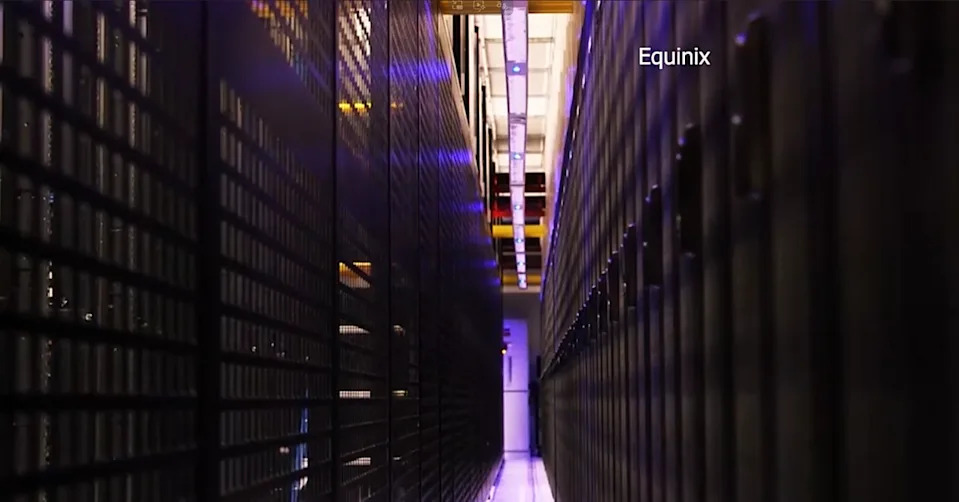
Image courtesy of Equinix.
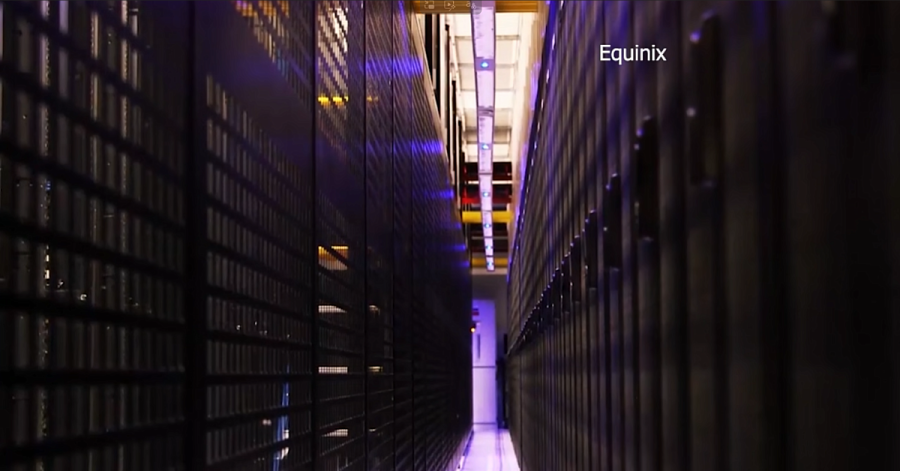
Wellise took KRON4 on a tour of Equinix SV5 — a mixed web of fiber optics cables and computers.
“This is all the interconnectivity across all the companies they’re operating within our international business exchange,” said Wellise.
SV5 is one of 12 data centers in Silicon Valley owned and operated by the global company founded in the Bay Area. It is a dimly lit temperature-controlled facility, housing cages filled with processors owned and operated by mostly Fortune 500 companies.
“We provide a neutral location for businesses, enterprises to connect with each other and transmit and transfer data,” said Wellise.
The halls are intentionally dark to minimize overheating the high-powered equipment. The noise made by fans to keep the processors cool is certainly loud but cannot be heard beyond the walls.
At Equinix, some of the heat emitting from the gear is recycled and used to generate power.
“One of the things that you’ll notice is these blanking panels here — these plastic panels. So, we actually segregate the hot aisles from the cold aisles so that you’re optimizing for temperature and cooling,” said Wellise.
Wellise said that reduces the amount of energy being consumed in a building like this. “Anywhere between 25 and approximately 35% of the energy that goes into these facilities is to cool the facility.”
But in reality, the rapid expansion of these data centers near communities has sparked criticism over large consumption of energy and water, which Wellise understands. “The computers generate a fair amount of heat, but as you’ll see when we go outside, Equinix is innovating the type of energy that we’re actually producing and much of it is produced on-site.”
Wellise points to the Bloom fuel cells stationed in the back lot — solid oxide electrochemical devices that convert natural gas into electricity.
“Currently 50% of the amount of power consumed by the computers in that building, right there, are powered by Bloom fuel cells. That is going to be ramped up to 100%,” said Wellise.
Earlier this year, Equinix celebrated the grand opening of SV12x, the company’s newest local data center and the byproduct of the city of San Jose’s partnership with PG&E. It was an agreement reached between the city and utility, doubling power at a local substation and adding 2,000 megawatts of new transmission capacity to attract and accommodate large customers like Equinix.
“We don’t have that intermittency like you and I when we go home and we turn our A/C on depending on where we live. There are peaks and valleys in electricity usage, whereas a data center like this is up 24/7 providing a very consistent baseload,” said Wellise.
PG&E’s expanded grid makes room for up to 15 data centers to come online by 2030, which is expected to save smaller customers, like households, money in the long run.
PG&E says large power loads at data centers actually bring rates down for customers.
“We are bringing in data from all around the world,” said Wellise. “Transferring it at a local level and at a global level.”
To date, Wellise says Equinix boasts 280 locations in 77 metro areas around the world, claiming the company is essentially within 10 milliseconds of 90% of the world’s population.
“What’s powering the modern digital world is really data, and we need to transmit that data,” said Wellise. “Companies need to communicate with each other and transmit that data in order to do the work that’s necessary to keep things moving.”
Wellise said you can almost think of a data center as an “international airport of information.”
Copyright 2026 Nexstar Media, Inc. All rights reserved. This material may not be published, broadcast, rewritten, or redistributed.
For the latest news, weather, sports, and streaming video, head to KRON4.