
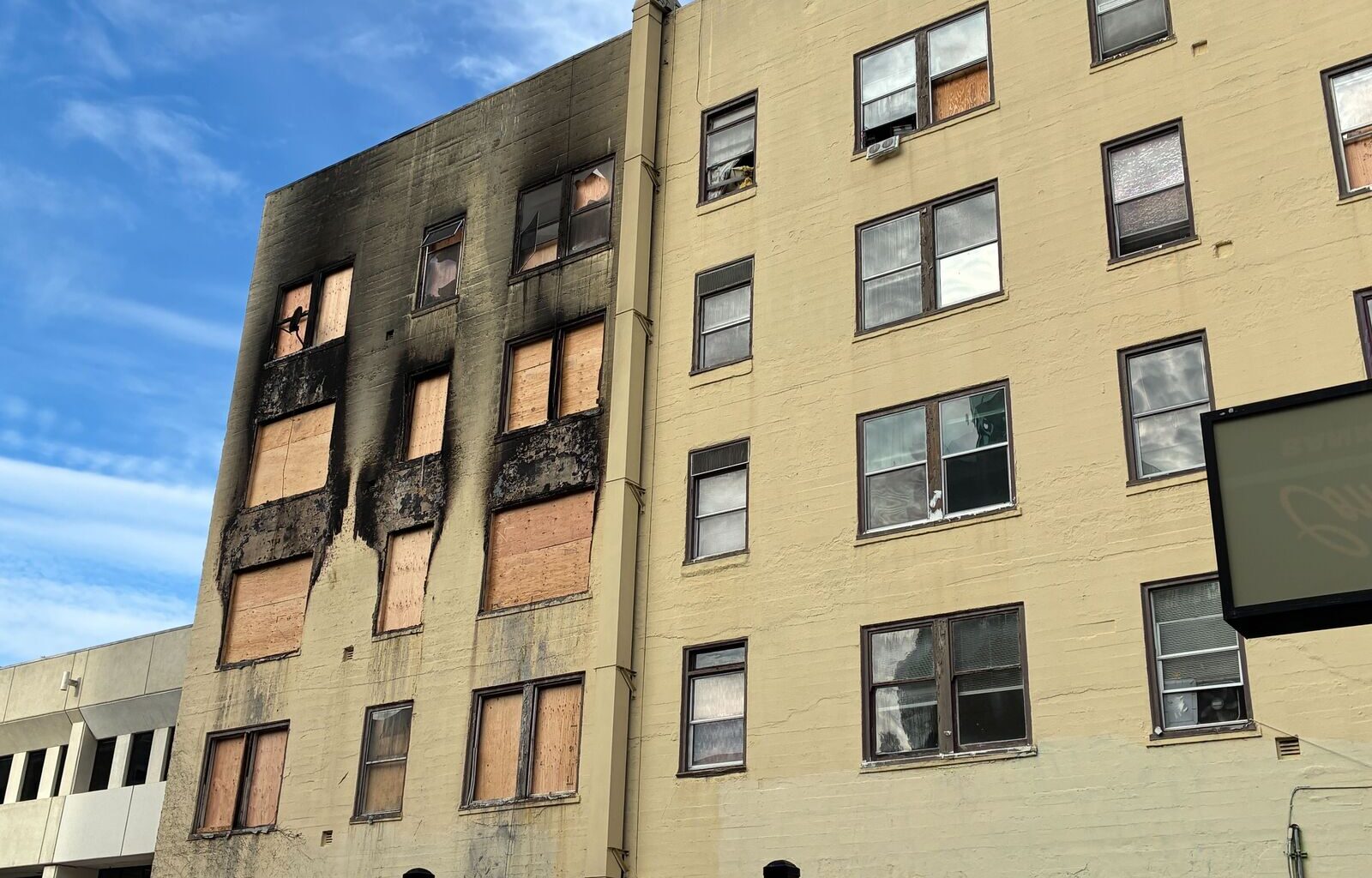
A fire tore through a downtown apartment building the morning of Jan. 19, displacing dozens of tenants and prompting the fire department to red-tag the property.
The next couple of days were chaotic around 1770 Broadway. Some residents moved into an impromptu shelter, while others looked for couches to crash on. Information came out about an illegal chop shop in the building that likely caused the fire.
And controversy soon erupted over a letter distributed by the landlord the same day as the blaze, announcing leases were terminated — a letter the city attorney demanded he withdraw.
A day later, amid this tumult, the landlord, Ted Dang, sent an email to an affordable housing developer.
“Now that the building is damaged and vacant,” Dang wrote, “Would it be a better candidate for that housing program?”
He attached a photograph of flames and smoke billowing out of the building 30 hours prior.
The developer, Ali Kashani, quickly forwarded Dang’s email to a city housing staffer, explaining that he’d toured the property the month before, considering submitting it for a city program that funds the purchase and conversion of existing buildings into affordable housing. He “declined” to pursue buying it at the time, Kashani wrote, “chiefly due to the extensive Health and Safety issues with it.”
But “now that it is vacant, it could be a candidate for some kind of city funding. Any suggestions, ideas?”
Housing director Emily Weinstein responded curtly:
“We are currently working to identify potential vacancies for displaced tenants. Ted Dang must comply with all of the City’s tenant rights and relocation requirements and processes.”
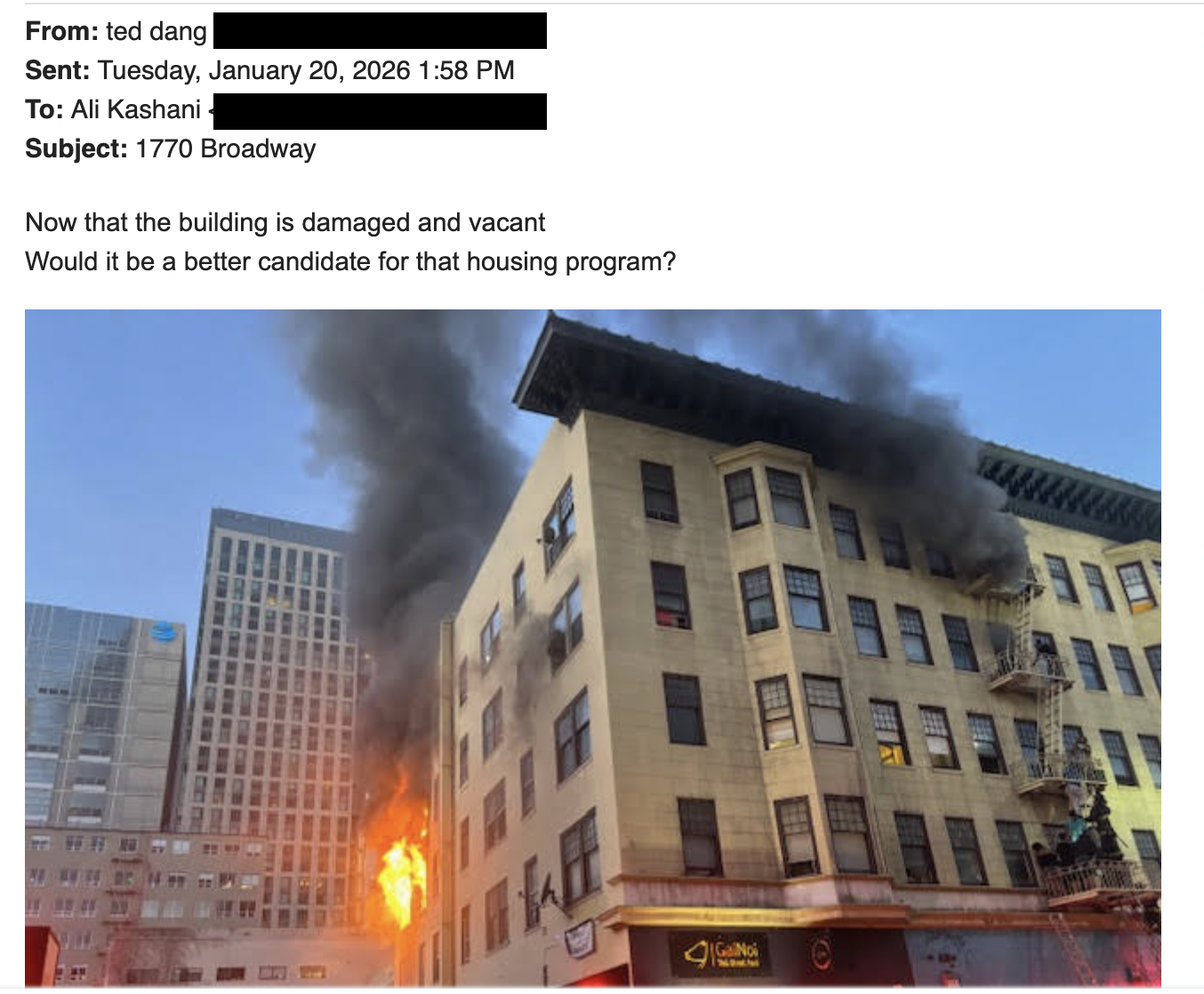 Dang’s email to Kashani the day after the fire, obtained by The Oaklandside via a public records request.
She continued, “As you know we have the following funding programs,” and linked to the city’s webpage for developers.
Asked about his email this week, Dang said the context is important — he and Kashani have a history of collaborating on creating affordable housing in Oakland. Dang is the co-founder of the East Bay Asian Local Development Corporation, or EBALDC, a prolific affordable housing developer in Oakland.
“We want to keep it affordable,” Dang said of 1770 Broadway. While not currently a subsidized building, the older rent-controlled property housed many low-income tenants, including many with Section 8 vouchers.
Dang told The Oaklandside that an unoccupied building is better suited for the city’s Acquisition and Conversion to Affordable Housing funding program.
The “cost would be less” to renovate a vacant property, so the building was a stronger candidate for the city program after the fire, he explained.
Kashani told The Oaklandside he’d reached out to the city to “take the temperature” on opportunities for the property post-fire but didn’t end up pursuing anything.
Dang insisted that neither the letter claiming leases were terminated, nor his email to Kashani meant that current tenants couldn’t eventually return to the building.
In the meantime, Dang is embroiled in a dispute with the city over whether he owes tenants relocation payments while repairs are occurring.
During a city hearing for that matter last month, Dang and his lawyer said the letters weren’t meant to be eviction notices. Instead, they wanted to quickly let tenants know the building was damaged and uninhabitable and to explain next steps, like how to return their keys and get their deposits back.
Soon after the fire, the city of Oakland determined that Dang is responsible for covering relocation payments for the displaced renters — about $8,600 per unit, or $11,000 if there are low-income, senior, or minor tenants.
Dang and his property manager were well aware in advance of the conditions that likely led to the fire, the city argued, and of problems caused by trespassers they allowed into the building, not by tenants.
Dang, who’s owned the building through his company 19th & Broadway Associates since the 1980s, has appealed this ruling. He argues that he did everything in his power to remedy dangerous conditions but was repeatedly stonewalled by police and the courts. He also hired a tenant, who was a licensed security guard, to patrol the property. He notes, too, that no code compliance issues had been identified in the building prior to the fire.
Tenants were displaced by a fire, not the property owner’s actions, his appeal says.
The Oakland Fire Department has not officially determined the cause of the Jan. 19 fire. But the renters, owner, manager, and city staff generally all believe it was caused by someone charging a lithium-ion battery at an electric scooter “chop shop” run out of a unit in the building. The enterprise was reportedly run by someone who’d been a guest of a tenant on a different floor, but later moved themselves into the unit where the fire occurred, displacing the tenant there, who had mental health challenges and was often forced to sleep in the laundry room.
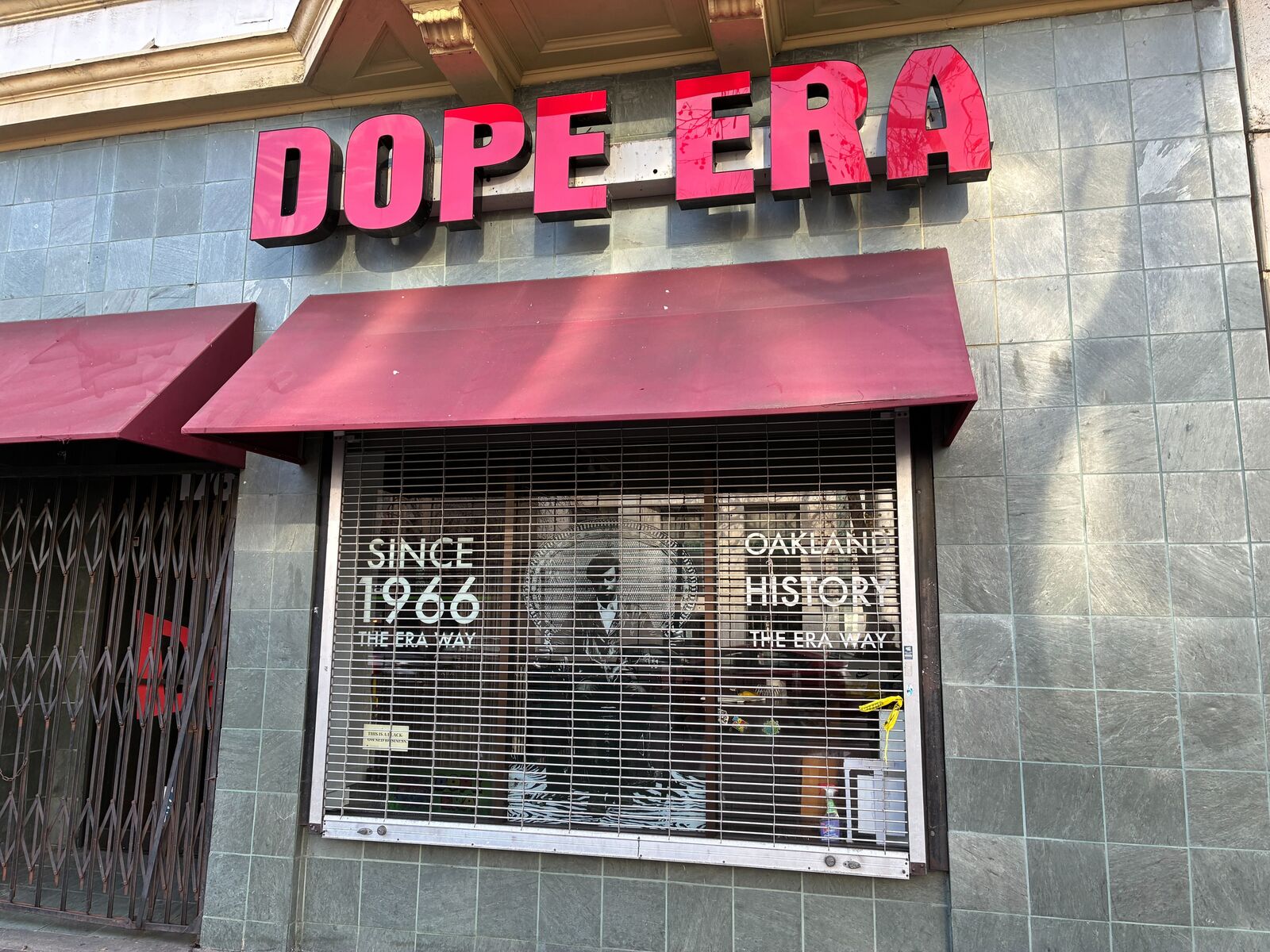 Mistah F.A.B.’s Dope Era shop was one of four businesses on the ground floor of the building. They suffered water damage and had to close after the fire. Credit: Darwin BondGraham/The Oaklandside
Oakland’s housing department “has the attitude that if you own a building that is destroyed by fire, you must pay displaced tenants as if the owner was an insurance company,” wrote lawyer Clifford E. Fried of the firm Fried, Williams & Grice Conner, in the appeal.
He goes further to say “it could be argued” that the city’s housing department and the Eviction Defense Center, which receives funding from the city of Oakland, “caused the fire by allowing the problem tenants and their lithium-ion chop shop guests to remain in possession of their units.” Fried writes that the Eviction Defense Center represented the tenant in the unit where the chop shop was originally located, whom the landlord was trying to evict.
In a response, Deputy City Attorney Braz Shabrell wrote that the relocation program is completely distinct from the city’s various contracts with service providers.
“By all accounts, this was a foreseeable fire that should not have happened,” Shabrell wrote, noting that Dang’s property manager admitted during the appeal hearing that he was “bluffing” when he told the chop shop operator that he’d remove his belongings if he didn’t leave the property. Dang never pursued an eviction in the unit he’d moved into, where the fire started, Shabrell said.
Property owners who appeal a relocation payment determination are still required to deposit the full amount with the city ahead of the hearing. In this case, Dang received a waiver allowing him to proceed without posting the $400,000 for the building.
“We don’t have any money to pay it — we’re not collecting any rent,” Dang told The Oaklandside. “I can’t ask my partners for any money at this time.”
He also disputed the city’s calculation of the number of tenants in the building, given that there are several vacancies — though city staff said Dang didn’t provide them a list, so they had to estimate.
Dang and his family own at least 16 other properties in the Bay Area, many around downtown Oakland, Chinatown, and Adam’s Point, according to public records. He said he’s not pursuing the city’s Acquisition and Conversion to Affordable Housing funds for any others.
He said the city and police should focus on finding and penalizing the chop shop operator, who he said is responsible for the fire and disappeared afterward.
At the appeal hearing on March 23, the hearing officer heard arguments from the city and the landlord, and gave each about a week longer to provide additional information.
No decision has been released yet.
After the hearing, some tenants and the advocacy group Tenant and Neighborhood Councils held a press conference. They described ongoing safety issues at the property and argued the landlord could have taken more action to resolve them.
“People came in and out of the building, slept in the hallways, tried to intimidate me, and stole belongings from other tenants,” said Rachael Thornton, who lived there for 10 years and is now staying with her boyfriend’s parents in El Sobrante.
“I feel Ted Dang was aware of these issues for years and did not take correct measures to ensure tenants’ safety,” she said. “The fire was extremely traumatizing.”
Keisha Bigbie, another tenant who lived at 1770 Broadway with her three children, said she’s “just appealing to the City Council…to just go ahead and grant us the relocation fees we need through Ted Dang.”
She said she’d heard of the security guard Dang had hired but “never really saw him.”
“*” indicates required fields