
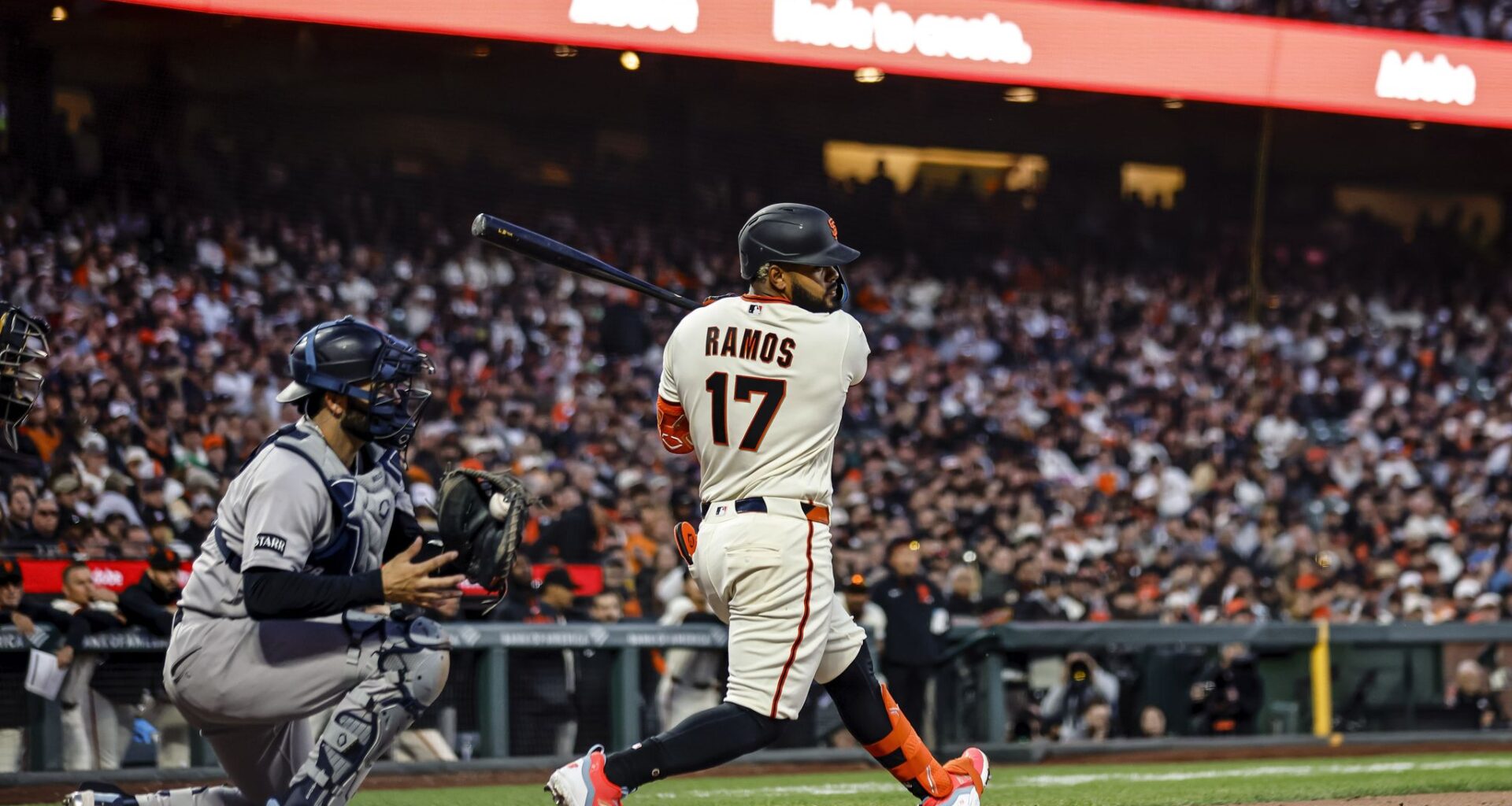
Giants left fielder Heliot Ramos swings through a pitch in the seventh inning on Opening Night, March 25, at Oracle Park. Ramos managed a .706 OPS against high velocity last season, compared with .728 overall.
Carlos Avila Gonzalez/S.F. Chronicle
Giants center fielder Harrison Bader reacts after striking out next to New York Yankees catcher Austin Wells during the ninth inning on March 28 at Oracle Park.
Jeff Chiu/Associated Press
Through the first two series, the San Francisco Giants’ offense largely dictated whether the team won or lost.
In their losses, opposing starters were able to shut the lineup down. In wins, the Giants got to the pitching staff early and — on Tuesday — often.
How the Giants fared against the fastball is the common denominator.
Article continues below this ad
They came to life against San Diego Padres starters German Marquez and Walker Buehler and New York Mets starter David Peterson. Each has fastball run values that are ranked well below the league average, per Statcast’s measurement of how many runs a pitch prevents. Marquez’s fastball had a minus-29 run value, Buehler’s was minus-5 and Peterson’s minus-1 in 2025. Those numbers aren’t trending much better in 2026.
Conversely, the Giants had nothing against Yankees starters Max Fried, Cam Schlittler and Will Warren and the Padres’ Nick Pivetta. An elite fastball — above average run values on the pitch across the board — is what all four have in common. The value comes in different varieties: Schlittler hurls in the high-90s while Pivetta’s mid-90s fastball has top-tier induced vertical break.
Against the four, the Giants combined to score one run on nine hits and strike out 23 times in 21 innings.
San Francisco Chronicle Logo
Make us a Preferred Source to get more of our news when you search.
Add Preferred Source
It makes some sense to wave off these types of results. Pitchers are throwing harder and with more movement in the zone than ever before, making conditions for hitters even more difficult as they look for ways to keep up. It’s no easy task to hit a fastball these days.
Article continues below this ad
But the Giants have been largely mediocre for several years. A peek under the hood shows their struggles against the fastball have become a trend. The first two series in 2026 offer a small sample size, but their numbers against high-velocity fastballs in 2025 paint a clearer picture of the trend.
The Giants had a .308 expected weighted on-base average and .215 expected batting average against fastballs (four-seam, two-seam and cutters) that exceeded 95 mph (considered high velocity). Both figures were in the bottom five in MLB.
Hunter Mense is new to the Giants, fresh from his gig as the Toronto Blue Jays’ hitting coach, and came in aware of the poor fastball numbers. For a hitting coach, though, solving the problem isn’t about addressing it as a team-wide issue.
“It matters more from an, ‘OK, we will probably be pitched that way,’” Mense said. “We’ll probably get a lot of fastballs. We can figure out on an individual basis if somebody isn’t good at hitting fastballs and a guy throwing a lot of fastballs, a plan for how to go into that day covering it up.”
The Giants did see more fastballs in 2025 and early in 2026 than any other team (50.6%).
Article continues below this ad
Individually, many of the Giants’ star hitters turned in decent numbers against the high-velocity fastball last year. Willy Adames had an .882 OPS versus the pitch and Matt Chapman had a .843 OPS. Heliot Ramos scuffled to a .706 OPS.
Rafael Devers is an interesting case study. In 2025, his average against a high-velocity fastball was .277 with a .952 OPS with Boston, but only a .220 average with an .820 OPS with the Giants.
Those numbers tell a story of the type of hitters that made up the lineup’s core in 2025, Mense said. Guys with quick bat speed who make decent hard hit contact and, sometimes, high strikeout numbers might not always be prolific against the fastball — though Devers has historically been — but do damage when they connect.
“You look at other guys where they don’t hit the fastball consistently, but when they do it’s going to be crushed,” he said. “So there’s give and take of when it’s OK for certain guys to struggle with it. And do you need to make changes with guys just because they’re swinging and missing a lot of fastballs?
“But every once in a while they do hit a four-seam out, they do hit a fastball out. Are you willing to make that big of a chance so they just try to cover fastballs, but hit it more and put it into play instead of putting damage on it. It’s such a tricky thing, trying to figure out the best routes.”
Article continues below this ad
Part of what the Giants hoped to do heading into 2026 was create more balance in the lineup. That primarily comes from Luis Arráez and a hope that Jung Hoo Lee can show that contact hitting ability more readily, as advertised.
Though those guys aren’t expected to do damage on the heater, they’ll put the ball in play and diversify the offense against tough arms.
“Quickness of bat speed will always give you a chance,” Mense said. “Arráez hits fastballs. Doesn’t have bat speed, but there’s quickness to his swing.”
Balancing the lineup would, in theory, thaw a Giants lineup that typically goes into a deep freeze against hard-throwing or high induced vertical break-type arms. For individuals, preparing for different looks means having different types of swings depending on what kind of pitcher they’re facing. One player’s approach against Schlittler’s firm cutter will change against Pivetta’s rising fastball.
Article continues below this ad
The early results against Fried, Schlittler, Warren and Pivetta indicate the thaw is still a work in progress.