
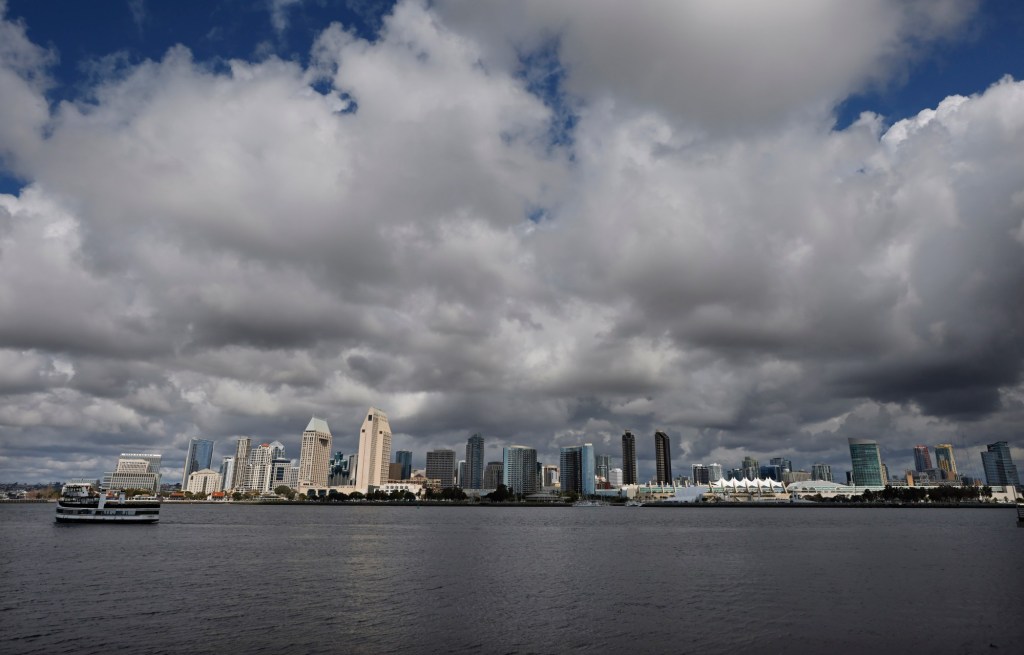
Demographers were justifiably worried about decreasing immigration being a key factor in the recent population decline in San Diego and California.
Immigration has been essential in keeping the economy moving and the population stable for a long time. The recently drop served as a potential warning sign.
“And if that flow of immigrants is cut off permanently, San Diego’s in big trouble,” said Dowell Myers, professor of urban planning and demography at USC, according to Lori Weisberg and Alexandra Mendoza of The San Diego Union-Tribune.
The decline in immigration has been recorded across the nation, attributed in large part to President Donald Trump’s efforts to deport millions of undocumented people, which has broadly discouraged immigration overall.
Analysts also pointed to another familiar factor that separates California from many other states: the cost of living, particularly when it comes to housing.
“There are tremendous problems with affordability in the state,” said Evan White, executive director of the California Policy Lab and co-author of a recently released study “Priced Out: Relocation Amidst California’s Affordability Crisis.”
The report doesn’t just delve into the economics that drive people from California, but how they fare afterward.
“What we show for the first time is that people who leave are, in fact, improving their financial positions, and are able to own homes in greater numbers after the move,” White said.
People may have sensed that, but the study puts data on the bones.
San Diego County’s population in 2025 fell by nearly 5,300, hardly noticeable among the 3.28 million residents. The state experienced a net loss of less than 1 percent of its 39 million inhabitants. So it doesn’t seem like a big deal, at least yet.
But the study says if this is the “new normal,” the implications “could be severe.” A shrinking population could mean a smaller tax base to build roads, fight fires and ensure public safety, the report says.
After the 2020 census reported a population decline, California for the first time in its history lost a seat in Congress, going from 53 to 52 — leading to suggestions its political clout is waning.
One surprising conclusion in the California Policy Lab report is that people leaving the state these days increasingly come from higher-income neighborhoods, while the share of those from lower-income neighborhoods has declined. White said moving to another state can be costly and that sometimes the decision is a “move of last resort” based on economic anxiety.
Some other highlights from the report:
— Among those who moved out-of-state, their new monthly housing costs averaged $1,706 — about $670 less than the average $2,376 in their former California neighborhoods.
—Those who moved into California saw average monthly housing expenses jump to $2,418, up 38 percent from the average housing costs where they lived before.
— After seven years in their new states, former Californians were 48 percent more likely to own a home.
— While incomes in their out-of-state neighborhoods were about 8 percent lower on average, the report says, the “difference is far outweighed by the lower costs of living.” At least some of the California expatriates were able to maintain their California incomes as they work remotely.
— Texas is the most popular relocation destination for exiting Californians in raw numbers, followed by Arizona, Washington and Nevada. On a per capita basis, Nevada is the leader.
White also suggested Proposition 13, the 1978 measure that limited property tax increases, may have played a role in the population changes. Under the law, homes are revalued when they are being sold, often raising property taxes substantially — effectively penalizing new homebuyers.
“New homeowners are paying really high property taxes,” White said, “whereas folks who have owned their home for 20 or 30 years are paying very low property taxes. With two neighbors, the person who’s lived in their home for a short time might be paying 10 or sometimes 20 times what their neighbor is paying.
“You’ve got a lot of people in the state who are living paycheck to paycheck or really struggling to meet the cost of living. That is a much bigger problem, and one that California should attend to.”
Experts basically agreed that continued population decline could have negative impacts, but cautioned against apocalyptic predictions.
“San Diego County is not Detroit in the 1970s. It’s not losing population because its economy is collapsing,” Eric McGhee, senior fellow at the Public Policy Institute of California, told the Union-Tribune.
“It’s declining because immigration has been cut off as a policy matter and also a high cost of living that makes it hard for people to move here. But San Diego and California still have a dynamic economy that’s been growing a lot in recent years.”
White noted California is still a global center for business and technology, entertainment and agriculture. And it has some of the world’s greatest national parks and wilderness areas. He also downplayed concerns about wealthy people leaving.
“California continues to mint more millionaires every day,” he said. “The business environment is such that for every millionaire we lose, we’re minting new ones — there’s pretty good evidence of that. The California Dream is still very much alive.”
So far, the drop in population doesn’t seem to have revved up the California doom loop prognostications to the degree it did following the 2020 census, the COVID pandemic and during other trying times for the Golden State. Much of that has come from East Coast and conservative media.
H.D. Palmer, who has experienced economic ups and downs as spokesman for the state Department of Finance, has worked in Sacramento under four governors — two Republicans and two Democrats. In 2021, he told Los Angeles Times columnist Mark Z. Barabak that the swings and accompanying death-knell predictions are common, like king tides.
“They’re expected, they’re predictable, and they’re dramatic,” Palmer said. “They also will eventually ebb and recede.”
Notable population changes, up or down, seem to be a particular barometer triggering criticism.
In the early 1990s, it was the state’s rapid growth and the resulting congestion and other problems that led Time magazine to declare on its cover: “California —The endangered dream.”
What they said
Neil Stone (@DrNeilStone) on and about X.
“April Fools Day simply doesn’t work on this site because there is stuff on here all day every day which is impossible to tell if it’s parody or not.”