
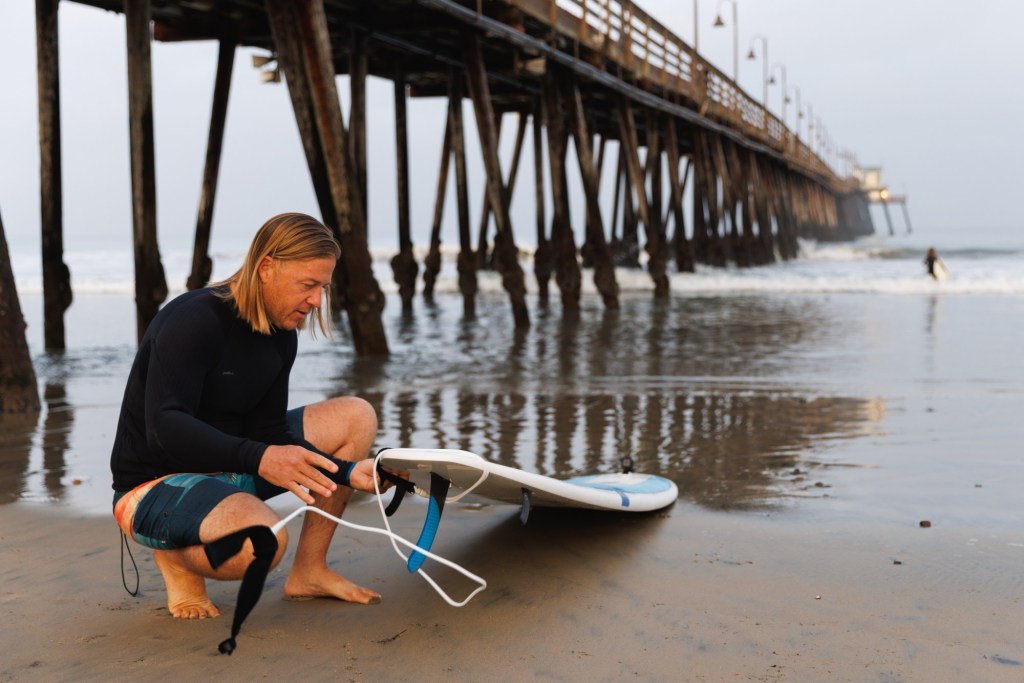
Matt Henry says his goal is to catch 2,026 waves in 2026.
Standing with his 13-year-old son, Liam, in the plaza at the foot of the Imperial Beach Pier on a clear Wednesday morning, Henry bowed his head to pray before paddling out.
Midway through, he had a brief focal seizure — a neurological episode that, to the untrained eye, can look like a few moments of confusion or a sudden, distant stare. He said it’s a byproduct of the cancer he lives with everyday.
Liam held him until it passed. Then they grabbed their boards and paddled out.
Henry, 45, was diagnosed with terminal brain cancer a decade ago. Doctors gave him three years. He has outlived that prognosis more than three times over, and he credits surfing — the discipline of it, the ritual, the feeling — with getting him through. It is, he says, the difference between whether he can function on a given day or not.
The surf that morning was clean and glassy, two to three feet, low tide, with barreling peaks breaking up and down the serene I.B. coastline. To top it off, there was no one out.
But in Imperial Beach, this scene comes with a caveat: wafting through the light onshore wind was that faint, unmistakable stench of sewage drifting in from the south.
Henry knows it’s there. He surfs anyway.
“If I’m not going to give up in a fight against cancer when they’re telling me, make your arrangements,” he said, “then I’m certainly not going to let this hold me back.”
On this bright, early spring morning, Imperial Beach looks like any other Southern Californian beach town. The pier stretches into the Pacific as fisherman perch from its railings. Murals and sculptures line the streets. Restaurants fill with locals, hotel guests, and the occasional visitor from up the coast. And yet, for years, the air has been tainted. The beaches have been closed — advisory signs posted at the water’s edge, warning people to stay out.
A roughly four-square-mile city of approximately 26,000 residents at the southwesternmost corner of the continental United States, Imperial Beach has been the epicenter of one of the country’s most protracted environmental and public health crises. Millions of gallons a day of raw, untreated sewage and industrial waste flows north through the Tijuana River, across the border, into the Tijuana River Estuary and out into the Pacific — polluting the air as well.
The human and economic toll on the city has been well-documented. What receives less attention is everything else Imperial Beach is trying to do at the same time — and the people, like Henry, who have decided that staying and fighting is the only answer they can live with.
A new dynamic at City Hall
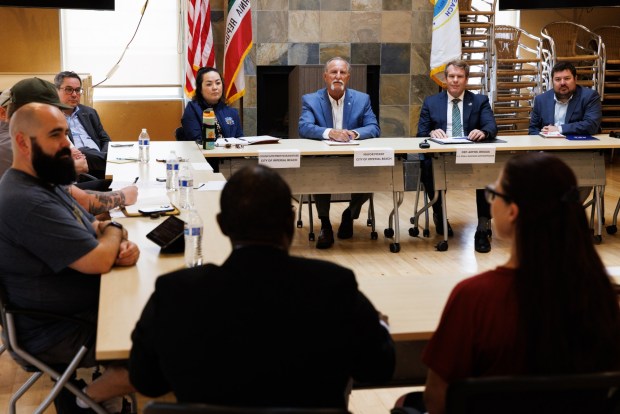 A roundtable meeting on the Tijuana River sewage with Imperial Beach business owners and U.S. Small Business Administration officials at Imperial Beach on Tuesday, March 31, 2026. Imperial Beach Mayor Mitch McKay, center, and U.S. Small Business Administration Deputy Administrator William Briggs, right, listen during the meeting. (Kristian Carreon / The San Diego Union-Tribune)
Since former Mayor Paloma Aguirre’s departure to the San Diego County Board of Supervisors last summer, a new governing dynamic has taken hold at City Hall. Aguirre, a crusading force in bringing attention to the pollution crisis alongside her predecessor, Serge Dedina, continues to push for solutions from her new post — groundwork that has given the city’s current leadership room to widen its focus.
Mayor Mitch McKay, who spent four decades in aerospace before running for City Council in 2022, now leads that effort.
“I think they (residents) wanted something a little more middle of the road,” McKay said, clarifying the council was not departing from the fight on pollution, but rather dialing back the rhetoric and focusing on a wider array of municipal issues. A tone that, by at least one account from within City Hall, appears to be filtering through the entire council.
Councilmember Mariko Nakawatase, who was appointed to the council and is its youngest member, credited McKay with creating space for members to collaborate, while at the same time, operate independently if need be.
“He gives a lot of space for all of us to speak our minds,” she said. “And I think we’re all really respectful of each other because we do appreciate each other’s opinions and mindset.”
Aguirre, who remains a resident of Imperial Beach, said she hasn’t followed City Hall’s work as closely since taking her county seat. But she said she has taken note of the shift in tone on the council regarding the pollution crisis.
“I would say it’s a different type of leadership, and different type of approach than I would take,” she said.
The shift has not gone unnoticed by residents — and not all of them view it the same way.
Sandy Brillhart is a 74-year-old retired resident who moved to I.B. from the East Coast 13 years ago and serves as vice president of the Imperial Beach Democratic Club. In her view, the current council isn’t doing enough community outreach and awareness on the crisis.
“I don’t think they’re doing enough advocacy,” she said. “I think this council is somewhat negligent with regard to that. I think they could be doing a better job keeping the public informed and telling us what we could do as citizens, who we should be contacting.”
Henry, meanwhile, sees value in both approaches. He respects Aguirre’s full-court press and believes it has unlocked real resources. But he appreciates the more moderate approach of McKay and this current council.
“Paloma was really like, ‘Hey, we have to talk about it all the time, we need the attention,’” Henry said. “But Mitch and the new city council have changed things a little bit to, ‘Hey, the water’s dirty, but the businesses are open.’ And I think that’s really good.”
The front line of the economic fallout
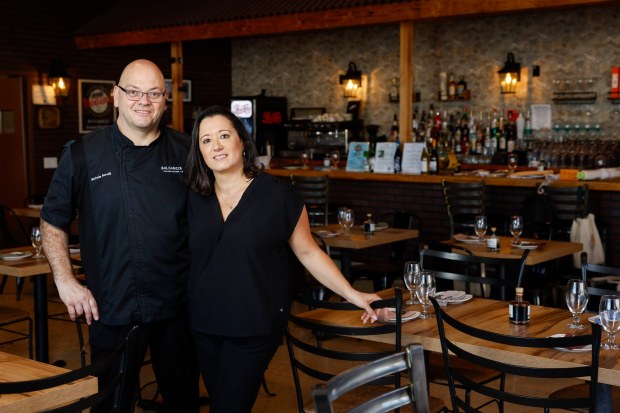 Michele Borelli and Elisa Borelli pose for a photo at Balsamico Italian Kitchen on Thursday, March 19, 2026 in Imperial Beach, California. (Meg McLaughlin / The San Diego Union-Tribune)
For those business owners trying to keep their doors open, however, the view from City Hall offers little immediate relief.
Sandi Crosby, president of the Imperial Beach Chamber of Commerce and broker for the Crosby Home Team real estate firm, said the situation is particularly acute for one type of business: restaurants.
“The ones that are feeling it the most are 1,000% the restaurants — because not only with rising minimum wage costs and food costs, they also now have less business because of the sewage issue,” Crosby said.
Balsamico Italian Kitchen owner Elisa Borelli described the impact of what she said feels like “thousands and thousands of days in a row” of beach closures — a stretch that has turned the city’s best asset into its biggest liability.
“We want to stay positive,” Borelli said. “I really hope it’s going to get better, that the beaches open back up and the people will come again. But for sure something has to change. Because right now, I’m not sure how long we can keep waiting, keep hoping that things will change.”
The restaurant opened after the pandemic and experienced one normal summer before the pattern reversed itself.
“The first summer that we opened, it was a real summer,” she said. “Ever since then, ever since the pollution really got worse, summers have not been real summers. As far as traffic, sales, tourists, there’s been a decline.”
Crosby said her brokerage is doing well in absolute terms, but the underlying market in I.B. is measurably depressed.
“The consensus is that the sewage has probably impacted home sales between 12% and 15%,” she said.
She cited the loss of a buyer segment that had emerged around 2022 — people from Coronado and elsewhere who had begun discovering I.B. as an accessible coastal alternative — as particularly significant. When the crisis intensified in 2024, that segment largely disappeared.
“It was like all of a sudden it put this stain on I.B. that we are just known as the sewage town,” she said. “And that’s just so unfortunate because that is so little of what the city really is.”
A city that keeps building
Even as the pollution crisis dominates headlines and impacts businesses, Imperial Beach’s city government has been accumulating a portfolio of infrastructure and development projects that officials say signal a community refusing to stand still.
Among them, City Manager Tyler Foltz said, is a multimillion-dollar renovation of the Sports Park Recreation Center, set to include a fully rehabbed gym and the city’s first indoor pickleball courts.
Dunes Park is being reconstructed. A new splash pad is in the works. The city recently secured a $26 million grant from the San Diego Association of Governments for a full rebuild of Palm Avenue — incorporating sidewalks, bike infrastructure, art, lighting and landscaping. A separate grant of over $2 million was awarded for a gateway entrance sign into the city.
Two hotels are in various stages of development: a Home2 Suites at Seventh and Palm and a proposed project at Seacoast Drive and Imperial Beach Boulevard.
Recent completed projects include full roadway rebuilds on Imperial Beach Boulevard, 10th Street and Ninth Street — each incorporating what Foltz described as an “artist mentality,” with artistic crosswalks, mosaic inlays, solar lighting and drought-tolerant landscaping.
“We want to still keep that sense of place within Imperial Beach and make people proud to live in this community,” Foltz said.
This pipeline of projects reflects years of work — much of it initiated under former Mayors Dedina and Aguirre — that the current administration is now seeing through.
Aguirre pointed to several of those initiatives as priorities she championed during her tenure, describing them as inseparable from the broader fight to keep Imperial Beach livable during the crisis. Among them was the splash pad, built expressly to give children an alternative recreational outlet while the beaches remained closed.
“It was a delicate balance,” Aguirre said. “I was always focused on improving the quality of life beyond the sewage.”
Brillhart, who rides her bike along the estuary with her husband nearly every day, sees those efforts for what they are — and appreciates them.
“There are a lot of positive things that already exist in the community that just get overshadowed by this sewage issue,” she said. “There are great restaurants, the estuary, the bikeway. There’s a lot to do here.”
But she is careful not to let her optimism outrun reality.
“I’m always worried about what it’s doing to me health-wise,” said Brillhart, who is immunocompromised. While her chronic eye irritation and scratchy throat are not debilitating, she said she did not have them before moving to I.B. “I’m not going to let it stop me from doing the things that caused me to move here in the first place. But I don’t feel as comfortable doing it as I did when we initially moved here.”
The tourism problem — and the problem of talking about it
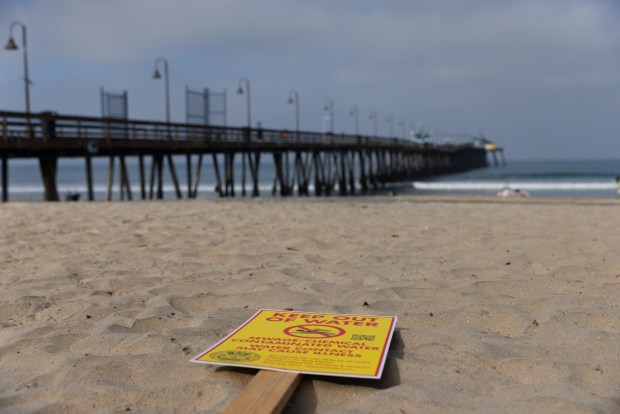 A keep out sign is seen by the Imperial Beach Pier on Wednesday, March 25, 2026. (Kristian Carreon / The San Diego Union-Tribune)
One of the subtler tensions running through the business community is around tourism promotion itself.
Crosby, who took over the chamber a few years ago, said she has worked to build cohesion through regular gatherings and peer-learning opportunities.
But the question of how aggressively to promote I.B. to outside visitors is genuinely contested within the community. I.B., she noted, has no dedicated tourism board, and neither the chamber nor the city has funding to establish one. More fundamentally, she said, “it’s hard to push for tourism when half the population of I.B. doesn’t think you should be pushing for tourism because of the sewage.”
The concern is not without basis.
The so-called Saturn Boulevard hot spot, where polluted water churns through concrete culverts, has been identified as the epicenter of the Tijuana River Valley air pollution crisis in the South Bay. Research shows the area releases millions of particles, aerosols and molecules of dangerous pollutants into the air — including hydrogen sulfide, which has twice spiked to record levels in the last two weeks, according to data from the San Diego County Air Pollution Control District.
County survey data reflects the toll: Nearly 70% of residents reported illness, and 90% said the crisis affects their daily life.
During one particularly severe stretch, Henry said he and his family slept in their living room together, huddled around an air purifier — and then moved into their converted school bus in the driveway because it was easier to control the air in a smaller space. His wife, Chrissy, 44, developed exercise-induced asthma. One of his teenage children gasped for air in the middle of the night.
The risk, likewise, applies to the surf.
“Surfing is medicine for me in a big way, but I can’t recommend surfing here to people,” Henry said. “If there’s tourists and others, I tell them, ‘No, it’s real serious.’ I don’t know, maybe we’ve got a little bit of immunity from living here, but it’s real serious.”
At the same time, while acknowledging the public health impacts, Crosby pushed back on the perception that the pollution is a constant, all-consuming presence.
“I think people have this misconception that it stinks all the time down here, and that is just not the case,” Crosby said. “There’s weeks and months where you’re not walking around just smelling sewage all the time. So people should not be afraid to come here.”
What it means to be from here
For all the policy complexity and economic strain, officials and business owners — and residents like Henry and Brillhart — consistently returned to something harder to quantify: the particular character of the place itself.
McKay, who has lived in Imperial Beach for 63 years, described it without much elaboration.
“It’s my home,” he said. “You take care of home, take care of your yard, sometimes you take care of your neighbor’s yard.”
Nakawatase grew up in the city, played under the council dais as a child while her mother served in local government, and now sits on the council herself.
“It’s a very unique feeling,” she said. “It makes me all the more passionate about trying to showcase and highlight our town.”
Brillhart moved here at 61 to enjoy a coastal retirement and still does — just with more worry than she bargained for.
“I still think I.B. is a great place,” she said. “I hope that we get back to being able to enjoy our beautiful coast and beach soon.”
Imperial Beach seems to have settled on a variation of the same message: the city is more than its crisis, that the work of being a city continues regardless, and that the community’s resilience is both its greatest asset and its most tested one.
Henry, for his part, is not going anywhere. He surfs contaminated water every morning because it is the one thing that makes the rest of the day possible. He is raising six kids in a city where the air outside causes them breathing difficulties. He is living with a tumor that has no cure. But on that Wednesday morning, after surfing nearly an hour, he said he caught 18 waves — on his way to 2,026.
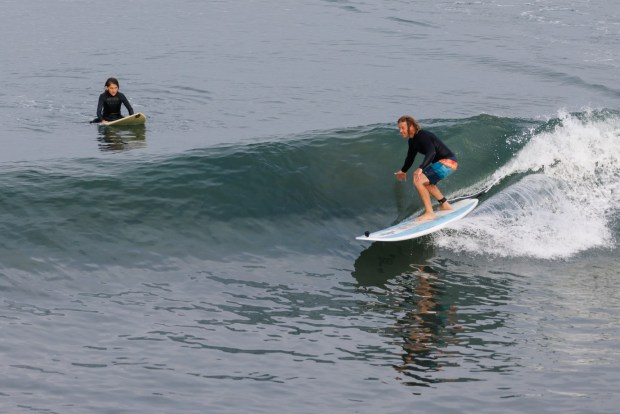 Matt Henry rides a wave as his son Liam watches at the Imperial Beach Pier. (Kristian Carreon / The San Diego Union-Tribune)