
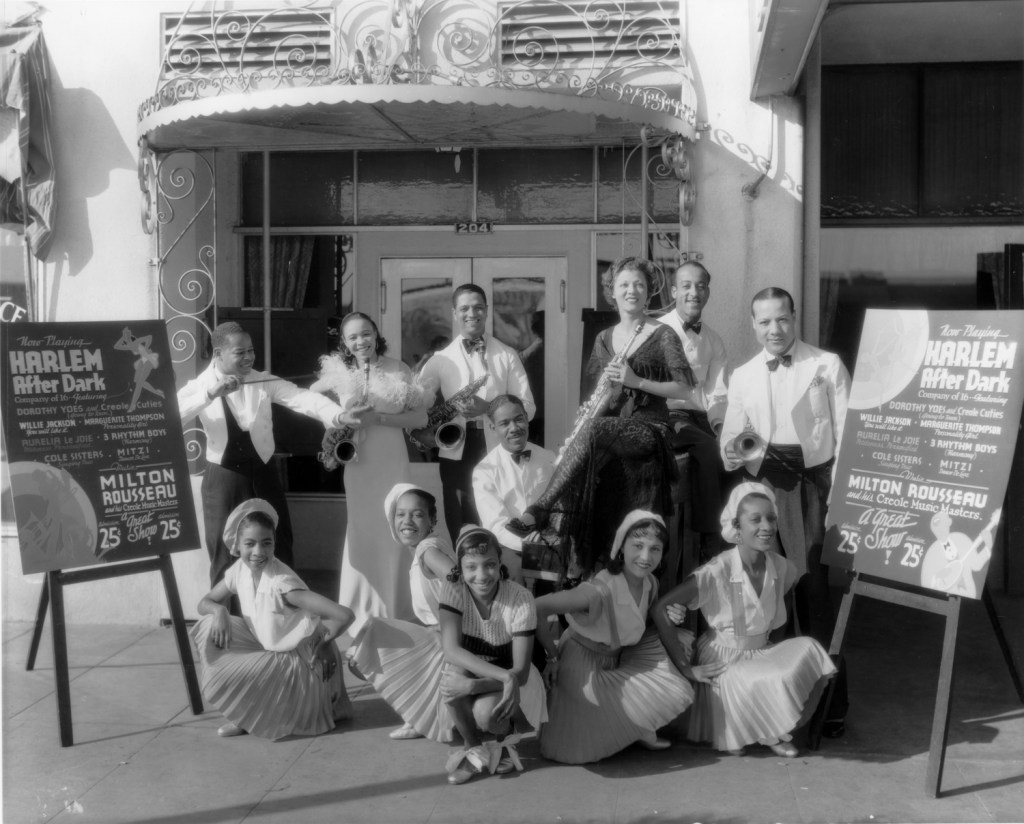
The famous Harlem neighborhood of New York City, and its Black cultural and social renaissance, created the kind of influence and inspiration that stretched beyond its physical boundaries to people all over the world, including in San Diego.
“Wherever African Americans are, we have built our businesses, developed communities, and celebrated who we are as a people through our arts, and socially and politically,” said Yvette Porter Moore, a genealogist and public historian.
In partnership with the San Diego African American Museum of Fine Art, the San Diego History Center is celebrating the music and history of the jazz era as part of Jazz Appreciation Month with “Harlem of the West: Jazz Night” on April 18. It will feature live jazz performances, spoken-word poetry, and some of the stories of historic Black communities in San Diego, including through the “San Diego’s Lost Neighborhoods” exhibition. This exhibition, curated by Gaidi Finnie, executive director of the SDAAMFA, documents the neighborhoods that “were displaced by redlining, freeway construction, and other discriminatory policies.” Yolanda Marie Franklin, host of the event and executive artistic director of Common Ground Theatre, will perform selections inspired by writers of the Harlem Renaissance.
Porter Moore, whose research has been focused on the “Harlem of the West” and the development of the San Diego Black Arts & Culture District, took some time to talk about some of the history of San Diego’s historic Black neighborhoods and the significance of Harlem and what its legacy represents.
Q: What specific area in San Diego was considered the “Harlem of the West”? Why was that area referred to this way, and what was taking place during that time and in that part of town?
A: Our Harlem was in downtown San Diego. This Black San Diego was present in downtown in the 1880s, but by 1917 the presence had evolved into a concentrated cultural district. We resided in downtown San Diego and had businesses up and down different areas of downtown. We had night life like the Douglas Hotel, which was built in 1924; before then, the heart was the Creole Palace Cafe.
By 1917 there was the Creole Palace Cafe and there’s information showing that there were establishments that had entertainment. Most of the time, when we’re looking at the Harlem of the West, we’re looking at George Ramsey, we’re looking at Al Ramsey, who came to San Diego in the early 1900s and were central figures who built spaces, hosted events, and navigated city regulations. The city of San Diego was already recognizing the Black community and George Ramsey as a community leader. With the Creole Palace Cafe, and even before, there were some (city officials) who had issues with these various establishments in downtown San Diego that had nightlife because of the mixing of the races and the ways they were thinking of the moral context of that at the time. They were thinking about the alcohol that they were trying to regulate, and all of that, so the city council was going to shut down the Creole Palace. There was a period where we didn’t see much of the nightlife because of that, but in 1924, George Ramsey and Robert Rowe built The Douglas Hotel (named for the famed abolitionist, Frederick Douglass).
Calling this area the “Harlem of the West” was actually coined by George Ramsey in his ads that he would put in the newspaper to advertise his activities and events. We were saying Harlem of the West because of the Douglas Hotel and the other nightlife establishments for African Americans, however, “Harlem of the West” moved where the people moved, where African Americans moved. Different things have occurred from us having to move from downtown San Diego to Logan Heights to Imperial Avenue, up to Valencia Park and into what we call southeastern San Diego today, or Encanto. You can’t take the people out of any “Harlem,” so when we had housing restrictions, the way redlining occurred, the way the freeways came through Black and Brown neighborhoods and broke up our communities, we had to move into areas and find ways to continue the cohesiveness of our lives. When we’re looking at Imperial Avenue, it was rich in Black businesses and churches, clubs and organizations, that were integral for our lives because those things had occurred that separated our communities. When we were downtown, it was a concentrated Black cultural district with the music and the performances and the community life that existed.
During the jazz era, we had various jazz artists—like Billie Holiday, Duke Ellington, the Mills Brothers, and others—who would come into town and perform from the 1920s and into the 1940s, maybe even the ‘60s, I would say.
Q: Your research has been focused on the “Harlem of the West” and the development of the San Diego Black Arts & Culture District. When did you start this research, and what have you found?
A: I’ve been researching for a long time, I would say at least 15 years, so I have found some of the key people who’ve been part of the building of our communities: individuals such as Jack Kimbrough, our first Black dentist and also an activist for civil rights; Dennis V. Allen, who was also a human rights activist and ensured that the signs came down that said “No Coloreds Allowed”; people like the Debose family, who purchased land in La Jolla; Ed Anderson, who had a mortuary (and served multiple terms as president of the San Diego branch of the NAACP); and all of these different people who were civically minded. They were busy fighting for the right to teach in the school system in San Diego, to have a police station and fire station, to work amongst everyone else. I think that we all want the same things, and we’ve been dealing with racism and discrimination, so they had to come together to ensure that they built their community the way they wanted it built.
Q: The National Museum of African American History & Culture in Washington, D.C., talks about the cultural explosion of the Harlem Renaissance that also extended outside of Harlem, including places like Cleveland, Ohio, Los Angeles, and other cities shaped by the great migration of Black people leaving the country’s southern states and moving north and out west. These other cities experienced a similar kind of cultural explosion described as “a spiritual coming of age” where Black people were transforming from a social disillusionment to racial pride. I was wondering if you could talk about anything you’ve found in your own research of San Diego’s Black community during this time period, and how this evolution in Black arts and culture was being understood.
A: From what I’ve been reading and researching, I find that we’ve always been a proud people. I think this was a time when it was all about us and we didn’t look to the other races to tell us who we are, to define us. We defined ourselves and we came together as a community; we depended on one another, and we brought our culture and our intellectual knowledge and built our communities. I don’t think that we ever lost that, but I feel like there’s always been something external trying to break us up. As a people, we’re powerful, so when we have these freeways cutting through our communities and laws that suppress what we have going on, it just chips away at the things that we’ve tried to accomplish in San Diego. One of those things is that our communities have been, it seems to me, are losing the information about the things that we’ve accomplished, the memory of our history. Our history is held in the hands and in the minds of the people that live here, that have lived here for generations. What I’ve uncovered are generations of people who are descendants of those who built the Black community, and if they are aware of it, that they can come together and move us forward to continue building the community. It seems like our community keeps on being covered up, like our history disappears, but we do know our history and it’s time for us to document it and share it. Individuals I’ve met from some of the early families, they hold some of their own documents and pictures. They have things that some of the museums don’t even hold with the passing down of scrapbooks and clippings from grandmothers. Like, we have those in our families and it’s just time for us to share.
Q: The Harlem Renaissance, with all of its branching into arts and culture, entrepreneurship and activism, it’s said to have created a more realistic presentation of what it meant to be Black in America and created this self-portrait of Black American life, identity, and culture. From your research, what has this self-portrait of Black San Diego looked like?
A: The portrait that I see is that we are still struggling to been seen, not only to others, but for ourselves. I see that we are looking for unity, and we need to unite and come together to make this happen. One of the other things I’m seeing is the Black Arts & Culture District, and we haven’t had our own area like some of the other districts that exist. It was approved by the city council, but I would like to see this district funded so we can do some renovations to the buildings, and have our cultural center, our museum and archives, art studios and things like that. That we have a place that we’re proud of.