
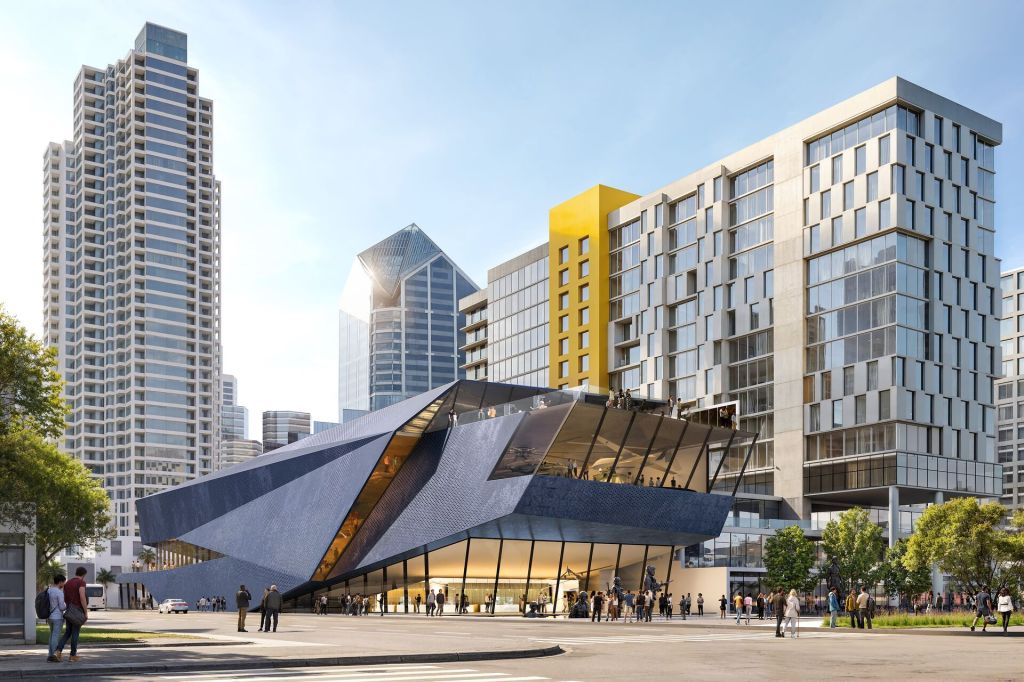
In the works for more than two years, a proposal to erect a striking, $256 million waterfront museum that honors the United States Navy’s maritime special operations force will soon go before the government body that controls the site.
Later this month, the Board of Port Commissioners for the San Diego Unified Port District will decide whether to advance an ambitious plan from developers Navy SEAL Museum San Diego LLC and Hensel Phelps Development LLC to remake a portion of the old Navy property at 1220 Pacific Highway in downtown San Diego.
The developers are proposing a four-story, 85,000-square-foot Navy SEAL Museum at the northern edge of Lane Field Park along Harbor Drive.
The Navy SEAL Museum proposal, which has remained under wraps until now, envisions an architecturally and culturally significant destination that invites visitors to experience the legacy of the SEAL organization across seven different galleries that are complemented by educational spaces for kids, a cafe, a retail store and event space.
“Our vision is to add a new, iconic destination on the waterfront in San Diego that’s representative of the significant impact of the iconic organization that is Naval Special Warfare,” Jason Booher, a retired Navy SEAL who is leading the local expansion effort on behalf of nonprofit UDT-SEAL Museum Association Inc., told the Union-Tribune. “We want people to come and learn about the history and heritage of the SEAL teams and Naval Special Warfare, but leave inspired to go serve something bigger than themselves.”
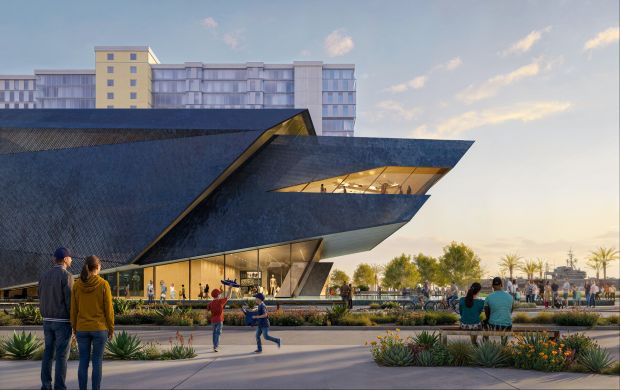 The unconventional, angular Navy SEAL Museum building features a perforated blue metal skin. A shallow, reflecting pool at the Harbor Drive entrance is meant to mirror the building’s sculpted mass. (ZGF Architects)
The proposal will be discussed publicly for the first time at the port board meeting on April 21, when commissioners will vote on staff’s recommendation to begin the environmental review process required by the California Environmental Quality Act.
“Staff is scheduled to present the Navy SEAL Museum proposal to the Board of Port Commissioners at the April public board meeting,” said Anthony Gordon, the port’s vice president of real estate. “The meeting follows preliminary due diligence and discussions at the staff level. We look forward to presenting this project proposal and hearing feedback from the board and stakeholders.”
The board’s action to advance the project would not constitute final approval, but it would be a signal that the agency is seriously entertaining a development deal with the museum.
If all goes as planned, the developers hope to start construction by early 2029 and open the museum in 2031 or 2032.
The Navy SEAL Museum proposal comes in the wake of the Navy’s September 2023 decision to exit 1220 Pacific Highway as part of a milestone deal that returned control of a 3.4-acre site opposite San Diego Bay to the port. The termination of the federal government’s lease gave the development entity behind the immediately adjacent Lane Field hotels — the InterContinental San Diego and the dual-branded Marriott SpringHill Suites-Residence Inn at Broadway and Pacific Highway — the first right to propose something new for the site.
In the months following, the Lane Field developers transitioned from a mixed-use, hotel-centric redevelopment plan for the entire site to focus solely on the Navy SEAL Museum concept, citing financing constraints in the hospitality sector. Two of the hotel developers decided not to continue in the latest iteration of the proposal.
The museum plan currently being evaluated by the port involves using a 1-acre, rectangular slice of the 1220 Pacific Highway site, next to the Marriott SpringHill Suites-Residence Inn, referred to as parcel three. The project also entails completion of a 0.3-acre park space in front of the dual-branded hotel, referred to as parcel four.
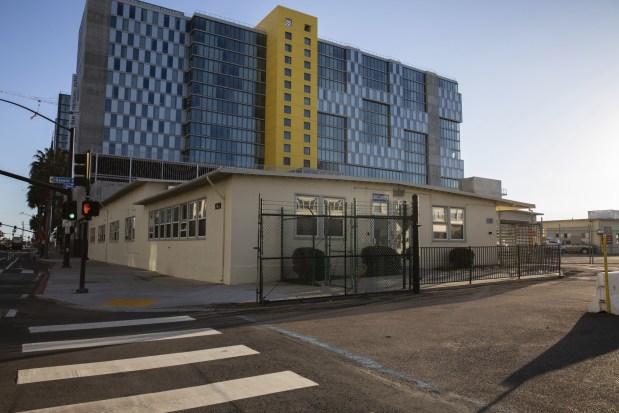 Dated, low-rise Navy buildings, pictured on March 2, 2023, currently occupy the 1220 Pacific Highway site proposed for the Navy SEAL Museum. (Adriana Heldiz / The San Diego Union-Tribune)
In December, the port entered into a two-year, exclusive negotiating agreement with Navy SEAL Museum San Diego and Hensel Phelps. Hensel Phelps is acting as the fee developer, meaning it will oversee the project’s design, entitlement, construction and completion. The nonprofit will be the sole owner and operator of the future museum, as well as the leaseholder with the port.
“Hensel Phelps Development is proud to partner with the Navy SEAL Museum San Diego and the Port of San Diego to deliver a world‑class museum honoring this elite community of service members and the sacrifices they represent,” said Alexander Guyott, development manager with Hensel Phelps. “We believe this is an exceptional use of the site and a meaningful addition that will further activate the North Embarcadero for locals and visitors alike. We couldn’t be more excited about this opportunity.”
Navy SEAL Museum San Diego is part of the nonprofit UDT-SEAL Museum Association, more commonly known as the National Navy SEAL Museum. UDT stands for Underwater Demolition Teams, which were the predecessors to the modern SEAL teams. The organization includes the original Navy SEAL Museum in Fort Pierce, Fla., which opened in 1985.
The San Diego entity opened its first facility at 1001 Kettner Blvd. in downtown San Diego last year, but the landmark attraction in the works at 1220 Pacific Highway is an order of magnitude greater in size, scope and cost than anything previously completed by its parent organization.
Like the first local venue, the proposed Navy SEAL Museum seeks to tell the story of the entire 10,000-person Naval Special Warfare Command, but it will do so in a much grander fashion.
The facility, designed by ZGF Architects, is rendered as an unconventional and imposing angular museum building with a defense ship-like shape and a perforated blue metal skin. A shallow, reflecting pool at the Harbor Drive entrance is meant to mirror the building’s sculpted mass and visually connect the museum to the water.
The facility’s central atrium, which extends the height of the 65-foot-tall building, will be partially visible to passersby and large enough to hang a Black Hawk helicopter. Inside, visitors will start in the 2,500-square-foot theater and then move through a chronological sequence of expertly designed exhibits and galleries. The largest of the galleries will include boats, vehicles and space capsules used in special operations. There is also a gallery that is dedicated to special operation training, and one that looks ahead to the future. Visitors will also have the option to purchase an add-on, virtual reality experience. The museum’s fourth floor doubles as an event space and features a large terrace that overlooks the bay.
“It will look like you’re walking into a Smithsonian,” Booher, the project lead, said. “We put about 250 years of SEAL experience in the room 3 1/2 years ago and spent four months on strategy, asking, ‘Why are we even doing this? What story do we want to tell? Why do we want to tell it?’”
The layout of the galleries reflects that work, he said. And the visitor experience is intended to be second to none, providing visitors with an authentic deep dive into the Navy’s elite maritime units, distinct from what they can get from popular movies or books.
The nonprofit is using the same exhibit and gallery designer, Gallagher & Associates, that worked on the National WWII Museum in New Orleans, Booher said.
The project, which is not directly affiliated with the Navy, will be privately financed. The museum association is hoping to solicit most of the funds needed for the $256 million project from donors. Hensel Phelps will assist the nonprofit in securing debt financing, if required.
A high-level financial model shared with the Union-Tribune estimates that the museum will draw 850,000 people a year by its third year in operation. The attraction is projected to generate $35.9 million in gross revenue and $9.4 million in net income by year 10. The business plan calls for the museum to disperse 10% of gross revenue to Naval Special Warfare families and veterans in need, and to local programs, although the size of the contribution will depend on whether the organization has to take on debt to fund the project.
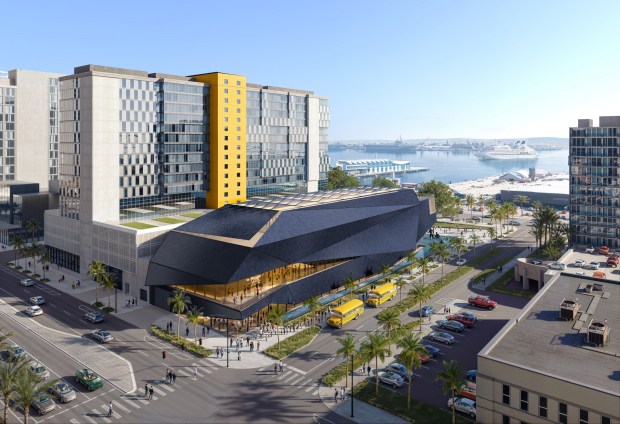 An aerial rendering of the proposed Navy SEAL Museum opposite San Diego Bay. The museum, pictured next to the Marriott SpringHill Suites-Residence Inn, is planned for a 1-acre site previously leased to the federal government. (ZGF Architects)
“We’re in a unique position as an organization to be able to support the actual active SEAL community … and we also want to be a good partner in the region,” Booher said.
The Navy SEAL Museum project will be a massive undertaking for a relatively small outfit. The nonprofit UDT-SEAL Museum Association collected $8.6 million in donor contributions in 2024 and ended that calendar year with $24.5 million in assets, according to the organization’s most recent Form 990 filed with the Internal Revenue Service.
The organization has, however, demonstrated that it can raise money when needed. The nonprofit raised $13.3 million to complete the Kettner Boulevard venue, Booher said. It has also set aside an additional $1 million to cover expenses associated with the environmental review.
The project’s environmental review is expected to take 18 to 24 months to complete. The time period aligns with the term of the developers’ negotiation contract with the port, which seeks to culminate with a development deal that will require board approval. Along the way, the museum and its development partner will need to submit documents to prove that they can complete the project.
The port or the developers can walk away at any time if the project is not feasible.