
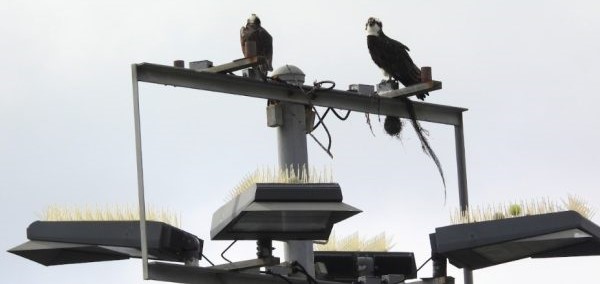
Feathered guests have settled onto light posts at the La Jolla Tennis Club, and while their droppings are causing some disturbance, they’re likely in for a longer stay.
A few ospreys built nests at the public club at 7632 Draper Ave. last month. Their presence has led to increased droppings and fish remnants landing on the courts. In response, club manager Jon Ross has ramped up cleanings on the three courts impacted by the birds. Instead of washing the courts once a month, cleanings are now conducted weekly or biweekly, and more cleaning solution is available for spot treating.
Ross said two ospreys are there most of the time, though he has seen a third.
As a federally protected species under the Migratory Bird Treaty Act, ospreys cannot be captured, transported, sold, traded or killed without authorization of the U.S. Fish and Wildlife Service.
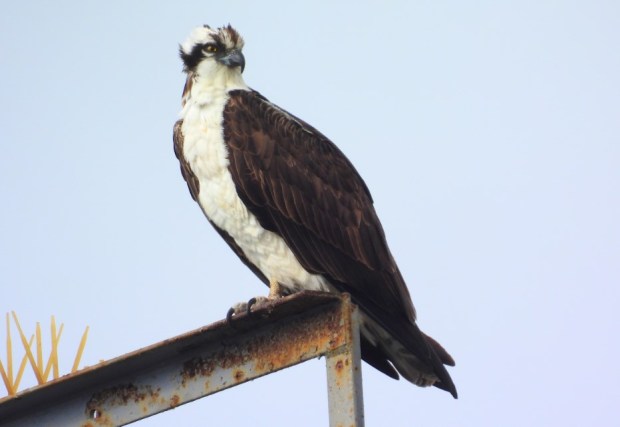 Ospreys are a federally protected bird species. (Azi Sharif)
Inactive nests sometimes can be removed without permission, in recommended consultation with local wildlife authorities. But active nests like those the Tennis Club’s newest residents made cannot be removed or relocated.
Ross has kept club patrons updated through a series of emails. And last week, he invited a wildlife expert to evaluate the situation.
“The balance of it is that we obviously are respecting the birds,” Ross said. “Technically, we are in their territory. I mean, it’s prime real estate for an osprey. Our light posts are probably 30 feet high, so they are perched way above any other structure in the area.
“They also are a block from the ocean, so they can go out, hunt, catch a fish and bring it back. It’s like a beachfront apartment for them.”
Ross said some people have complained that “it’s unpleasant [or] gross because there are fish guts and fish carcasses that we have to pick up. … [But] most people have said ‘We get it — they’re going to make a mess, but they’re really cool birds and they’re federally protected.’”
“As manager, I’m still trying to do my part to give people as much information as possible and let them know we’re going to try to keep the courts as clean as possible,” Ross added. “But Mother Nature does its thing and we can only do so much.”
One of the players impacted by the ospreys’ presence is Tina Mertel, who said she first noticed them in early March.
“I played this morning [April 1] with them there and they aren’t a physical nuisance to me, but they’re a curious sighting,” Mertel said. “Usually you don’t see that when you’re serving a ball or waiting to return a ball — that this pretty impressive bird is at the other end of the court.”
“When you first see it, it looks pretty majestic,” she said. “And then you start getting used to it and you expect to see them.”
Given the unusual circumstances, she praised the Tennis Club for how it is handling the situation.
“I’m really proud of being a member of the La Jolla Tennis Club, where the leadership is finding a win-win solution — not rushing to figure it out but taking a very thoughtful approach,” Mertel said.
Azi Sharif, founder and executive director of Wildlife Jewels, a nonprofit with an office in Solana Beach, visited the Tennis Club on April 2 to evaluate the nests. She spent an hour observing two of the birds and taking photos. Soon, she’ll share a presentation with club users offering her insights.
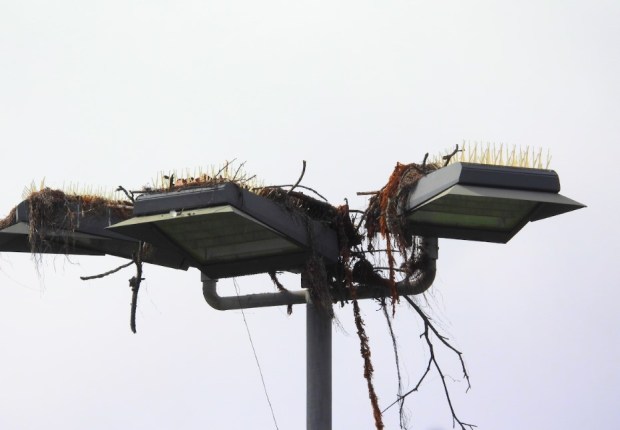 Ospreys that have built nests on light posts at the La Jolla Tennis Club likely will stay for a few more months, according to Azi Sharif of Wildlife Jewels. (Azi Sharif)
“This is early-stage nest building,” Sharif told the La Jolla Light. “They’ve selected the site, they’ve already built the nest and it’s their space. Perhaps in the next week or two is when they’re going to start having eggs and the incubation process starts.”
Sharif estimated the ospreys will depart in three to four months, once their chicks are able to fly.
In the meantime, she said, “they are federally protected and it’s essential for us to coexist with them. This is temporary — it’s just about three to four months with maintenance and cleaning.”
“We are lucky to have them here,” Sharif added. “They’re part of what makes La Jolla so extraordinary and special.” ♦