
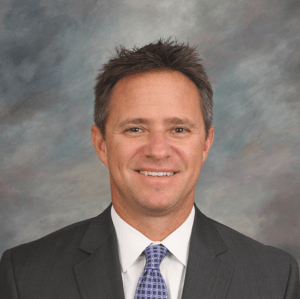
 Fullerton Joint Union High School District Superintendent Scott McLaughlin spoke at the Lunch with the League of Women Voters on October 23.
It is an honor to serve as the Superintendent of this school district, and I’d like to take a moment to introduce myself and share a bit about my journey. I’ve never backed down from a challenge, even as my path has taken me through school administration.
My journey began in a school district that ultimately didn’t connect me to my desired jobs, and I even faced the challenge of being let go from a position. Life often takes unexpected turns. My whole goal has always been to return to the high school district I came from, the same one in North County San Diego. That district has a great reputation, very much like Fullerton’s Joint Union High School District. There are about 780 schools there, and schools like Torrey Pines High School, Canyon Crest Academy, and San Diego Academy are reminiscent of what we have here.
As a student there, I discovered my love for education. This is a story I often share, particularly with groups like this one. When I was 15, I was thinking about my future and what I wanted to do with my life. I realized I had to let go of the idea of becoming an NBA player, and I narrowed my options to two: either to aspire to be the President of the United States or to become a teacher. Those were my two dreams at 15. I was aware that to pursue the presidency, I would have to engage in activities I wasn’t comfortable with, which led me down the path of education—a field I truly love.
Around that time, I also wrote down something that remains my motto to this day: “Change the world by inspiring others.” This has driven me throughout my career. After high school, I returned to San Diego and became a high school economics teacher. I entered the field of education as an ESL (English as a Second Language) teacher. Believe it or not, despite my height, I also became a high school basketball coach.
Eventually, I found myself in middle school—a place I never intended to be. I actually prefer working with younger students during their formative years. I loved that awkward transitional phase and the unique experiences it offered. I became a middle school history teacher and later transitioned into other roles, working as a labor representative and then an assistant principal at a high school.
After that, I taught at Newport Mesa, went on to become the Director of Secondary Education, and then served as the Director of K-12 Curriculum and Instruction. It’s been quite a journey!
I was heavily involved with child labor issues, and moved to Fountain Valley. My journey included learning from kindergarten and early grade school teachers and students. The magic they created truly warms both my heart and mind, inspiring me to think about how we can integrate these concepts across the entire education system.
Five years ago, I became a trustee after a 27-year career in public education, during which I was passionately committed to the field. I started at age 15 and have worked in five different school districts, gaining extensive experience. I have deep connections to these educators, and my family influences my commitment to education. No matter where I go, these people are always in my heart and mind.
Speaking of family, we recently had new family photos taken, and I’m excited to share them! My wife is a special education administrator in the Anaheim Union School District, focusing on behavioral services. Our daughters, Khloe and Sadie, love to travel with us—we’ve had wonderful trips to Greece, Whistler, Portugal, and Thailand.
Now, I’d like to provide a brief introduction to who we are as a school district. We are inspired by our community — staff, students, and parents — that fuels our mission and communication efforts.
A bit of history: the Fullerton School District has roots dating back to 1893. Here’s a picture I found of the first Fullerton Union High School from 1910. The image of what appears to be a Disneyland tram is actually an early school bus from around 1912. This history illustrates our community’s longstanding dedication to education, and we have achieved significant success.
We operate with five trustee areas—three of which are represented by elected officials in our school district. We are located in California, specifically in Orange County, with a small part in Los Angeles County, making us a joint district.
Fullerton Joint Union High School District represents a typical high school or secondary union district, with an interesting mix of geographic representation. We have four feeder districts: La Habra City, with approximately 4,000 students; Lowell Joint School District, with just under 3,000 students; Buena Park Elementary, with around 3,500 students; and Fullerton Elementary, with about 11,000 students. All of these districts have superintendents, and we work collaboratively despite facing declining enrollment over the years.
We previously boasted around 40,000 students, but currently serve about 34,000 collectively across these areas. Our partnerships are crucial: we work with the PTA, the District English Learner Advisory Committee, and our regional Special Education team, and we celebrate our collaborative efforts. We also partner with Regional Occupational Programs (ROP) to provide career-oriented programs and establish connections with higher education institutions such as Cypress College, Fullerton College, and Cal State Fullerton. Our goal is to ensure our students have access to local colleges and various community-based organizations to support our schools.
This morning, I had the opportunity to kick off the first monthly meeting for our School First Bank partners. A great partner, helping us with our benefits, while the Charleston Downtown Fullerton team, who are actually parents, has hosted events with us. Their support benefits all seven of our school sites and eight of our programs, including our alternative programs that we invested in last year.
Our board of trustees consists of several members, including our current President, Vicki Calhoun (President), Marilyn Buchi (Clerk), Lauren Klatzker, Joanne Fawley, and Chester Jeng. This year’s student board member, Arianna Machado, has a preferential vote; although it isn’t binding, it carries significant influence. She has been amazing this year, helping us start the district strong.
We have established a set of consistent priorities, especially during these tumultuous times in education. Our board is committed to:
Student achievement
Effective instructional leadership
Engaging, safe, and respectful learning and work environments
Fiscal responsibility
Optimizing our resources
Every July, we come together to reaffirm these priorities and ensure everyone is aligned and ready to execute throughout the district. Having steady leadership from our elected officials with clear priorities is crucial.
I also share a set of core values with staff and community members at the beginning of each school year, which are aligned with our priorities. We uphold high expectations for ourselves, for one another, and for our students. We actively work to raise expectations, providing increased support for everyone involved.
Continuous learning is a fundamental principle within our organization. We emphasize being good teammates because it is essential to our collaboration. We are dedicated to ensuring that every child has the opportunity to succeed. We conduct extensive research—both on successful organizations and within exemplary school districts. These organizations excel through clarity, focus, trust, communication, and collaboration.
Over the last four years, we have embraced three themes to guide us:
Making meaningful connections, particularly as we navigated challenges arising from the COVID years.
Together, we are HSD—binding ourselves around principles that support our students.
Establishing ourselves as the place to be.
We continue to work together for the success of our students and community.
Last year, we focused on uniting communities, engaging minds, and building futures. This year, we feel inspired, and along with that inspiration comes support. We recently read a book called “Principle,” which emphasizes that large-scale success requires a shared, coherent concept. We continuously work on this idea through purposeful, consistent interaction and learning.
Last year, we also read a book titled “Big Potential,” which presents five key concepts: surrounding ourselves with positivity, expanding our power, recognizing that everyone is a leader, enhancing our resources, and defending against negative influences. Additionally, we aim to sustain our gains; once we achieve progress, we strive to maintain it.
Next, we examined “Culture Code,” which explains that successful cultures may seem magical, but they are actually built on active relationships focused on a shared goal. This is an ongoing process within our school district as we work to develop and maintain successful organizations.
Last year, we read four books —why not read more? Here are some takeaways from those four books:
Moral Purpose: The most important job is to focus on relationships.
Dream Big: A key takeaway from “5 Star” is to believe that 100% of our students can be 100% successful 100% of the time. Even when we face challenges, we should stay motivated to create big dreams.
Have Fun: As highlighted in “Energy Plus,” we need to enjoy our work with kids.
Start with Why: It’s essential to understand why we do what we do; people are more connected to the purpose than the process.
This year, we are reading 11 books. Not everyone will engage with every book the same way, but we all share a commitment to learning through our inspired approach.
Now, let’s talk about our school district. We’ve had meaningful discussions about the data we collect. A quote from a mentor of mine resonates: “It’s not just the information we have that matters, but how we use it.” We must consider how to move forward and make informed decisions based on this data.
First, let’s focus on our people, because we are in the people business at Fullerton Joint Union. Our Human Resources department upholds a set of core values centered on CARE: Connecting, Appreciating, Reflecting, and Elevating. Working with our labor partners has been incredibly rewarding. Our SEO (teachers’ union) and CSA (classified staff union) are outstanding organizations. I meet with them at least once a month, sometimes even more. They have my direct cell phone number, and we communicate regularly. Our goal is to support and problem-solve for our employees, who represent almost 1,100 individuals in our district.
We also prioritize community engagement. Last year, we participated in over 100 community events. We may not always speak publicly, but we strive to be good partners in our community because their support is invaluable to us.
We successfully passed Measure L, a facilities bond, last year, thanks to strong community support. What this demonstrates is that our general fund, which supports only about 5% of our facilities, has enabled us to create some of the best facilities around. Our community prioritizes education, and this funding enables us to enhance our facilities, benefiting everyone.
With the passage of this bond, we are set to further improve our facilities. What does this mean for our community? First, it means we will have great schools that not only look good but also provide an excellent environment for our teachers and students. Additionally, housing values are directly tied to the support we provide for our students. We are responsible stewards of your money, maintaining a top bond rating that enables us to secure the lowest interest rates. This achievement is crucial and highlights the importance of our bond passing last year.
This next point is also significant. The state of California mandates that school districts reserve at least 3% for savings, which might cover only a week or two of expenses during tough times. Fortunately, we haven’t had to use that reserve despite some challenging moments. Our district currently holds a balance above 30%, while the state average for districts of our size is only around 8% to 12%. This demonstrates our prudent management of funds. The school board is dedicated to spending money wisely and ensuring we are prepared for any uncertainties that may arise.
Additionally, we have established a three-year agreement with our labor partners, which includes ongoing raises and full coverage of their benefits. This is our second successful agreement in a row, reflecting a 30% savings rate. It is essential to plan for the future, even when you don’t know what challenges may arise.
We serve approximately 12,481 students, which includes grades 9 through 12 and some adult transition students. Notably, 61% of our students are considered socioeconomically disadvantaged, which influences our decision-making. Our primary focus is to connect every student with the resources and opportunities they need.
Last year, we began tracking student participation, and the data shows that nearly every school site achieved 100% engagement, whether through attending dances, joining clubs, or participating in various activities. Research indicates that students who engage in their schooling perform better academically, and we are actively working to reach out to all our students to ensure they feel included.
Our athletic program is robust, featuring championship-level teams that help students pursue opportunities at the next level. We track participation in athletics, and 37% of our students are involved. While it’s not 100%, there are limited spots available, and we offer many other opportunities for student engagement. This commitment to inclusivity and student involvement is a testament to our district’s efforts.
Over the last few years, our district has prioritized mental health services due to the various challenges that students face in high school, especially following the impact of COVID-19. Our students need support, and this support extends to adults as well. To address this, we have ensured that a clinically certified mental health specialist is available at every school site.
These specialists engage with students through classroom visits, individual consultations, wellness campaigns, and discussions with athletic teams about good sportsmanship. They also collaborate with staff to check in on their well-being because supporting our staff is equally important.
As a result of these efforts, we’ve seen significant improvements. In our survey from last year, we found that students are increasingly valuing their school experience, with a 20% increase in reported school connection over the past three years. Supportive relationships and a sense of belonging are evident among our students.
Furthermore, we’ve noticed a decline in negative student behaviors, also known as disciplinary issues. Our suspensions are down by 20%, expulsions have decreased by 67%, and overall disciplinary actions are down by 38%. To provide context, the year before these initiatives were implemented, we had around 54 students expelled from our district. Last year, this number dropped to about 23. Currently, as we progress through the year, we are seeing positive changes in student behavior.
Our Student Services Director emphasizes that while it’s essential to maintain a safe school environment, we cannot rely solely on discipline and suspensions. Creating a supportive atmosphere is crucial.
We’re also adapting to the prevalence of social media, using it as a tool to connect with our community. I publish a monthly newsletter, and our principals send out weekly updates to keep everyone informed. Additionally, we actively engage on social media to foster a sense of connection within our school district.
From June 2024 to June 2025, we witnessed an impressive 35% increase in our social media engagement, reflecting our outreach efforts. Our marketing campaigns have received state recognition, with videos and promotional materials designed to attract and retain students. One highlight is national recognition for a promotional video.
Our end services team has set an ambitious goal—referred to as a “moon shot” goal. We aim to ensure that 100% of our students succeed 100% of the time, with the target of 80% meeting college and career-readiness standards. To achieve this, we will enhance our educational programs and increase student engagement in college readiness initiatives, including Advanced Placement (AP) courses. AP courses are college-level classes taught by our teachers, and students can earn college credit by passing the AP exams in the spring.
Over the past three years, we’ve seen an increase in the number of exams taken, rising from 8,400 to 9,500. This uptick signifies that we are successfully coaching and preparing our students to take the most rigorous courses we offer, with an impressive 84% passing rate. More students are gaining access to these opportunities and succeeding.
Our dual enrollment programs allow high school students to take college courses in partnership with Fullerton College or Cypress College. Last year, 80% of those students passed their college courses, demonstrating the effectiveness of this initiative. This expanded opportunity helps build students’ confidence as they consider their next steps, whether that involves college or other career paths.
We are also making strides in Career and Technical Education (CTE). Our CTE program aims to prepare students for post-secondary options, whether they choose to pursue college, a career, or to spend more time at home with family. Certifications for our CTE pathways come from various sources, with our primary partner being North. From the 2021-2022 school year to the 2024-2025 school year, we saw the number of completers rise from 984 to over 2,600. This targeted funding approach focuses on preparing students for college and career opportunities.
Additionally, we track the number of students who qualify for California colleges, such as the University of California (UC) and California State University (CSU) systems. Currently, 60% of our students meet these eligibility standards. While there was a slight dip in this percentage, we have been actively working to improve these numbers.
Our overall graduation rate stands at 95%, with a true graduation rate closer to 98%. Our goal is for 100% of our students to graduate. In California, some students may not earn a traditional diploma due to special circumstances, which slightly affects the graduation statistics. Nonetheless, we are performing above both the county and state averages, which gives us a point of comparison.
Now that I’ve shared who we are and how we operate, let’s address some recent concerns about the state of the world and its impact on schools. People often ask how we are doing in light of current events, and I genuinely believe the situation in our schools is positive.
To provide some background, I began my teaching career in September 1999, during the lead-up to Y2K, a time when many were concerned about potential disruptions to society. As a new teacher, my focus was on caring for my students during this uncertainty. Unfortunately, shortly after that, we faced the tragic events of September 11, 2001. As I entered my second year of teaching, the fear and anxiety surrounding those events heightened concerns about safety and the world around us. Through it all, my commitment has remained steadfast: to take care of my students.
The Great Recession occurred from 2007 to 2009, but its effects lasted until 2016. The impact on schools was devastating—layoffs and furloughs. It felt like the world was ending. What could we do? We focused on taking care of our kids, and that’s what we did. We made strategic decisions centered around children, believing everything would turn out okay.
Who could forget the challenges of COVID-19? We often wondered how we could continue teaching under such circumstances. We needed to prioritize our students, and we did, ultimately coming through it. When the world changes—year to year, moment by moment, politician by politician—we must consider how we can best care for our kids.
Looking ahead to 2025, we see new ventures emerging with different administrations and directives affecting education and global politics. Our focus remains on taking care of our kids. With new immigration orders, our response is still the same: we take care of our children.
At Fullerton Joint Union, we educate our community and families, providing them with resources and support. Every student who walks through our doors is welcomed, no matter where they come from. We partner with organizations like the Orange County Department of Education to ensure families receive the assistance they need.
Now, regarding the effects of national-level education cuts, it’s a significant concern. People often don’t realize that the responsibility of educating our kids is primarily left to the states. While we do receive federal funds (roughly $5 million for Fullerton Joint), our overall budget is about $250 million. If we were to lose $5 billion, it would be a severe blow, prompting us to make strategic decisions. However, those cuts have not yet been implemented, and we must focus on caring for our kids.
There’s a lot of noise surrounding potential cuts from the Department of Education, and I’m happy to answer questions about that afterward. What’s crucial to remember is that our main priority is our children’s well-being. Many factors concerning education are beyond our control, but we can focus on what we have and advocate for our needs.
We are currently navigating challenges at the state level, particularly regarding the governor’s impact on schools. Our families include federal workers who rely on our support, so we remain committed to caring for them. While there may be future economic impacts, our attention remains on what we can manage now—our kids and their families.
In the United States, education, whether public, private, or charter, is one of the few common threads that bind our democracy. Think about it—what other experiences do we share as a society? Attending school is a universal experience, with a standard curriculum that includes subjects like English, math, and history. This is a commonality that shapes our lives.
The U.S. Constitution states that the responsibility for education lies with the states. That’s why we’ve focused on our district’s specific needs while following state laws. Our efforts in Orange and LA Counties are directed at our children and at upholding the regulations issued by the state of California. Ultimately, our dedication is to our kids.
We have an amazing board that offers great perspectives on kids, technology, and diverse views of the world. They come together to determine what is in our children’s best interest and to provide us with clear priorities. They tell us what they want us to do and how they want us to do it, and we are committed to ensuring that our kids are well cared for.
We are returning to our core values and the way we do our work, and we’ve already seen positive outcomes. Recently, we read 11 books as part of a book review process that includes principals and my executive cabinet, which consists of 4 members. Our goal is to advocate effectively for our students.
I appreciate trustee Joanne and am grateful for the support we receive for many reasons. In my initial interview for this position, I was offered the job and asked when I could start. Despite having a family vacation planned for July, I knew that if I were offered the position, I would have to cancel. They proposed a start date of July 1, and I acknowledged that family is the most important thing. I often share this story around the state as an example of the value our leadership places on family.
I feel fortunate to have a board that advocates for public education in numerous ways. Together, we strive to strengthen our relationship with our Assembly members and other elected officials, as well as with the California Board of Education and the Department of Education. Through these engagements, we provide input and learn from their expertise, as these organizations are instrumental in representing us.
We are part of several important organizations, including the California School Boards Association (CSBA), which advocates at both the state and national levels. The Association of California School Administrators (ACSA) is a significant player in state education matters, and I am an active member as a Superintendent. School Services of California assists us in navigating the complex Prop 98 funding formula and the financial challenges it presents.
Additionally, the California High School Coalition, which started about three years ago, has allowed districts to collaborate on high school issues. We successfully changed the legislation two years ago, opening enrollment for college classes and allowing more students to participate. Advocating at this level is crucial not only for our students but also for all children in California. Ultimately, we are inspired by our students.
I explored two approaches to conclude this discussion and could have listed numerous attributes of our district. For instance, Troy High School is currently considered one of the top schools not only in the state but also among the top four or five schools in the nation. We have also received many accolades for our athletic programs. For example, La Habra High School has excelled in CIF football competitions.
Additionally, La Vista and La Sierra, our alternative education schools, are recognized as a model continuation school in California. Buena Park High School will be honored in December for its statewide award for an innovative dual enrollment program. I planned to attend that event.
I also want to highlight our student board member, Ari Machado, who has stepped up this year. We aim to provide better support for Ari and other student board members. Earlier this year, Ari led the inaugural Student Board Member Summit in Orange County, which we hope will become a regular event. If no one else volunteers, we are prepared to host this summit ourselves.
The board has decided to compensate our student board member for their time and efforts. Although it’s not a large sum—around $200 a month—it acknowledges the hard work they put in.
I mention Ari because she plays a crucial role in our Student Advisory Committee (SAC). We have a long history with this committee, and in recent years, we’ve focused on empowering student voices to guide our decisions. By consulting with students, we strive to understand their needs and preferences.
The SAC meets monthly and consists of student leaders from across the district. I also meet with them quarterly to check in. They organize a unique event, the SAC Symposium, every fall, where approximately 400 students gather for a leadership event run by students, for students. The mission is to connect across the district and learn from each other to enhance student engagement. They also host a community event around February or March that brings the entire community together.
Question from a League Member: I have a financial question. I understand that many students are being transported from Irvine to Troy Tech, which is an excellent school. I’ve heard that they even have a separate lunchtime chef. While I’m sure the parents cover the cost of the chef during lunchtime, I’m curious about who pays the taxes that support the school.
Answer from Superintendent Scott McLaughlin: Great question! Troy High School has approximately 40% of its students coming from outside our district, though this can vary from year to year. So, who pays for these students? In California, funding comes from the state based on enrollment in our schools. Each of those out-of-district students brings an apportioned amount of funding, which we can use to support not only them but also the entire district.
This is actually beneficial for us, as we actively promote maintaining our attendance, both for our students and for those who wish to enroll from outside the district. These students bring additional resources, and our funding is based on the number of students we have, as in other public schools.
It’s worth noting that many California school districts are facing declining enrollment. Still, Laguna and Newport Mesa have different funding structures—they rely more on community resources rather than state funding. However, most districts are funded through the state’s formula, meaning that the more students we have, the better off we are.
As for busing, that’s a private service that the community manages. I’m not fully aware of the specifics on that, but Troy High does bring in students, and this influx provides resources that benefit not just Troy High but the entire district as well.
Question from a League Member: I’m very happy to hear from you! I view this from the perspective of a teacher, as I have many years of experience, particularly in elementary school, including time spent in the Fullerton School District. One of the biggest challenges we’ve faced is class size. I know firsthand what it’s like to teach 35 first or second-graders, which can be impossible. So, I’m curious—what is the current class size in the Fullerton High School District?
Answer from Superintendent Scott McLaughlin: Within our district, our staffing formula is based on a general class size ratio of 28.5 to 1. This means that for every 28.5 students, we assign one teacher to the campus. It doesn’t mean that every class has exactly 28.5 students; rather, we aim for an average of 28.5 to 1 across the board. Depending on the type of course, class sizes can vary significantly. For example, some classes may have 15 to 20 students, while others, such as physical education or athletic programs, may have 36 to 40 students.
It’s important to note that our class size ratios are among the lowest compared to many districts. I have worked in multiple districts and have studied others, and most begin with class sizes of around 33 to 35 students. While we do have classes with enrollments of 35 or 36 students, we prioritize supporting our teachers. We provide extensive training each year on instructional practices and strategies.
Research indicates that for significant student achievement gains in high schools, class sizes need to be below 25 students.In fact, optimal gains are often achieved with class sizes of 18-20 students. However, to achieve a class size ratio of 20, we would need at least twice our current funding, which would limit what we can do.
We collaborate effectively with our teachers to manage class sizes. In some instances, we implement co-teaching or collaborative teaching by assigning an additional teacher to assist. This approach helps us address the challenges of class sizes while maintaining a high standard of education. Overall, we are proud of having one of the lowest staffing ratios in the area.
Trustee Joanne Fawley added, “Let’s consider the matching funds we have. We need to think about the class sizes and where to hold all these classes. The availability of physical space is important, as it shouldn’t become a challenge. It would be fantastic to have more classes right now, but we often overlook that as we spread people out, we need to find suitable places for everyone. This can create additional challenges.”
Question from a League Member: I recently heard that civics education has been a longstanding issue for the league. I believe it was during an Ollie class when students were asked to raise their hands to indicate what they felt was missing from their education. I understand there is now a push to fund civics education. As a former board member in another district, I know that there are only so many hours in the day and a limited number of classes that students can take. Do you have any comments on this? Is there anything developing that we should be aware of?
Answer from Superintendent Scott McLaughlin: These are important questions. Our school system is designed to create and cultivate engaged citizens who can participate effectively in our democracy. However, we face challenges due to the limited time and space available in our curriculum. Currently, students typically have only six or seven classes, and if we were to mandate an additional civics class, we would need to determine how to fit that into their schedules.
At this time, the state isn’t introducing a formalized civics curriculum. However, we do offer high school-level courses that engage students, such as government and economics classes during their senior year. Additionally, we promote community engagement through service hours, which are an integral part of our program. Many of our students participate in state-recognized activities, earning a special seal on their diplomas for their civic engagement.
We are continually exploring ways to enhance civic involvement, as part of the SEC’s goal is to foster connections with the local community. We aim to inform students about the workings of city councils and how these activities impact their lives. While there isn’t a new civics curriculum being implemented at the moment, our priority remains to encourage students to become civically engaged and take an active role in their communities.
Question from a League Guest: I have three questions. First, are high school students participating in the collaboration with first-year college students? Is it possible for a freshman high school student to start college while still attending high school and graduate with both a high school diploma and college credits?
Second, is the school district working with the city? I understand that the city has a Youth Advisory Board that provides firsthand knowledge about the responsibilities of advising the City Council on what is needed in our community for children.
Lastly, is there a possibility for the League of Women Voters to establish a Junior League chapter on various campuses? This could create opportunities for students interested in civics to meet and engage in a neutral environment, helping them understand different parties and stay informed about various legislation.
Answer from Superintendent Scott McLaughlin: First question: 9th graders are currently taking college courses through our dual enrollment program. While these courses are usually for 11th and 12th graders, we believe it’s beneficial for 9th graders to start some college coursework independently and submit their own transcripts. Our goal is to expand dual enrollment options in the coming years. It’s only been in the last couple of years that we’ve really focused on this initiative, so we’re still in the early stages.
Regarding clubs, I always encourage students to reach out via email instead of contacting me directly. Please let me know your interest, and I can connect you with the appropriate staff member. We have an assistant dedicated to this, and Dr. Carl, a long-time resident of Fullerton, oversees our student engagement efforts. We also have a community coordinator who works through the school’s activities director, especially during events like club rush, to help create new clubs.
As for establishing a student advisory group with the city, we’ve previously reached out to the principals to find a student who would like to get involved. Currently, I don’t have any updates on that matter. I meet once a month with the former city manager of Fullerton and the Superintendent of our school district to discuss city and school district issues. Our business department also works in coordination with the city to provide various services.
I should also mention that one way we involve our students in civic engagement is through the Student Board Member program. We have five Troy High School students who have applied to serve as student board members on the State Board of Education. By having our students participate in this program, they will effectively represent our school and community.
Question from a League Member: Thank you for the great presentation! Fullerton has many achievements to celebrate. As a resident of Fullerton, I believe that FJUSD deserves recognition, so let’s give them a round of applause. However, I want to address a concern that the media and others are expressing—that education is declining and is solely about test scores. Notably, the National Assessment of Educational Progress has reported a decline in high school performance. So, how does FJUSD measure up when we discuss these troubling test scores?
Answer from Superintendent Scott McLaughlin: That’s a great question, and I put this one out because there’s so much data within the state of California. We have the California Assessment of Student Performance and Progress (CAASPP), the standardized testing program for students in grades 3 through 8, and again in 11th grade. Think about it: we have third graders taking this assessment, and it continues through fourth, fifth, sixth, seventh, and eighth grades. However, when students reach high school, they don’t take the assessment for 3 years; only 11th graders do.
Here’s what I can tell you: our longitudinal data for 11th graders is flat. Many high schools have been facing this issue for the past 12 years, and it’s challenging to compare 11th graders who haven’t taken assessments for 3 years. But some new data is emerging, surprising but promising.
As a high school district, we look at how students who come to us in 9th grade grow by the time they reach 11th grade. We do this for students who started with us in 9th grade and stayed with us. We’re just beginning to analyze some new data, and based on what I saw recently, it appears that the students who started in 9th grade with us showed growth by 11th grade. Specifically, they grew by 60% in English and 66% overall if they stayed with us for three years.
However, we know that students who move in during high school can experience challenges that can negatively affect their scores due to the tumultuous changes in their lives. This information is exciting for us because it indicates that our students are growing while remaining in our district.
In standardized testing, we have some areas that need improvement. For instance, we recognize that we have reading deficits and are actively targeting them through our literacy interventions. We continuously analyze test scores alongside local assessments to determine where we need to focus our efforts.
We strive not to over-test our students, but we need that information to target instruction effectively.
A League Member added, “Before we wrap up, I want to address a comment that was shared. I was thrilled to hear that you also taught middle school. I did too, and we referred to our students as “Ramones.” I wanted to learn more about you, so I looked you up online and found a wonderful one-hour interview with you and the Chamber of Commerce. It was truly inspiring! Thank you.”
Like this:
Like Loading…
Related
Discover more from Fullerton Observer
Subscribe to get the latest posts sent to your email.