
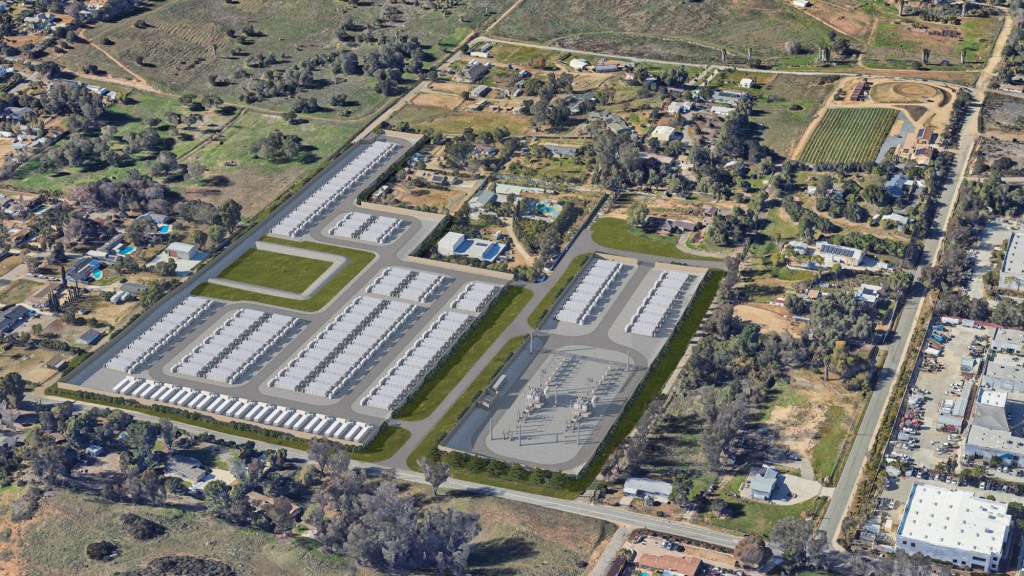
Global energy company AES has nixed plans to build a large battery storage facility in Eden Valley that drew opposition from residents who worried about the potential risk of a fire breaking out.
A subject of intense debate for the past three years, the Seguro energy project planned to store racks of battery modules in metal containers on a 22.5-acre tract of private land between San Marcos and Escondido.
The facility was designed to generate 320 megawatts and 1,280 megawatt-hours of electricity that would flow to California’s electric grid — enough to power about 240,000 homes for four hours.
But San Diego County officials confirmed that AES informed the county last week it was withdrawing its application for the project.
The Virginia-based company did not offer many specifics, saying on its website that AES will “prioritize other projects amid challenging market conditions, we remain committed to advancing projects that can provide the safe, reliable, and affordable power needed to strengthen the region’s electric grid and generate meaningful economic benefits locally.”
AES went on say it wished to “thank our local and regional stakeholders who have supported this project and look forward to continued opportunities to partner to drive San Diego County and California’s energy leadership.”
Opponents of the Seguro project celebrated the news.
“You have a company worth billions that wanted to muscle their way into something that they shouldn’t be doing and they disregard the little people, and the little people fought back,” said JP Theberge, board member of the Elfin Forest Harmony Grove Town Council. “And this time, the little people won.”
AES officials earlier said the proposed location would be ideal — close to an existing San Diego Gas & Electric substation that would allow electricity from the battery project to feed into the state’s power system without requiring miles of overhead transmission lines.
But locals often forcefully expressed their anxieties about fire risk at numerous public meetings, questioning whether there were enough accessible roads to allow them to quickly clear out in case of an emergency.
“We’ve been evacuated because of wildfires (in the area) twice,” an Escondido homeowner said during a workshop in March 2024. “There are people in the valley who own horses, donkeys, all kinds of animals, and for them to evacuate was very difficult.”
Others worried about the Seguro project’s proximity to the Palomar Medical Center.
In August 2024, the Escondido City Council passed a resolution questioning the economic benefits and highlighting the potential safety risks of battery facilities located in or adjacent to Escondido.
“I want to make clear we’re not opposed to battery energy storage,” Escondido Mayor Dane White said. But he went on say, “I don’t believe that this one in particular (Seguro) is located in a reasonable location.”
AES scaled back the footprint of the project’s original design by about 20% to help assuage concerns, but opposition remained steadfast.
“I want to see the state to go to zero (emissions) energy and get off the fossil fuel pipeline as well, but at the same time, you can’t sacrifice communities and neighborhoods for that,” said Theberge, who is also a member of Californians for Safe Energy Storage that advocates for “common sense regulations to protect communities from the harmful consequences” of battery fires.
The number of commercial storage facilities across California has boomed in recent years, and their continued growth is a crucial piece of the state’s goal to derive 100% of its electricity from carbon-free sources by 2045, if not sooner.
Commonly stacked in rows, batteries take electricity that’s generated during the daytime hours from solar, store that energy and send it to the electric grid in the evening.
Electricity from batteries — which emit no greenhouse gases — can offset power that would otherwise be supplied by fossil fuel generation such as natural gas, while also enhancing grid reliability during those hours.
Though relatively rare, there have nonetheless been multiple instances of excessive heat inside lithium-ion batteries leading to a chemical reaction that spreads in a chain reaction to other batteries in what’s called “thermal runaway.”
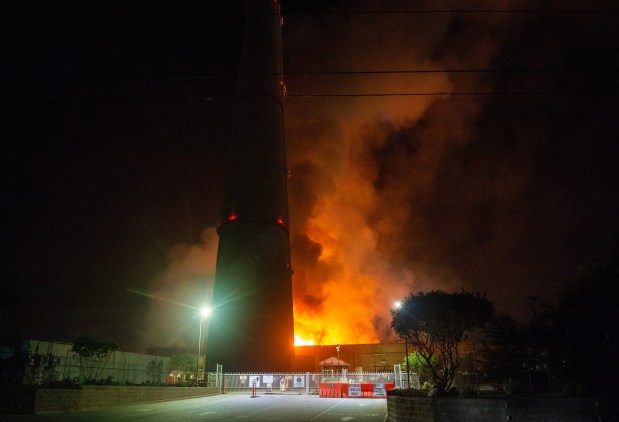 A fire rages at the Vistra battery storage plant, one of the world’s largest, in the town of Moss Landing on Jan. 16, 2025. (Doug Duran/Bay Area News Group)
Last year, a fire broke out at a 750-megawatt facility containing 99,000 LG battery modules in the Central California community of Moss Landing, which led to the evacuation of about 1,500 residents. The blaze burned for two days and closed a section of Highway 1 for three days. Monitoring by the Environmental Protection Agency for hydrogen fluoride and particulate matter showed no risk to public health throughout the incident.
A raft of battery fires broke out in recent years in the San Diego area.
One of the most noteworthy occurred in May 2024 at the Gateway Energy Storage facility in Otay Mesa, when nickel manganese cobalt batteries kept reigniting. It took nearly 17 days before the last firefighting and air monitoring crews from San Diego Fire and the Sheriff’s department left the scene.
Battery storage companies and renewable energy supporters say newer battery chemistries and enhanced facility designs have greatly reduced the risk of thermal runaway.
By next month, Arizona-based renewable energy company Arevon expects to take its Nighthawk Energy Storage Project in Poway online. The facility plans to deliver 300 megawatts and 1,200 megawatt-hours of storage capacity — enough electricity to power about 385,000 homes for four hours during peak demand periods.
The Nighthawk facility will deploy Tesla Megapack 2XL batteries that use a lithium-iron phosphate, or LFP, chemistry that Arevon executives say are “orders of magnitude” more stable and less likely to overheat and ignite than older, conventional batteries.
Another proposed battery storage facility is drawing attention as well.
Nova Renewables wants to construct what’s been dubbed the Clean Energy Valley Center, south of Valley Center Road and between Rock Hill and Round Tree roads. If approved, about half of the 141-acre site will be used to generate 10 megawatts of solar and four hours of evening electricity from battery storage.
Nova Renewables says the facility will use “the safest available batteries on the market” but some Valley Center residents don’t want the project built and have collected signatures opposing it.
San Diego County officials told the Union-Tribune the Clean Valley Energy Center has applied for a major use permit.
“The application was submitted and reviewed by staff,” a county spokesperson said in an email. “We are awaiting a resubmittal by the project applicant to address County comments.”