
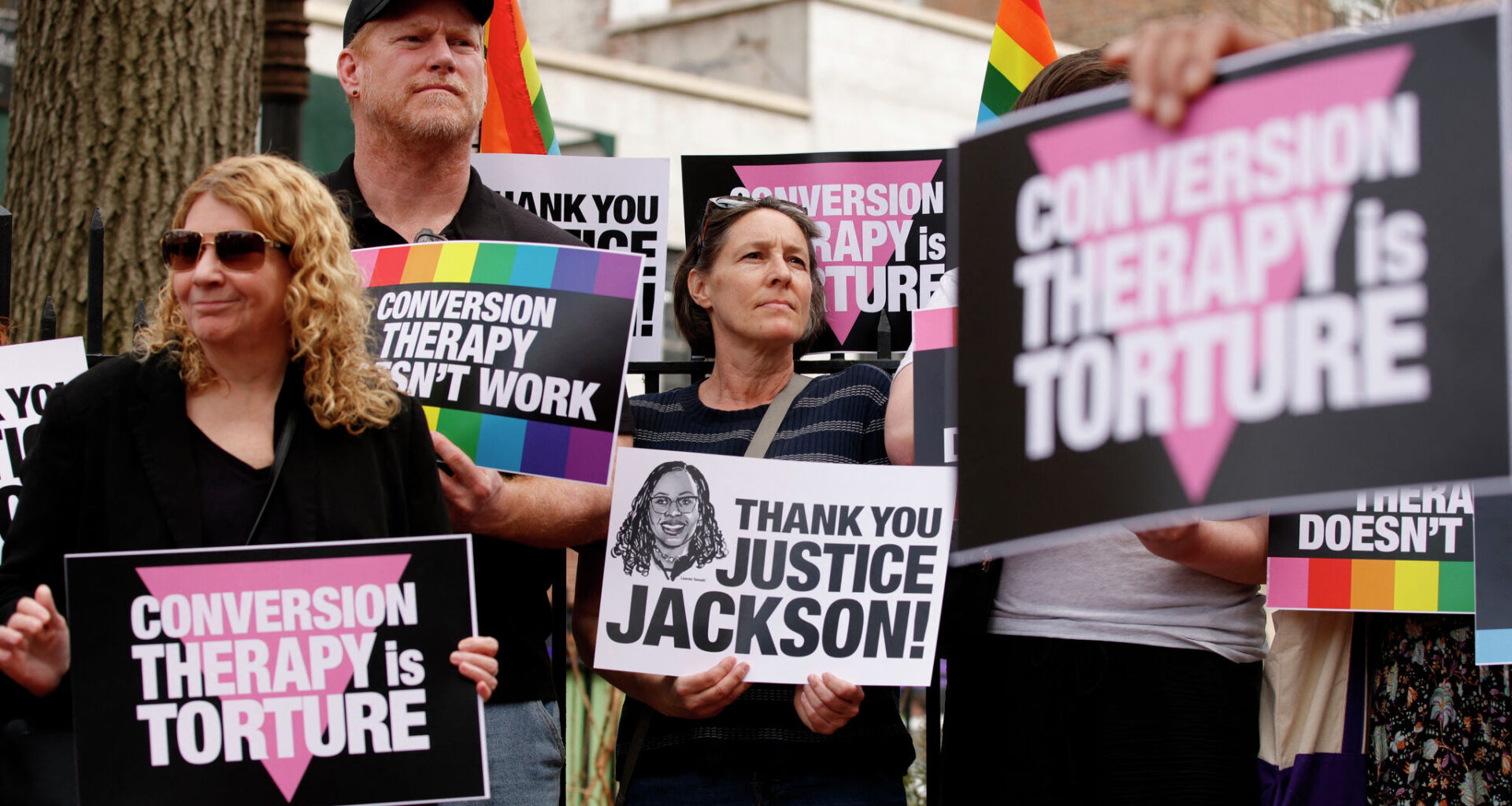
Demonstrators rally at Stonewall National Monument in New York on April 1, 2026, a day after the Supreme Court directed a lower court to scrutinize Colorado’s conversion therapy ban on free-speech grounds. The new litmus test will eventually come for California’s landmark law, supporters and critics agree.
LEONARDO MUNOZ/AFP via Getty Images
It took Shannon Minter a moment to see the upside in the Supreme Court blowing up conversion therapy bans in California and half the country.
On March 31, the court held that a 2019 Colorado law barring licensed counselors from trying to change children’s sexual orientations or gender identities violated a Christian therapist’s religious speech.
The 8-1 opinion in Chiles v. Salazar, written by Justice Neil Gorsuch and joined by all but one liberal justice, was a resounding loss for the medical and LGBTQ communities, which point to an overwhelming body of research about the futility and psychological toll of so-called conversion therapy. But the majority, classifying talk therapy as constitutionally protected speech rather than medical treatment to be regulated, sent the case back to a lower court with new marching orders that likely mean Colorado’s ban — and others like it — won’t survive in their current forms.
Article continues below this ad
Minter, legal director at the San Francisco-based National Center for LGBTQ Rights, which helped draft California’s template ban in 2011 and was also central to the state’s marriage equality push, counted himself among the demoralized. Then he slept on it.
“I woke up and thought, ‘You know what? This is actually going to be good,” Minter said. “The net effect of this decision will be to strengthen legal protections for young people who are harmed by conversion therapy.”
San Francisco Chronicle Logo
Make us a Preferred Source to get more of our news when you search.
Add Preferred Source
As it was more than a decade ago, California will be a laboratory for the effort.
Shannon Minter, legal director for the National Center for Lesbian Rights in San Francisco, said the Supreme Court’s narrow conversion therapy ban ruling left a path forward for California and other states to take.
Mike Kepka/The Chronicle
For the past year, since the Supreme Court took up Chiles v. Salazar for review last March, the center has been working with a coalition of LGBTQ civil rights groups and the office of state Sen. Scott Wiener, D-San Francisco, on a backup plan. That plan, Senate Bill 934, dropped in January.
Article continues below this ad
If successful, proponents say it could prove a stronger deterrent than California’s current ban: Senate Bill 1172, enacted more than a dozen years ago, is enforced through the threat of disciplinary action. SB934, on the other hand, calls for civil damages through malpractice lawsuits, which Wiener said Gorsuch explicitly exempted from the court’s analysis.
“This is very high-stakes,” he said. “What this extremism has done is it really forced us to think as creatively as possible.”
The backup plan
Wiener had seen the writing on the wall.
The San Francisco Democrat, who previously worked as a deputy city attorney, said he’d been paying attention to the Supreme Court’s increasingly elastic interpretation of the First Amendment — from its 2010 Citizens United ruling that equated corporations to people and money to speech, to a 2017 one holding that a Colorado baker’s religious beliefs meant they could refuse filling a wedding cake order from a gay couple.
Article continues below this ad
So when the high court last year took up the case of Kaley Chiles, a Christian counselor challenging Colorado’s law against using therapy to convince gay kids that they’re straight, Wiener said he invited a coalition of LGBTQ civil rights groups to plan for a future without California’s landmark conversion therapy ban.
“Once the oral argument happened last fall, it was clear to us that this law was very much at risk,” he said.
SB934 would significantly extend the window someone has to bring a malpractice suit against a conversion therapy provider from three years to potentially three decades, giving children who were harmed by a conversion therapist until they’re 40. It would also bolster such claims by allowing expert testimony that reflects the scientific consensus about the harms of sexual orientation change therapy.
Every major medical and psychiatric association has determined that trying to change a person’s sexual orientation or gender identity doesn’t work and can instead inflict psychological trauma, especially on children.
“It’s quackery, it’s torture and it should be banned,” Wiener said. “And if we can’t ban it, we should at least give people the tools to seek compensation from the people who inflicted this harm on them.”
Article continues below this ad
Minter said extending the statute of limitations, which California has already done for victims of child sexual abuse, is significant.
“What we see over and over again from survivors of conversion therapy is it often takes them many years to understand that the problem was not that they personally failed, it was that this therapy was harmful and does not work,” Minter said. “It could in some ways be a more effective deterrent.”
Signed into law in 2012, California’s conversion therapy ban used the potential for disciplinary action to deter would-be practitioners. It was effective, but not very toothsome, its proponents say. After all, how many young people know how to file a complaint with the California Board of Behavioral Sciences, which licenses mental health providers, Minter asked. “That’s always been a weakness of this law.”
Greg Burt, vice president of the California Family Council, a Fresno-based Christian nonprofit that championed the Supreme Court ruling, also doubted that SB1172 was used in a punitive way.
“What we hear from around the world on these therapy bans is that they are rarely ever enforced,” he said via email. “Their effect is that they intimidate counselors with the threat of enforcement.”
Article continues below this ad
The board has not yet responded to the Chronicle’s request for disciplinary information.
Wiener and Minter also see SB934 as a vehicle to tweak California’s ban so it can withstand legal challenges under the new standard established by the Supreme Court.
“I do not think it will be tough,” said Minter, who characterized the ruling as “very narrow” and suggested that’s why it was joined by liberal justices Elena Kagan and Sonia Sotomayor. “(The) upshot is not that states can’t regulate, just that we need to go back to the drafting board and make sure the laws are viewpoint neutral.”
California’s ban defines sexual orientation change efforts as “any practices by mental health providers that seek to change an individual’s sexual orientation,” including those intended to reduce same-sex attraction or change gender expression, and excludes therapies that provide acceptance and support.
Minter said the court took issue with language in Colorado’s ban, modeled after California’s, that appeared to favor mental health providers who affirm LGBTQ patients and disfavor those who don’t.
Wiener said he was working with LGBTQ groups and the Senate Judiciary Committee “to see if there are adjustments” to make California’s ban “more defensible in court.”
Supporters and critics agree the day in court will come.
“Colorado’s ban on change-allowing talk therapy for minors was patterned on and is nearly identical to California’s harmful 2012 ban,” Dean Broyles, president of the conservative National Center for Law and Policy, said in a statement after the ruling. “I look forward to a soon-to-be legal challenge that ends the unlawful ban in California.”
Broyles didn’t respond to an interview request.
“Our ban on conversion therapy is very similar to Colorado’s,” agreed Jorge Reyes Salinas, communications director at Equality California, the largest statewide LGBTQ civil rights organization in the country. “We’re going to face legal uncertainty. We don’t know what that looks like.”
Burt suggested a challenge could come from a counselor, parent or teen “interested in the type of counseling that SB 1172 currently forbids.”
“The lawsuit will not come from us,” he said via email.
The legal process could take years to unfold.
SB934 got its first public hearing Tuesday before the Senate Judiciary Committee.
Though Minter found the silver lining in the Supreme Court’s ruling, he also deemed it hypocritical. The same court ruled less than a year ago that states can ban gender-affirming care for minors. Like Justice Kentaji Brown Jackson, who wrote a scathing dissent in Chiles v. Salazar, he disagreed with the majority that therapy is not medical care.
A 2020 study in the American Journal of Public Health found that exposure to sexual orientation change efforts increased the odds of a suicide attempt by 80% for nontransgender sexual minorities, while a 2019 study of transgender adults found that those who were put through conversion therapy as kids were more than twice as likely to attempt suicide.
“That is shocking,” Minter said. “This should not be a political issue.”