
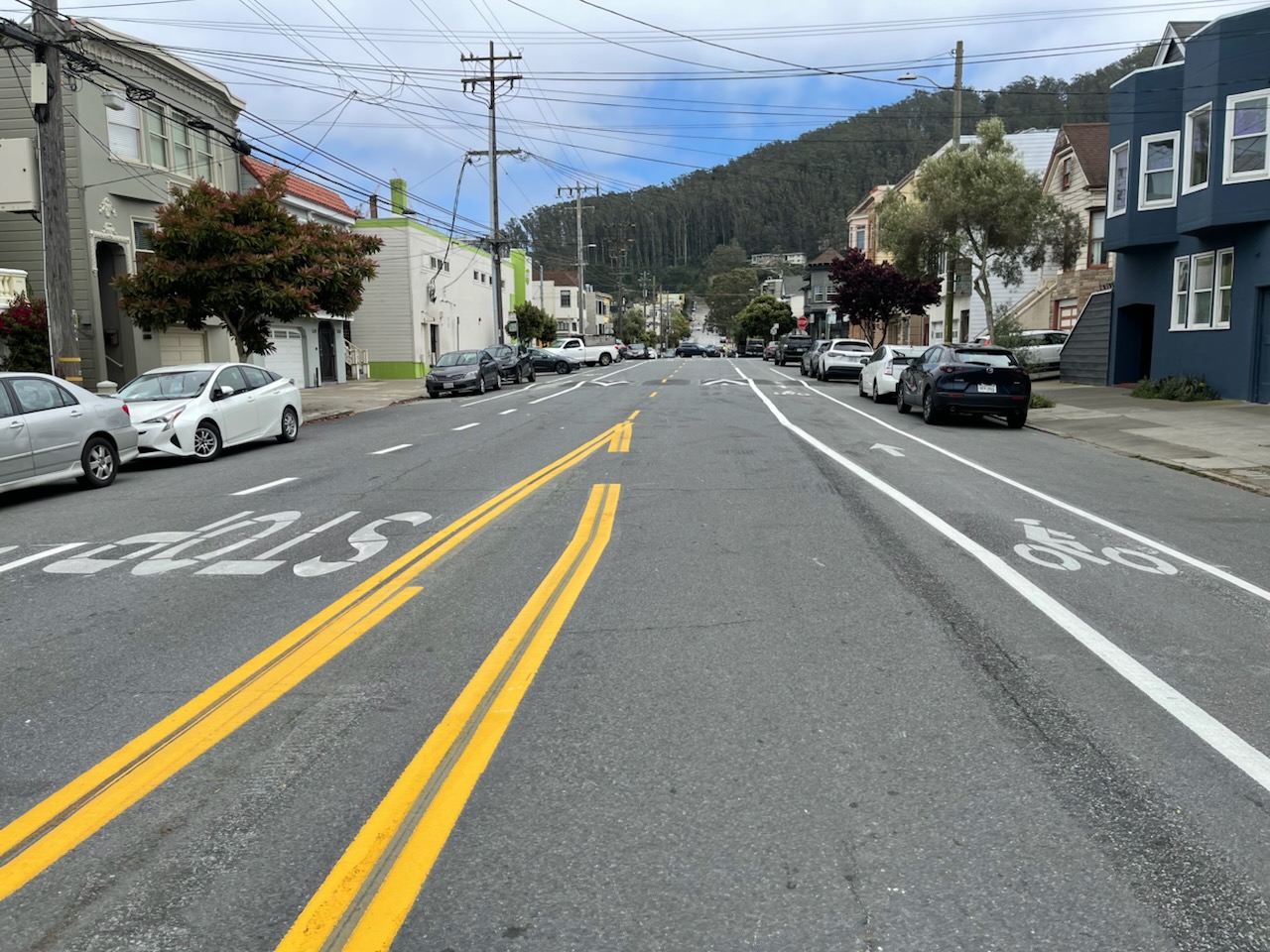
San Francisco crews recently removed the “neck-down” safety feature on Kirkham between 9th and 10th Avenues. It was replaced by speed humps and new stripes.
“We worked to install a speed cushion in the middle of the block between 9th and 10th Avenues, install small painted and raised median islands on both Kirkham Street approaches to 10th Avenue, and paint crosswalk markings at 10th Avenue and Kirkham Street,” wrote SFMTA’s media department, in an email to Streetsblog.
Streetsblog readers will recall that the neck-down, described as an “experimental” treatment to force drivers to look up from their cell phones and navigate the block at safe speeds, was installed last year. SFMTA collected data and found that it was working as intended: slowing traffic to a safe speed. It also did not cause any delays or collisions.
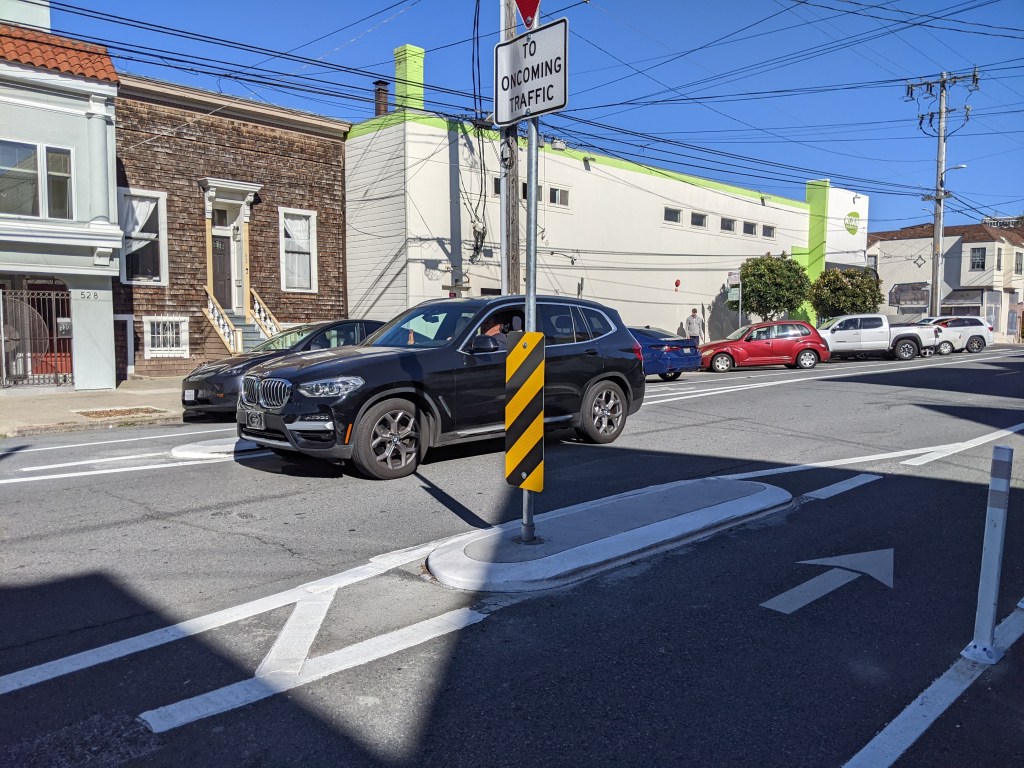 The Kirkham neck-down worked as intended, forcing motorists to put their cell phones down and pay attention. So SFMTA removed it. Photo: Streetsblog/Rudick
In other words, SFMTA finally installed a modest concrete treatment used throughout the world to force drivers to slow down and be safe. But a handful of loud motorists complained to District 7 Supervisor Myrna Melgar, who in turn complained to SFMTA, an ostensibly independent city agency. Out came the jackhammers.
So how much did all this cost? Here are the figures from SFMTA:
Install:
Neck-down islands = $6,348
Sign Shop = $1,400
Paint Shop = $1,700
Tearing it out and replacing it:
Removing the neck-down islands and installing a new concrete island at 10th Ave = $6,632
New speed cushion = $11,621
New signs = $1,100
New paint = $13,000 (new crosswalks at 10th Ave, new painted island at 10th Ave, striping adjustments, speed cushion chevrons)
It’s worth noting that this location is just a few blocks from where a cyclist lost her leg last month because the city “can’t afford” to put in safe infrastructure, such as concrete-protected bike lanes. Streetsblog, meanwhile, watched as drivers sped over the Kirkham speed hump almost as if it weren’t there.
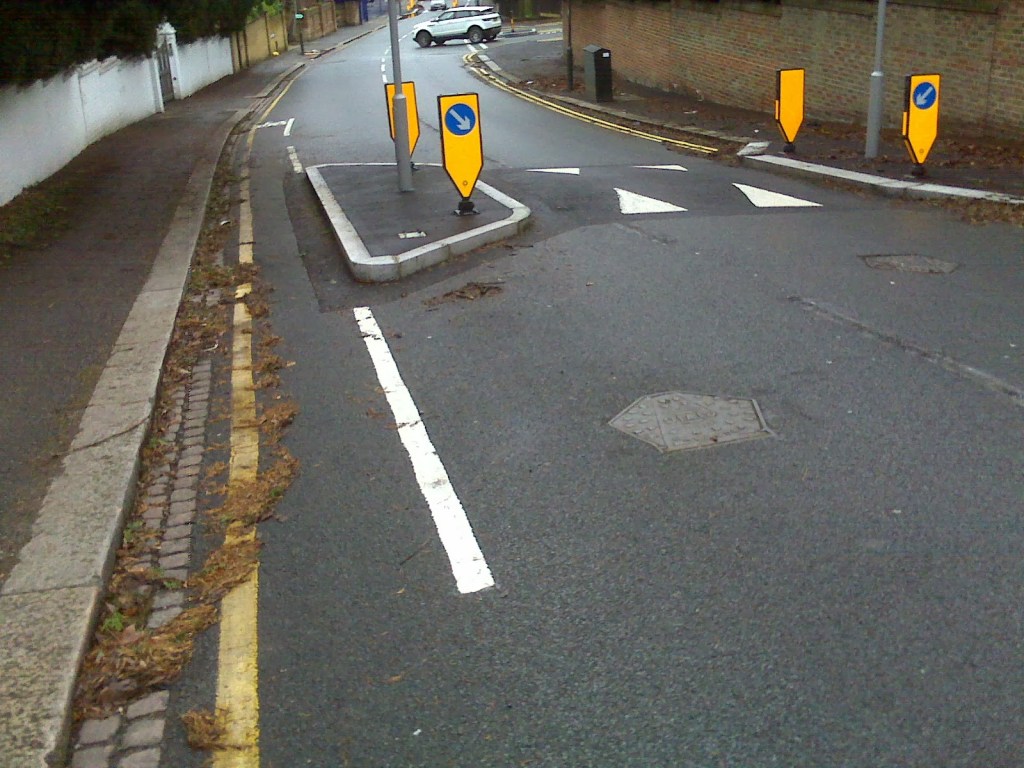 They call neck-downs ‘pinch points’ in London, as seen here. London has about a third the number of traffic fatalities per capita as S.F. thanks in large part to treatments such as these. Image: Google maps
If there had been neck-downs on Ulloa, would the Pinto-Oliveira family have died at the hands of a reckless motorist going over 70 mph through a residential neighborhood? If there were neck-downs on 4th and Channel Way, would a toddler have been killed by a distracted motorist? In those situations and hundreds like them, the answer would usually be “no”, because the oblivious and/or speeding drivers would have crashed into a neck-down long before they had a chance to kill someone. Or they wouldn’t have been driving recklessly in the first place.
“Dangerous speeding threatens our lives and our communities. With speed as the #1 cause of severe and fatal traffic crashes in San Francisco, we should be celebrating solutions like this and asking for more,” wrote Walk S.F.’s Marta Lindsey when asked about the value of the neck-down a few months ago.
The city has a binary choice: prioritize motoring convenience or take Vision Zero seriously and build for safety. City electeds repeatedly choose political expediency and motoring convenience, with horrific results.