
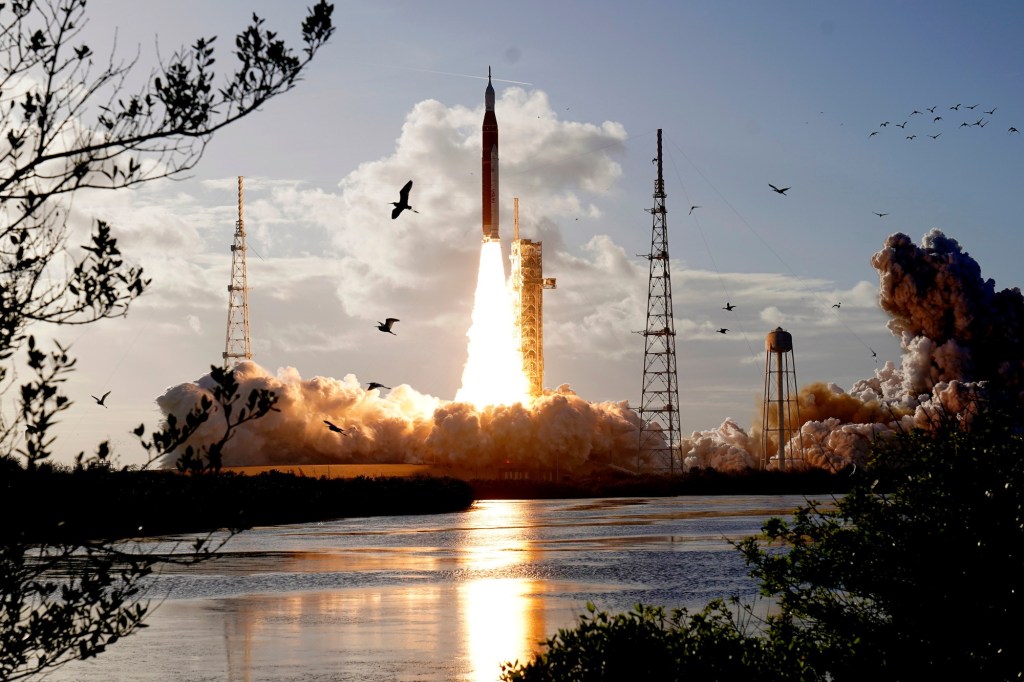
NASA’s Artemis II mission launched on April 1 for a 10-day trip marking the first time in over 50 years that astronauts reached the moon.
People all over the world watched liftoff and continue to track the Orion spacecraft Integrity as it travels back to Earth. The three American and one Canadian astronauts inside are scheduled to return to Earth on Friday, landing about 50 to 60 miles off the coast of San Diego.
San Diego warship to recover Artemis II astronauts when they splash down in ocean Friday
But the excitement around space travel and exploration doesn’t have to stop any time soon. San Diegans have other ways to feed those interest in San Diego. Here are five of them.
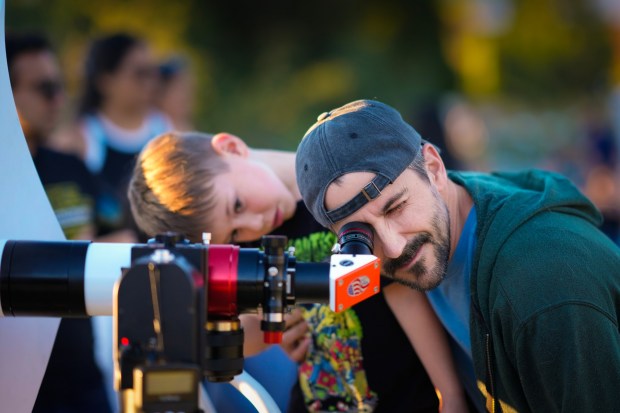 Keith Morrison and his son, Slade, from Oceanside, observe the sun through a 60 mm telescope provided by astronomer Craig Storms during the Dark Sky Festival held at Menghini Winery in Julian on Saturday, Aug. 16, 2025. (Nelvin C. Cepeda / The San Diego Union-Tribune)
International Dark Sky Week
From April 11-18, San Diegans can celebrate International Dark Sky Week locally. There will be several events across the region where the public can stargaze and celebrate the night skies, and this year’s celebration coincides with a meteor shower and a new moon. On April 11, the Festival of the Night Sky and Nocturnal Creatures takes place at Los Peñasquitos Ranch House. The Borrego Springs Dark Sky Welcome Center open house is on April 13. The Borrego Springs Library is holding an astrophotography and binocular discussion on April 14. A solar telescope viewing and nighttime star party at Anza-Borrego Desert State Park, and the Dark Sky Week symposium’s Defending the Night and stargazing event are both happening at Santa Ysabel Nature Center on April 18. For more information, visit idsw.darksky.org.
Palomar Observatory
For exploratin during the day, the Palomar Observatory is open daily. Guests can see the observatory’s 200-inch Hale Telescope and take tours of its museum and facility. The museum has exhibits on the Milky Way, planetary scientist Eleanor F. Helin and a viewing area for live camera feeds from the Hale Telescope. Guided tours are approximately one hour and take visitors around the Palomar Observatory. The observatory is also teaming up with Fleet Science Center on April 18 to host a special edition of its The Sky Tonight event series. 9 a.m. to 3:30 p.m. daily. 5899 Canfield Road, Palomar Mountain. sites.astro.caltech.edu/palomar
Fleet Science Center
The Fleet Science introduces visitors to scientific activities and exhibits in hopes of teaching how science can help build a better future. That includes its Space Gallery, which allows for exploration of the Earth, sun, solar system and universe. It also hosts regular “The Sky Tonight” events with guest speakers and stargazing opportunities. This week, the center is organizing three days of events to observe the return of NASA’s Artemis II mission back to Earth. The public can view the splashdown on the Heikoff Giant Dome screen. Each day will feature limited-time activities and the opportunity to engage with experts and watch the mission. A live splashdown event is scheduled for April 10 from 3 to 5:30 p.m. and separate tickets are required. For more information on the events, visit fleetscience.org/experiences/artemis-week.
San Diego Air & Space Museum
The San Diego Air & Space Museum’s goal is to educate, preserve, inspire and celebrate aviation and space flight history and technology. The museum has a collection of artifacts and aircrafts such as the Apollo 9 Command Module, a mock-up of the Lockheed Vega 5B, flown by Amelia Earhart, B-58 Hustler flight plans and various pictures of famous aviators and airplanes. The museum also has a wind tunnel, which was acquired from General Dynamics, and it hosts various events throughout the year, such as a children’s summer camp. The museum is open daily from 10 a.m. to 4:30 p.m. Plus, the museum is organizing an Artemis II splashdown pajama viewing party on April 10 starting at 4 p.m. There will be family-friendly activities, including rocket launches, parachute and landing challenges, chocolate heat shielding experiments and robotics and engineering buildouts. 2001 Pan American Plaza, San Diego. 619-234-8291, sandiegoairandspace.org
San Diego Astronomy Association
The San Diego Astronomy Association organizes events for those who are interested in everything beyond Earth’s atmosphere. The group sets up stargazing watch parties at Father Juniper Serra Trail, Scrips Ranch and Sycamore Canyon Open Space Preserve on the first, third and fourth Friday nights of each month after sunset. Also, the group meets outside of The Fleet Science Center for a night of stargazing every first Wednesday of the month. These stargazing events are free to attend and the association provides equipment and shares its expertise on the stars and planets. sdaa.org
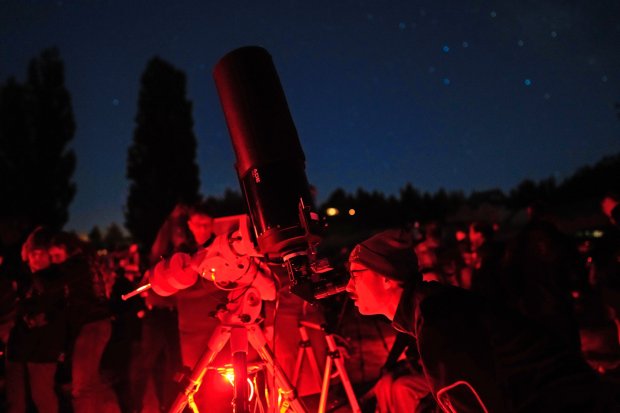 The public was invited to view through several telescopes on display during the Dark Sky Festival held just outside the Menghini Winery in Julian on Saturday, Aug. 16, 2025. (Nelvin C. Cepeda / The San Diego Union-Tribune)
Bonus tip: For those who want to learn about stargazing in San Diego County, here is our beginner’s guide to finding the best places and times to do so: Stargazing is challenging, but possible, in San Diego County. Here’s how to view our night sky.