
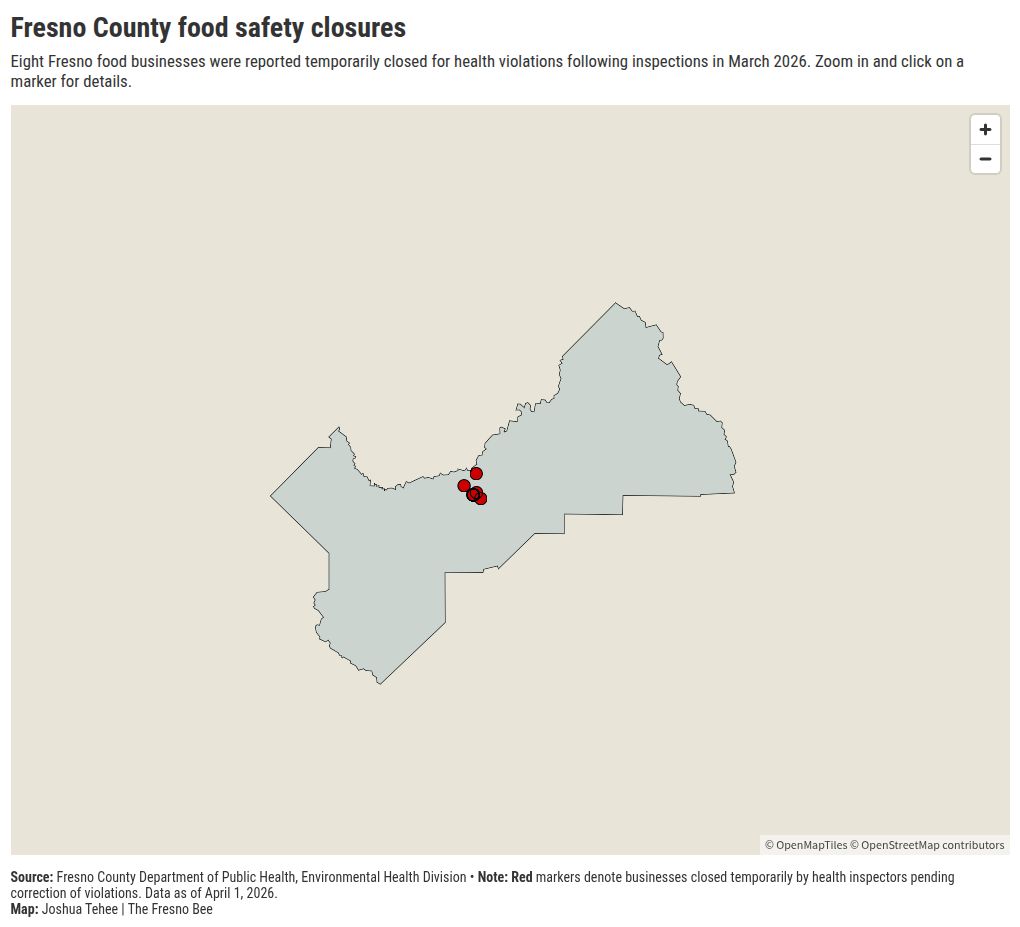
Fresno County’s Department of Public Health temporarily closed six food trucks and mobile food vendors in March, according to its Food Facility Closure report released Monday.
The businesses were cited for a range of issues, from lack of permitting to improper sewage and wastewater disposal. At least one truck, El Taco Nazo, remains closed.
In that case, a March 24 inspection found the food truck “parked at the commissary preparing food for the other permitted trailers.” The truck itself had not been permitted since 2020, according to the inspection report. The truck was also found “draining waste water and food debris onto the cement,” instead of the waste tank dump station. The department ordered the truck cease all food preparation, pending fixes.
The other mobile food vendors that were closed temporarily included:
Rainbow Shaved Ice, which halted operations for several weeks over permitting issues, after it was found selling at the Selma Flea Market. It was allowed to resume business March 20, according to the county.Mi Noodles Long Time, which closed for just under a week for a “lack of hot water and sanitizer solution.”Mi Ranchito Mexican Food, which was closed for one day following a March 19 inspection found “improper hot and cold holding temperatures.”Taqueria Haro. The food truck was closed for several days following a March 23 inspection that found a lack of hot water (needed for sanitation purposes) and inadequate hot holding (keeping food at the required 135 degree temperature).Kona Ice of Fresno. The mobile vendor was ordered closed for less than a day, pending a plan check for proposed remodel. Those plans were put on hold, according to inspection reports.
Two other businesses were also closed in March, per the county’s closure report. They are:
Gem of Thailand, on Herndon Avenue in Fresno. The restaurant was closed for three days after an inspector “observed grease and wastewater surfacing out of the grease trap and onto the kitchen floor.” The system was cleaned, and the restaurant passed a re-inspection.Diamond Gas and Market 18, which was ordered partially closed due to a lack of hot water. During the closure it was allowed to only sell prepacked foods.
The closures mark a considerable uptick from the two businesses that were closed in February. According to data tracked by the Bee, 16 restaurants, mobile food vendors and markets have been temporarily closed for a day or more since the start of 2026.
How do county health inspections work?
The Fresno County Public Health Department has about two dozen environmental health specialists who monitor some 5,000 restaurants, snack bars, grocery stores, commissaries, delicatessens and food vendors across the county.
Inspectors make unannounced visits several times a year but are also called out following fires or changes in ownership or in response to complaints or other concerns from the public. This includes when people report what they believe are health or sanitation issues at restaurants (if someone sees a rat, let’s say).
These inspectors work through a lengthy and detailed list of more than 50 items that can cause violation.
It can be simple and bureaucratic: whether the business has the proper license or permit or have submitted plans for a remodel (see above), or whether management and employees have the required food safety or food-handling certificates on hand.
But it can also be things like the hygiene of individual employees or temperature control systems (to keep cold food at or below 41 degrees and hot food above 135 degrees) or sanitation (again, see this month’s report).
Do the facilities do proper sterilization on counters, tables, utensils and cookware? What is the overall cleanliness of a building (are restrooms stocked with supplies, for example)? Are sinks and floor drains working properly?
Inspectors chronicle their findings in reports made available to the public in a searchable database online.
In most instances, problems can be fixed on the spot. That includes things like having enough bleach or sanitizer in the water used to wipe down food-preparation areas; replenishing soap, paper towels and toilet paper in the restrooms, or reminding employees to wash their hands and wear gloves and hairnets.
Serious violations, those that pose an imminent health hazard, will trigger closure and mandatory reinspections. This includes things like rat or roach infestations, refrigerators that don’t keep food cold enough or steam tables that don’t keep food hot enough to inhibit bacterial growth. Clogged sinks or drains, can also call for a closure, as contaminated water can back up into kitchens.
Ditto for hot water. This is one of the most common (and quickly fixed) reasons for closure and violators typically get reinspected and reopen with a day or two.
Related Stories from Fresno Bee
The Fresno Bee
Joshua Tehee covers breaking news for The Fresno Bee, writing on a wide range of topics from police, politics and weather, to arts and entertainment in the Central Valley.