
By Kyle Stock | Bloomberg
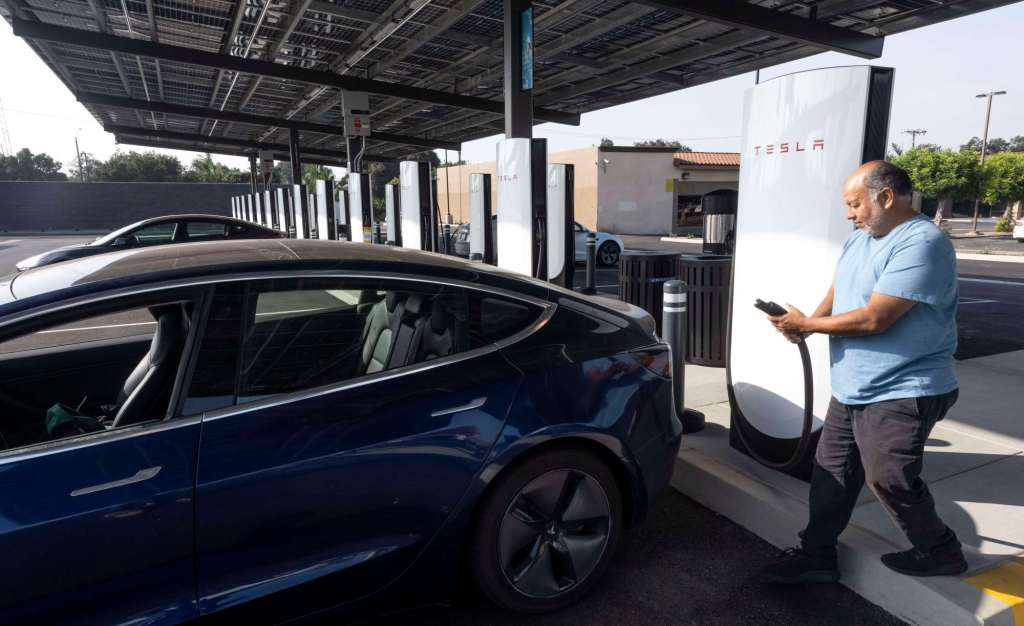
US electric vehicle charging networks were still racing to catch up to demand when the Iran attack and surging gas prices reignited EV interest.
Some 605 public, high-speed EV fueling stations switched on in the first quarter, a 34% increase over the year-earlier period, according to Bloomberg News analysis of federal data. The country now has nearly 13,500 places to quickly add electrons to a car or truck, 25% more than it did a year ago.
Also see: Rove brings 40-station EV charging center, 24-hour lounge to Santa Ana
The charging boom proved particularly propitious in March, as the Iran War roiled oil markets, gas prices surged and Americans started searching for EVs en masse. After skidding for months, Tesla sales climbed in the first quarter compared to last year. (Though they did come in under analysts’ expectations.)
“It’s obviously been a very anti-EV situation at the federal level,” said Ingrid Malmgren, senior policy director at Plug In America, an EV advocacy group, referring to the Trump administration’s gutting of subsidies and clean air regulations. “But what we’ve seen continuously is that people love their cars, and once they start driving an EV, nobody wants to go back.”
Most of the demand is driven by the private sector.
Also see: These Southern California startups are part of a growing epicenter of EV truck production
Truck stops, in particular, have been adding electron pumps in a bid to sell lucrative snacks and sodas to battery-powered road trippers. Pilot Flying J Inc., an empire of interstate rest stops, added chargers to nearly 30 of its locations in the first quarter, from Mount Airy, North Carolina, to North Platte, Nebraska. The company now has nearly 1,200 charging stalls, roughly half of what it intends to stand up.
The goal is to offer “the same convenience, access and reliability that non-EV drivers have come to expect,” said Brandon Trama, Pilot’s head of electrification.
In Orange County, the startup Rove has built two EV charging stations packed with DC fast-chargers plus amenities for drivers. A new facility opened April 8 on Harbor Boulevard in Costa Mesa.
Networks, meanwhile, have been emboldened by an improving business model. Recent EV buyers are more likely to live in multi-unit housing thus, more likely to charge in the wild. And newer, more efficient chargers are pumping more electrons in less time, making charging more profitable.
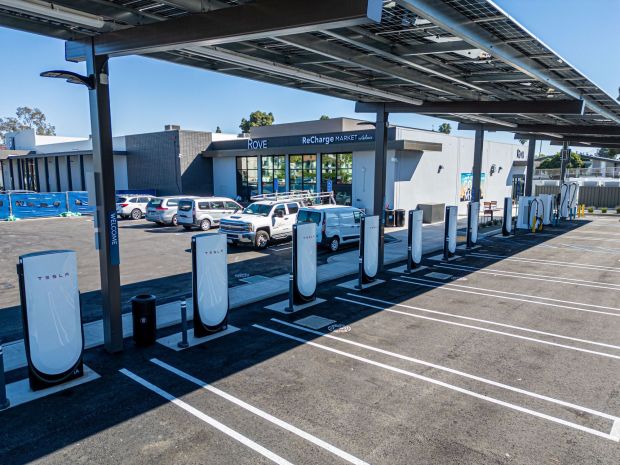 In Orange County, the startup Rove has built two EV charging stations packed with DC fast-chargers and amenities for drivers. A new facility opened April 8 at 2666 Harbor Boulevard in Costa Mesa. (Photo courtesy of Rove)
That’s creating a virtuous cycle, as speedier and more reliable chargers convince more drivers to go electric and use public plugs, according to Paren, a data platform focused on EV infrastructure.
Also see: Automakers face an ‘EV winter’ in 2026 as sales growth slows
Despite several months of slumping EV sales, Paren expects US fast-charging infrastructure to expand by 8% in 2026.
“The charge-point operators we talk to are not building for 2025 or 2026; they’re building for 2035,” said Paren cofounder and Chief Technology Officer Bill Ferro. “They may slow down their deployment, but they’re still going to deploy.”
Indeed, US charging networks were still in catch-up mode when federal EV subsidies expired in September. Although US EV sales swooned in the fourth quarter, there were still 7.4 million plug-in electric vehicles on US roads at the end of 2025, nearly 3% of all registered cars and trucks, according to S&P Global Mobility.
The country’s ratio of cars to chargers remains one of the most lopsided in the developed world.
That said, EV adoption could stay ahead of charging infrastructure. Since the Iran War began, the average price of gasoline in the US has surged to $4.82, a nearly 37% increase. Economists say those in the market for a car at the moment are more likely to go electric. If gas prices stay elevated for months, even drivers who had no plans to buy a new car will consider switching.