

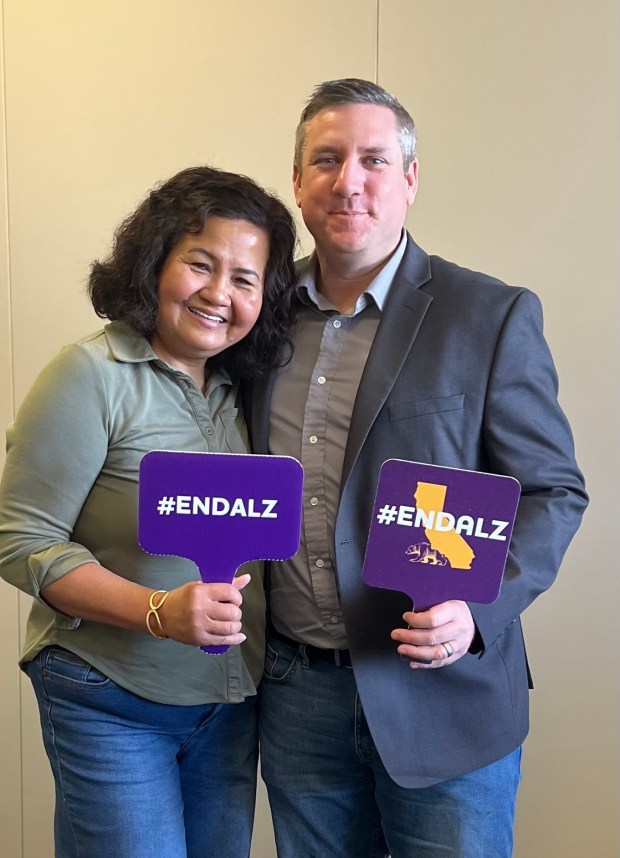
 Elizabeth Santos had an opportunity to discuss the bills directly with Assemblyman Chris Rogers. She was encouraged by their conversation and hopes he will support all the legislation. (Contributed)
Elizabeth Santos, State Champion for the Alzheimer’s Association’s Northern California-Northern Nevada Chapter, has recently returned from yet another lobbying trip to Sacramento.
For years, Santos has been an Alzheimer’s patient advocate and a liaison between families, physicians, and care facilities, helping people get the Alzheimer’s and dementia-related care they need- and most importantly- helping them get the correct diagnosis. She has been a tireless advocate for patients, traveling to care homes up and down the state and to the legislative halls of Washington and Sacramento.
Santos’ most recent trip to Sacramento involved a visit to the offices of Assemblymember Chris Rogers and Senator Mike McGuire on California Advocacy Day, held on March 4th, to ask for support for 2 upcoming bills and a budget request. She was joined by over 150 advocates from all parts of California- but sadly, only Santos and one other advocate from Humboldt County represented the entire North Coast region.
“Alzheimer’s is a public health crisis that is quietly devastating our state,” says Santos. According to the Alzheimer’s Impact Movement, in 2020, 719,700 Californians were living with Alzheimer’s, which translates to 12% of the state’s adults over the age of 65. It is one of the leading causes of death in the state.
The majority of California’s Alzheimer’s patients are being cared for by family members. In 2024, 1.4 million people provided a staggering 1.89 billion hours of unpaid care, valued at over $50 billion dollars. 17.6% of dementia caregivers in California report having bouts of depression, and 13.1% report frequent episodes of poor physical health.
Even more alarming is the lack of available geriatric care in the state. Right now, a grand total of 802 geriatricians are responsible for the elderly throughout the entire state. Studies estimate that by 2050, the number of geriatricians needed to care for the burgeoning, boomer-aged population who will be suffering from Alzheimer’s must increase by nearly 70%.
Santos and her colleagues arrived in Sacramento with the goal of pushing forward two bills and an additional budget request.
SB 950, Alzheimer’s Treatment Coverage, would help to remove insurance roadblocks to those seeking treatment for Alzheimer’s. “The simple explanation for this bill is ‘treatment when it matters most,’” says Santos. The science behind the causes of Alzheimer’s and dementia has continued to make important strides, and more treatments are becoming available. “However, those treatments are designed for people in the earliest stages of the disease,” Santos continues. “We are in the era of treatment. But what patients and families tell us is that there are roadblocks set up by insurance companies that delay access to these treatments- treatments that delay the progress of the disease and buy time for families.”
The Alzheimer’s Association is sponsoring a bill that, if passed, would require state-regulated private health insurance plans to cover FDA-approved treatments that reduce clinical decline. The bill would provide non-restrictive coverage criteria for patients, buying precious months and possibly years for them and their families, which is critical for creating plans and cherishing the time families have left.
With the advent of blood-based biomarker testing and disease-modifying treatments, people are more likely to seek early detection and diagnosis to access these treatments, as well as FDA-approved monoclonal antibody treatments that target amyloid plaque building in the brain. But a recent survey by the Alzheimer’s Association showed that 44% of respondents noted insurance companies were not a support, but an obstacle to care.
“With these new treatments, time is everything,” says Santos. “There are no similar treatments for people in the middle or late stage of Alzheimer’s. No family should experience barriers to access based on an unnecessary delay from their insurance company.”
AB 2052 Vertical Prosecution: Crimes Against Older Adults is an Alzheimer’s adjacent bill, which is co-sponsored by the Alzheimer’s Association, along with the San Francisco District Attorney.
“The legal needs of our elders are often underrepresented,” says Santos. “In some counties, district attorneys can create special units where one attorney handles each stage of a case, making the process easier and more seamless for victims and families.”
Right now, if an attorney assigned to a vertical prosecution case is required to be in court, they must hand off their other work to a colleague, who may not have ever met the victim or their caregivers, creating knowledge gaps and potential misunderstandings. “This bill would enable a prosecuting attorney handling a case involving a victim who is a minor, dependent adult or old adult to receive a continuance for other responsibilities,” she explains. “Then our District Attorneys can prioritize service to vulnerable populations, like our seniors, and this might encourage counties like ours to establish units focused on elder and older adult issues.”
The issue that Santos feels is most relevant to Mendocino County is the “Dementia Care Aware” (DCA) budget request, sponsored by the Alzheimer’s Association. “The ask is for $5.4 million from the General Fund over three years to create a training program for dementia screening, care navigation, and case management.”
Since its inception in 2021 following the passage of SB 48, the DCA has trained more than 7,250 individuals in nearly every California county, using an in-person and online training program. “DCA has not received state funding since 2024. A private grant will help them continue through this fiscal year, but if no additional funding comes our way, the program will shut down,” says Santos. The DCA provides free, evidence-based training and implementation support using a cognitive health assessment that helps primary care providers and their teams to identify, diagnose, and manage dementia.
“39% of primary care physicians report they are not comfortable diagnosing dementia. And as we mentioned, imagine the wait list to see one of the only 800 geriatricians in California. Right now, the average wait time for a specialist-only diagnosis is more than three years! We do not have a geriatrician in Mendocino County, and most families must make the difficult journey with their loved one to UC Davis or UCSF to get an accurate diagnosis. DCA helps to bring that skill set into the offices of every primary care physician in Mendocino County.”
The DCA was built for the entire primary care team and has served both rural and urban settings. CE/CME units are available for those who need them, and the training helps health systems integrate dementia care into their medical office workflow. “Improved care management translates to fewer emergency department visits, fewer outpatient and acute care events, and overall cost savings—a clear return on investment.”
Before DCA was implemented, nearly one in four primary care providers reported having no training whatsoever in providing a dementia diagnosis, with two out of three providers characterizing the training they did have as “very little.” Following the reception of the DCA training, 81% of survey respondents said they felt confident to implement practice changes.
“For all of us living in Mendocino County, the technology and support of programs like the DCA are more than essential- they are the link between us and the higher levels of knowledge and information that are only available to those who live in the big cities.
“The program reaches underserved and rural communities, including Mendocino County and Humboldt County, ensuring more equitable access to dementia care training. I strongly urge Senator McGuire and Assemblymember Rogers to co- sign and champion this budget item, recognizing that investing in DCA now is an investment in better care and lower costs for our state,” Santos concludes.
150 Alzheimer’s advocates from all over California gathered in Sacramento for the annual California Advocacy, where they visited the legislature and encouraged their Assembly and Senate members to vote for upcoming legislation.