
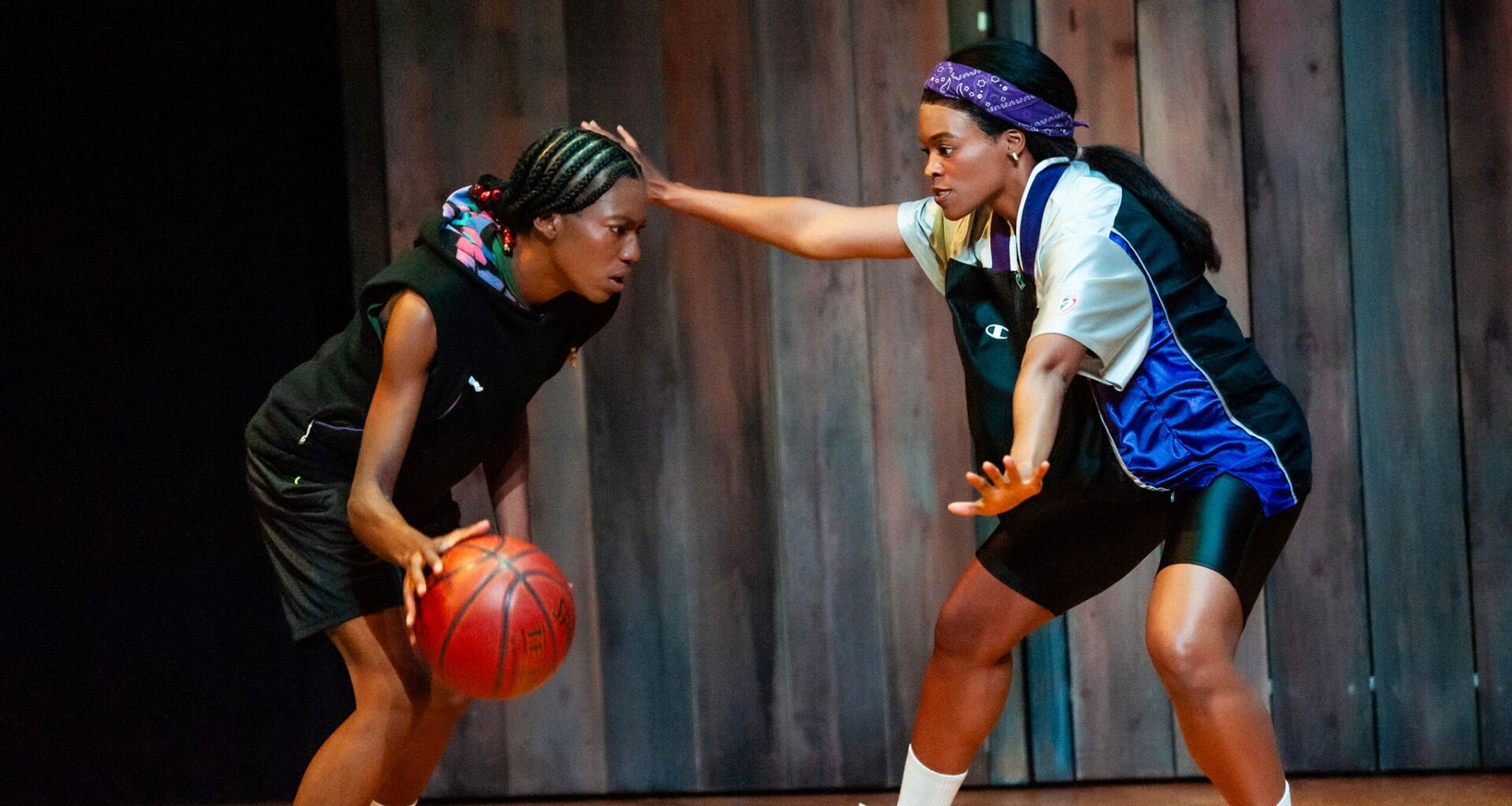
Starra has mastered the crossover between-the-legs dribble — the one that, even to those who know nothing about basketball, makes a player look like an NBA star.
In Candrice Jones’ “Flex,” the high school senior knows she looks good. Talking to herself on the makeshift dirt court outside her Arkansas garage, Starra (Santeon Brown) sings her own athletic praises in a way that’s only part-boast — it’s also exultation in the joy of balletic movement.
“It felt like a thousand basketball gods guiding my wrist,” she says. “My shot was a rainbow.”
But for a play about basketball, San Francisco Playhouse’s production, which I saw Tuesday, April 7, is oddly static. As the five starters of the rural Lady Train team drive their way toward state championships, they spend relatively little time dribbling, passing and shooting. Instead, director Margo Hall often plants players and coach in a horizontal line, like benchwarmers to their own play.
Swatting mosquitos during an outdoor practice, the girls spend an awful lot of time scolding each other about how little time they have left before the big game — but then just keep talking more and don’t run any drills at all. For many of the young performers, that talking has only two registers, Shout 1 and Shout 2, like keyboard buttons. Their poses are similarly stock and stagey. When Halili Knox as the coach enters, it’s a relief to hear someone marshal a full vocal range to divine the melody in text.
The stakes are manifold. April (Camille Collaço) is pregnant, and Coach won’t let her play, despite her teammates first-scene efforts to show they can all practice just fine wearing prosthetic baby bumps cribbed from the home ec classroom. Sidney (Paige Mayes) is getting scouted, which threatens Starra’s status — at least in her own mind.
Meanwhile, Cherise (Emma Gardner) and Donna (Courtney Gabrielle Williams) are secretly in a relationship, even as Cherise struggles to reconcile her born-again Christianity with her sexuality.
At best, the show takes a compassionate, wide-angle lens to the myriad sociological forces — lack of economic opportunity, single parenthood and teen pregnancy, religious moralism — that shape the girls’ lives in the pre-cellphone 1998, when burned CDs and handwritten notes are passed in class. With the teammates struggling to raise enough money and get reliable transportation for an abortion for April, the show could receive a favorable write-up for accuracy from the Abortion Onscreen Database, the UCSF initiative that tracks filmed depictions of abortion over time.
But as Starra violates her teammate in a cruel bid to stay on top, Jones bully-balls her plot mechanics into place. For a secret to get revealed, it’s as if a giant invisible hand is forcing a Harlem Globetrotters trick play to work in a real game. Exposition bludgeons. “That’s why I wrote you that letter,” Charisse says, with all the writerly grace of a bricklayer.
Still, the actors have their moments. At Starra’s nadir, Brown addresses the character’s dead mother with a combination of betrayal, rage and sorrow that makes her eyes blaze and glitter and her body vibrate with potential energy. As April wades deeper into her own impossible dilemma, Collaço combines rage at the universe with a nothing-matters nihilism. It’s like seeing the sad process of a child curdling into an adult in real time.
Because “Flex” is a sports story about kids, it must have at least a partial happy ending with life lessons learned along the way, and Jones fulfills these contractual requirements of the genre. At some points, she even spins beauty from them. The Arkansas dust and dirt derided throughout the play isn’t just a stain from which to escape. It’s also where we all come from. With each dribble, Jones poetically points out, a player can “bless” the ground.