
When the crew of the Artemis II mission to the moon splash lands off the coast Friday, it won’t be San Diego’s first moment in the NASA spotlight.
It won’t even be the first time a spacecraft has splashed down in the same general location. The county has contributed astronauts, launch vehicles and academic knowledge that have fueled missions spanning thousands of miles across space and many decades across history.
“From the first rockets that took Americans into orbit, to the aviators who learned how to fly here and went on to the moon, to the doctors and the scientists and engineers who have used San Diego as an incredible breeding ground for their science careers, San Diego has been a place where — the space program might not happen here — but everything that the astronauts needed to know could be learned in San Diego before they went to Houston,” said Francis French, historian, author, educator and former director of education for the San Diego Air & Space Museum.
As Navy personnel prepare to pick up Victor Glover, Jeremy Hansen, Christina Koch and Reid Wiseman and bring them to land in San Diego, here are some other interesting facts from local space history.
‘One of America’s air and space giants’
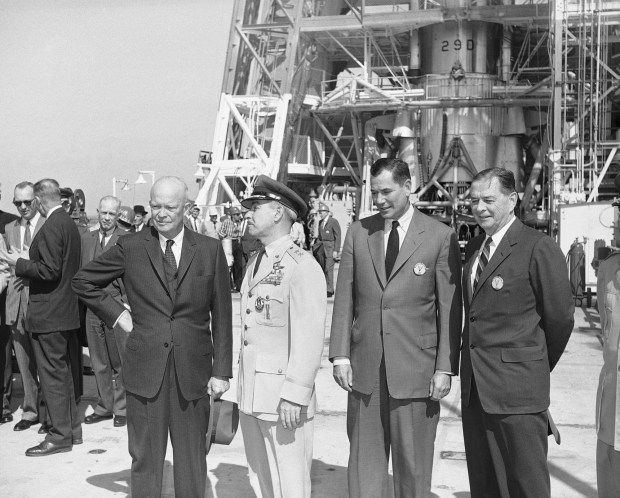 President Dwight Eisenhower is accompanied by two Defense Department chiefs as he tours the Cape Canaveral Missile Test Center in Cape Canaveral, Fla., Feb. 10, 1960. Standing before a gantry housing an Atlas intercontinental missile are, left to right: Eisenhower; Maj. Gen. Donald N. Yates, commandant of the missile center; Defense Secretary Thomas S. Gates, Jr.; and Air Force Secretary William H. Douglas. (AP Photo)
San Diego played an essential role in the early days of the Cold War and the space race when Convair (later run by General Dynamics and Lockheed Martin Corp.) successfully produced the Atlas intercontinental ballistic missile in the late 1950s. Rather than war, it was ultimately used as a vehicle for space missions, launching satellites, test vehicles, planetary probes and people into space. The San Diego Air & Space Museum, which holds a collection of records, photos and films from the Atlas project, referred to it as “one of America’s air and space ‘giants.’”
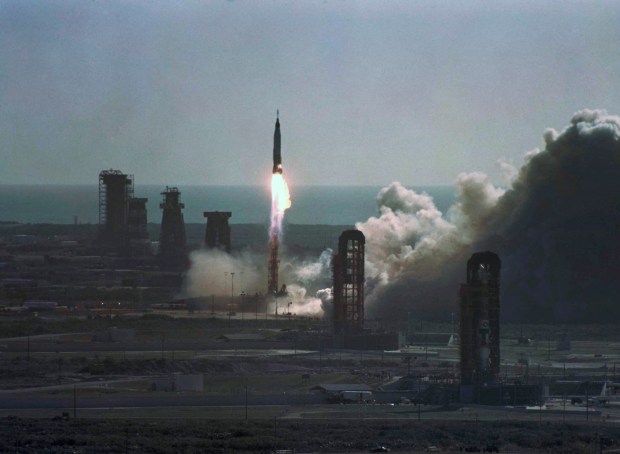 Astronaut John Glenn, the Friendship 7 Mercury Capsule is shown being launched from Cape Canavarel, Fla. on Feb. 20, 1962. (AP Photo)
Convair production and test sites for the Atlas program included Navy-leased property in Point Loma, Sycamore Canyon at a former Marine Corps base known as Camp Elliott, Edwards Air Force Base in the Mojave desert and the flight test center at Cape Canaveral in Florida. Atlas was also used as part of the rocket that took Friendship 7 Mercury and John Glenn to space to orbit the Earth in 1962.
Home-grown astronauts
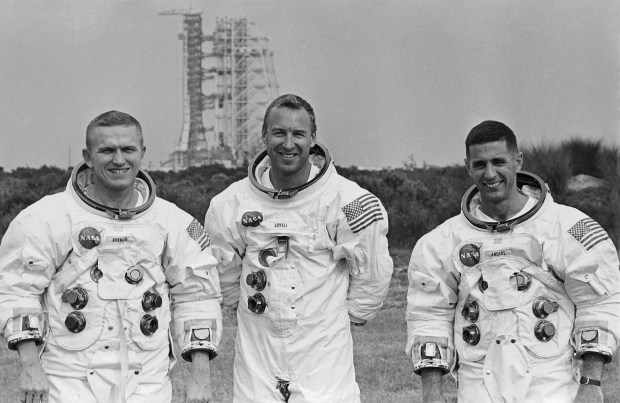 Apollo 8 astronauts Frank Borman, James A. Lovell Jr., and William A. Anders (l to r) in front of the Saturn V rocket in Cape Kennedy, Fla., Oct. 22, 1968. (AP Photo)
San Diego County has educated a range of participants in space programs over the years, but one of its most unique facts is that one of its high schools, Grossmont High, has contributed three astronauts.
William “Bill” Anders: An honorary 1951 graduate, Anders was a member of the Apollo 8 mission, which was the first manned flight to orbit the moon. He is also famous for taking the “Earthrise” photo.
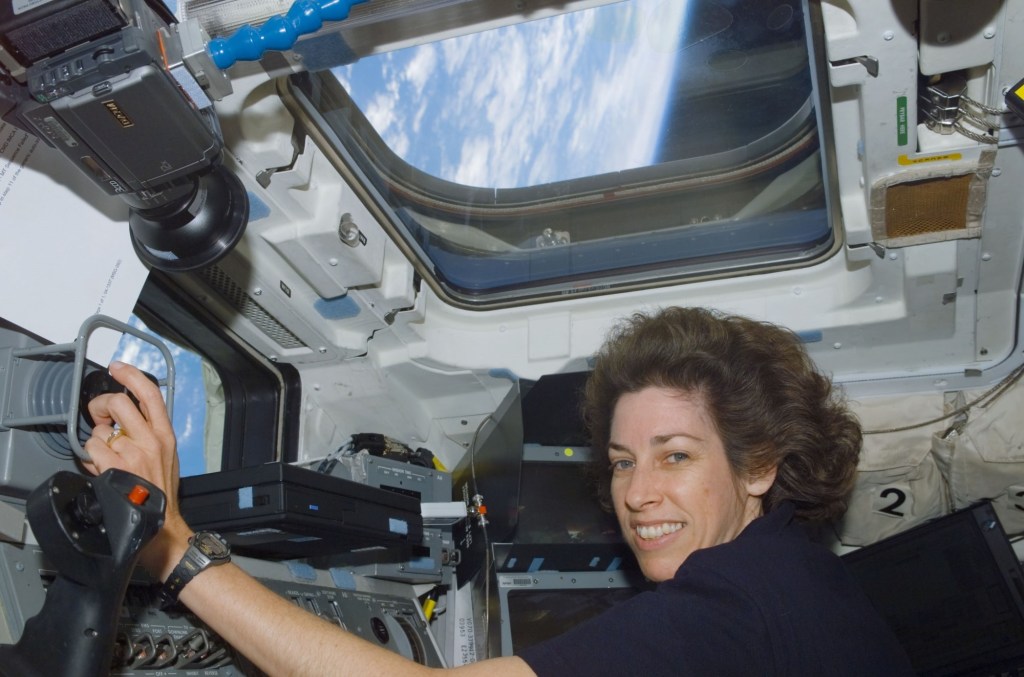
Ellen Ochoa: A 1975 graduate, Ochoa can claim the title of first Latina in space. She went on to direct the Johnson Space Center, received the Presidential Medal of Freedom and has a building named after her at San Diego State University, where she was a 1980 graduate.
Frederick “Rick” Sturckow: A 1978 graduate, Sturckow served as a pilot and crew commander on multiple shuttle missions to the International Space Station.
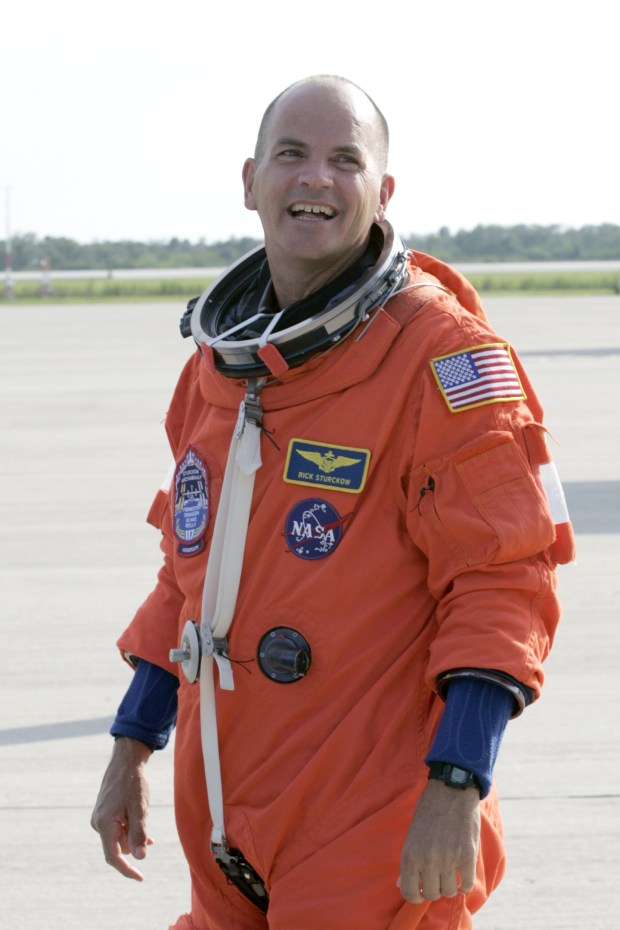 Space Shuttle Atlantis Commander Rick Sturckow is all smiles as he prepares to practice landing approaches to the landing facility aboard a shuttle training aircraft at the Kennedy Space Center in Cape Canaveral, Fla., Tuesday, June 5, 2007. (AP Photo/Terry Renna )
More San Diego astronauts
William McCool: “Willie,” as people called him, was born in San Diego. McCool went aloft in the shuttle Columbia in early 2003. He died a few days later when Columbia disintegrated while re-entering the atmosphere.
James Newman: The La Jolla High School graduate, who considers San Diego his hometown, flew four shuttle missions and performed six spacewalks. Newman worked as a professor and administrator at Naval Postgraduate School in Monterey until retiring in 2025.
Michael J. McCulley: A San Diego native, but one who considers Livingston, Tenn., his hometown, was a pilot on the shuttle Atlantis in October 1989.
Stanley G. Love: Love is a San Diego native, but considers Eugene, Ore., to be his hometown. He served as a mission specialist on a 2008 trip to the International Space Station. He currently works as the deputy chief of the Astronaut Office’s Rapid Prototyping Laboratory and is listed among NASA’s active astronauts.
Military connections
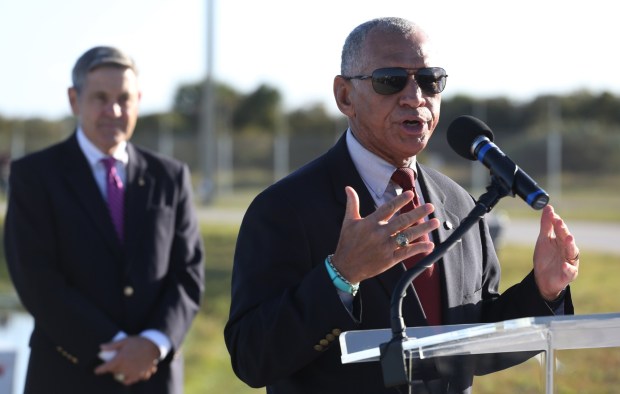 NASA administrator Charles F. Bolden Jr. speaks at a news conference at the Cape Canaveral Air Force Station on Dec. 3, 2014, in Cape Canaveral. (AP Photo/Marta Lavandier)
San Diego’s military contributions to space exploration are numerous, especially considering how many NASA personnel come from Navy and Marine Corps service. That includes Glover, on the Artemis II mission, who spent about a year at Marine Corps Air Station Miramar as a member of VMFAT-101, an F/A-18 Hornet training squadron.
Another decorated connection is Charles F. Bolden Jr., a shuttle astronaut who went on to lead Camp Pendleton’s 1st Marine Expeditionary Force, then commanding general of the 3rd Marine Aircraft Wing, based at Miramar. Bolden retired from the Marines in 2004. Five years later, President Barack Obama nominated him for the position of NASA administrator, the first African American to hold the position.
Sally Ride makes San Diego her home
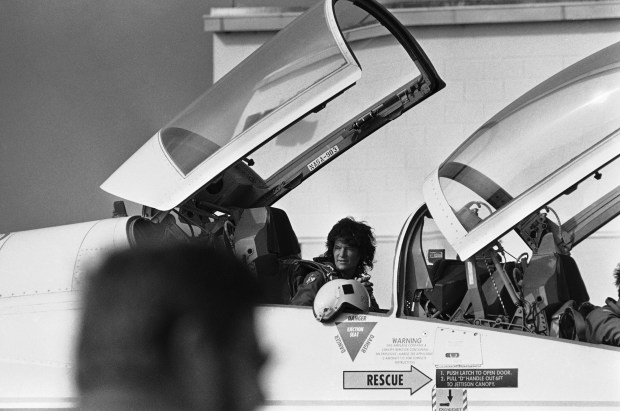 Astronaut Sally Ride sits in her jet at Kennedy Space Center on Wednesday, June 16, 1983, in Florida, just after she and four other crew members arrived to prepare for a launch of the space shuttle Challenger. (AP Photo)
The first American woman to fly in space became NASA’s best-known shuttle astronaut and later developed a respected San Diego company that promotes science education, especially among young girls. Ride flew two shuttle missions, traveling aboard Challenger in 1983 and 1984. She eventually left NASA, joining the physics department at UC San Diego in 1989. Ride also became director of the UCSD California Space Institute. She retired from the university in 2007 and died in La Jolla in 2012.
Astronauts and NASA staff educated in San Diego
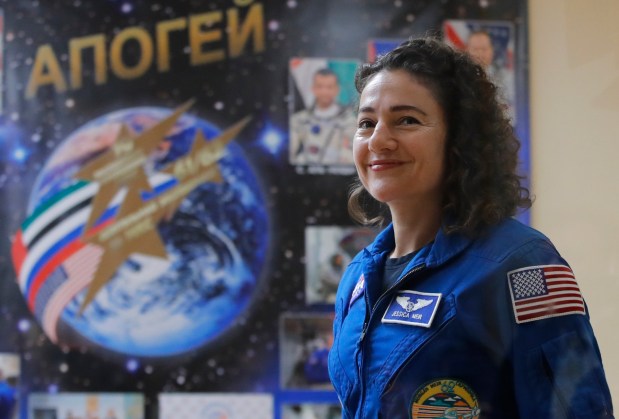 U.S. astronaut Jessica Meir, a member of the main crew to the International Space Station (ISS), attends a news conference in Russian-leased Baikonur cosmodrome in Kazakhstan on Sept. 24, 2019. (AP Photo/Dmitri Lovetsky)
Universities located in San Diego County have educated many scientists, engineers and doctors who went on to work for NASA, including one who is now in space. Jessica Meir launched with SpaceX Crew-12 on a mission to the International Space Station on Feb. 13, 2026. She holds a doctorate in Marine Biology from Scripps Institution of Oceanography. Before her current mission, she served as flight engineer on the International Space Station for Expedition 61 and 62, participating in the first all-female spacewalks.
These are some of the other notable local graduates.
Kathleen “Kate” Rubins: Rubins, who retired from NASA in 2025, was the first person to sequence DNA in space. She has a bachelor’s degree in molecular biology from UC San Diego.
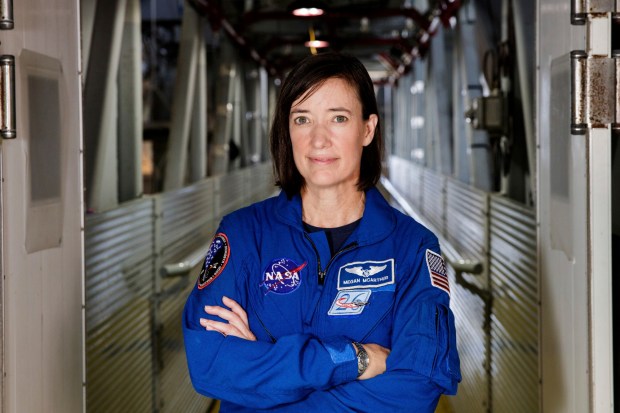 In this Tuesday, June 25, 2019 photo made available by NASA, astronaut K. Megan McArthur poses for a portrait at the Kennedy Space Center in Florida. McArthur was a member of the crew for SpaceX’s third astronaut launch to the International Space Station on Friday, April 23, 2021. (Joel Kowsky/NASA via AP)
K. Megan McArthur: McArthur, who also retired from NASA in 2025, was the first woman to pilot a SpaceX Dragon spacecraft. She has a doctorate in oceanography from the Scripps Institution of Oceanography.
Deniz Burnham: Burnham is an active astronaut who was selected in 2021. She earned a bachelor’s degree in chemical engineering from the UC San Diego.
Matthew Dominick: Dominick is an active astronaut who was selected in 2017. He holds a bachelor’s of science in electrical engineering from the University of San Diego. He recently served on the International Space Station as commander of NASA’s Space X Crew-8 mission, which launched in 2024.
Jonny Kim: Kim is an active astronaut who was selected in 2017. He holds a bachelor’s degree in mathematics from University of San Diego. Last year, he spent time on the International Space Station Expedition 72/73 flight engineer. He is also a U.S. Navy lieutenant commander, with a previous assignment as a special warfare operator with SEAL Team 3 in San Diego.
Scripps Oceanography director has NASA history
Meenakshi Wadhwa, director of Scripps Institution of Oceanography, is a planetary scientist who contributed to a number of NASA missions before joining UC San Diego in 2025. She was a co-investigator on the Genesis mission and a collaborator on the Mars Science Laboratory mission. Other titles held for NASA include chair of the science committee of the NASA Advisory Council and of the NASA Curation and Analysis Planning Team for Extraterrestrial Materials (CAPTEM) analysis group.
Splash downs off San Diego from SpaceX
This will not be the first time a spacecraft has landed off the coast of San Diego. In January of this year, SpaceX guided a capsule returning Crew 11 from the International Space Station to a safe landing Jan. 15. Last year, it also splash landed Crew 10 off the coast Aug. 9.