
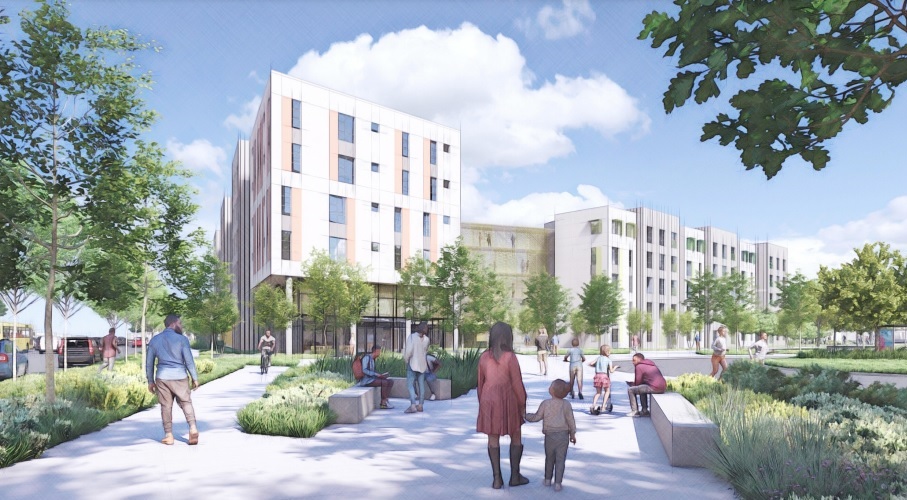
In a city where the median home price is close to $1.5 million and nearly a quarter of renters routinely spend more than half their income on housing, a new $8.4 million loan to MidPen Housing filled the last gap in financing for a fully-affordable development expected to break ground near the Capitol light rail station by November.
The San Jose City Council on Tuesday unanimously approved the loan, clearing what is expected to be the final funding hurdle before construction can begin.
Planned for a parking lot at West Capitol Expressway and Narvaez Avenue adjacent to the Capitol VTA station, the three-building development will include 201 income-restricted units and two manager’s units. The Valley Transportation Authority began planning for the 10.1-acre site around 2021. MidPen Housing was selected as the developer in March 2022.
Rents will be capped for households earning between 30% and 60% of the area median income — roughly $45,200 to $87,840 annually for a family — a federal benchmark used to determine affordability.
Monthly rents will range from $1,098 for a one-bedroom unit to $3,045 for a three-bedroom unit. While the project includes 31 studio apartments, they are reserved for households with slightly higher qualifying incomes, with those rents starting at approximately $1,366.
The effort is one of at least nine active transit-oriented development projects across the South Bay, collectively seeking to build up to 2,500 new homes — including more than 600 affordable units — near stations such as Berryessa, Tamien and Winchester. According to the VTA, at least 28 sites across Santa Clara County have been designated for transit-oriented development around light rail, Caltrain and BART stations.
The Tamien affordable housing project opened earlier this year, while construction on a 700-unit, mixed-income development by the Berryessa BART station launched last year.
The $169 million Capitol project is funded through a mix of public and private sources.
The city said the loan aligns with its priorities to increase housing stock across all income levels and provide gap financing as the final funding source.
The loan carries simple interest of 4% and will be repaid from the project’s annual net cash flow over a 55-year term. The funds are drawn from the city’s housing project reserve.
The approval comes as San Jose — consistently ranked among the most expensive cities in the country — scrambles to meet housing targets.
The city has the second highest housing production goals in the region behind San Francisco and must permit and zone more than 60,000 units by 2031. Across the Bay Area, 110 local governments must collectively plan for more than 440,000 new homes to meet state housing goals.
Earlier this week, city officials broke ground on a 109-unit office-to-housing conversion at the Bank of Italy building in downtown San Jose. That project contains no affordable units, which drew questions about the city’s approach.
Mayor Matt Mahan said the goal was to increase housing supply by any means — both market-rate and affordable — arguing it was not feasible to require below-market-rate units on every project without dedicated funding.
The Capitol project, by contrast, is fully affordable and has secured funding sources.
“I am really excited to see this project move forward,” said Councilmember Pamela Campos, who represents the district. “Particularly the emphasis on affordability for those in our community who we know are in dire need of spaces like this.“