
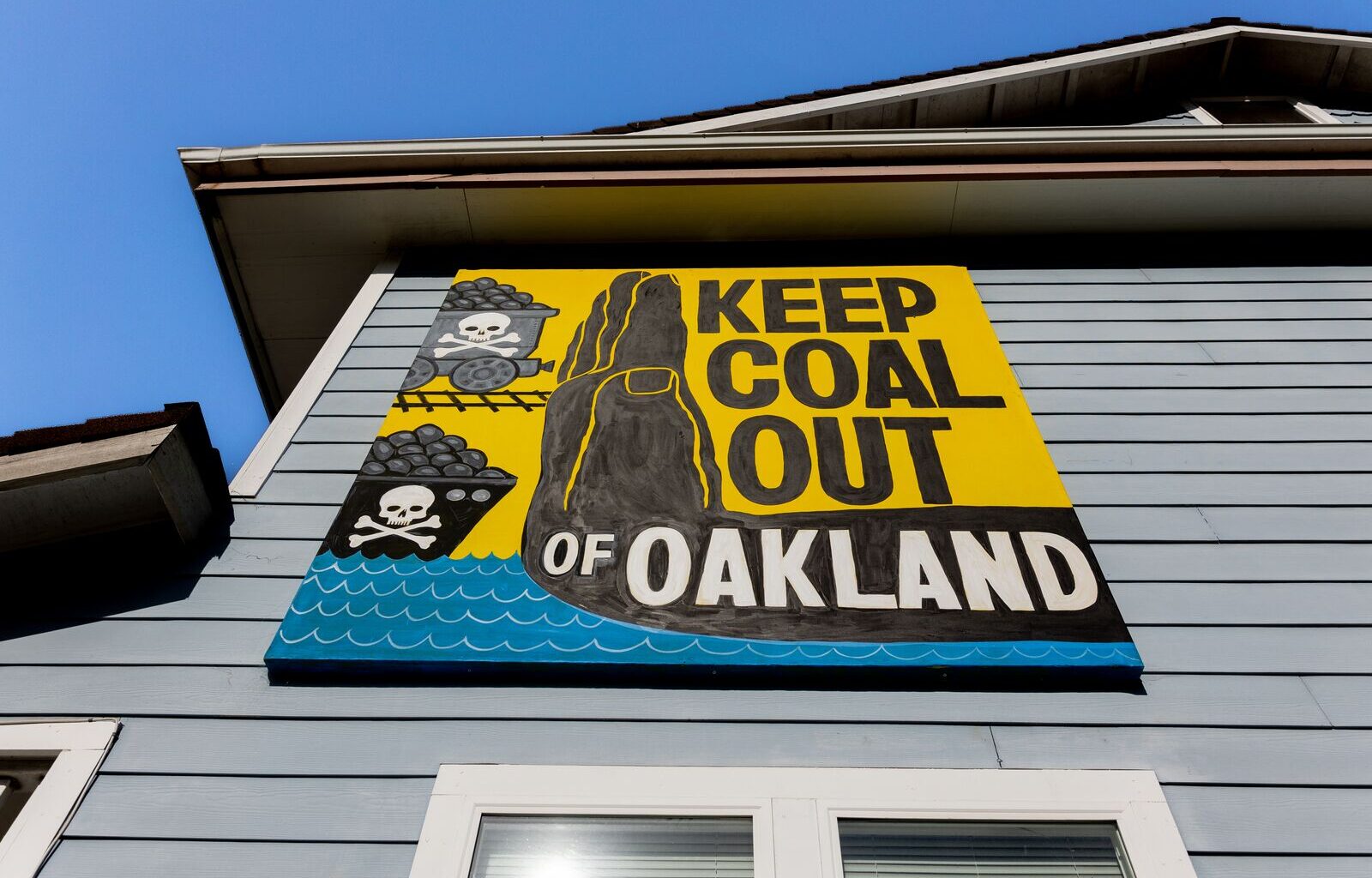
10 years ago, a coalition of Oaklanders launched a campaign to stop a coal export terminal from being built in West Oakland. They won the political battle, convincing the city to ban the handling and storage of coal. But after the developers prevailed in a series of courtroom fights, shredding the city’s law and excoriating Oakland for stalling the terminal in a bureaucratic morass, the project now looks poised to move ahead.
However, the activists haven’t given up.
Leaders of the campaign are girding themselves for a new battle, one that will be waged outside the courtroom.
Ted Franklin, an organizer with the group No Coal in Oakland, outlined their new plan inside the West Side Missionary Baptist Church last Wednesday. Speaking over the din of passing BART trains, and just a few blocks from the freight tracks coal trains could one day traverse, Franklin explained that his group is petitioning the Bay Area Air District to impose strict regulations that would make it more difficult — ideally impossible — for the terminal to receive and handle coal across.
Franklin’s organization is also rebuilding the “grand coalition” of environmental groups, faith leaders, labor unions, and residents who fought to stop the coal terminal a decade ago.
He pointed out that 40 Bay Area organizations and over 1,000 East Bay residents have signed an open letter to the air board, urging the powerful regulator to review the developers’ permit applications with the “utmost care.”
Between securing stricter air regulations and rallying community opposition, anti-coal activists hope to drive potential investors away from the project.
“The developers want everyone to believe that a coal terminal in West Oakland is a done deal,” Franklin said. “We stand before you today to say that it’s anything but a done deal.”
No Coal’s letter, which was shared with the air board last week, urges regulators to prevent increased fine particulate matter emissions from transported coal. The group cites a peer-reviewed study published in 2023 that examined emissions from uncovered coal cars traveling between mines in Utah to the Levin Terminal in Richmond. The study found “significant increases” in tiny air pollution particles known as PM2.5 due to the trains, representing a “significant public health hazard.”
No Coal in Oakland is asking the air board to hold the terminal developer, Oakland Bulk and Oversized Terminal, accountable for promises it made years ago that helped persuade a federal judge to set aside Oakland’s coal ban. Franklin said this should include forcing OBOT to transport coal in covered cars and to adopt practices that will mitigate public health risks from coal dust. According to Franklin, covered coal cars do not appear to exist in the U.S. or anywhere else in the world.
Margaret Gordon, the co-founder and former head of the West Oakland Environmental Indicators Project, showed the crowd in the church an inhaler that she said cost her $194. Asthma has been linked to various environmental pollutants, including particulate matter from coal dust. Gordon recalled visiting a school near the church many years ago, and a nurse pulling out a shoe box full of inhalers for students.
“If we’re not going to have mitigations, they should not get a permit, a license, anything to operate — nothing,” Gordon said.
 West Oakland community leader and environmental advocate Margaret Gordonis among those vowing to continue the fight to stop coal shipments through the city. She spoke at the West Side Missionary Baptist Church on April 1, 2026. Credit: Eli Wolfe/The Oaklandside.
In December, the city granted OBOT permits to start building fences along a road near the former Oakland Army Base, marking the first approvals related to the project since 2018, according to the East Bay Times. But developers are still a long way off from constructing a terminal.
Phil Tagami, one of OBOT’s principals, did not respond to an interview request for this story.
Veronica Eady, executive director of WOEIP, said the air district has invested a great deal in improving the health of West Oakland. She cited Assembly Bill 617, a state bill approved in 2017 that required local air regulators to implement community monitoring programs to reduce air pollution.
“Why on earth would they permit this facility at the Port of Oakland?” Eady asked. “This project can’t break ground without multiple permits from the air district, so this is our opportunity.”
The legal battle to keep coal out of Oakland failed
 A coal train parked on side tracks in Albany on Feb. 2, 2025. Environmentalists say they want to hold Oakland’s coal terminal developers to their promise to use covered train cars. Credit: Darwin BondGraham/The Oaklandside
The Oakland coal war ignited in 2015, when media outlets reported that Utah officials were planning to invest in an export terminal proposed by Tagami and his partners in order to ship tons of coal to overseas markets. The location of the terminal was to be in West Oakland, on the former Oakland Army Base.
Public opinion was decisively against the project. The possibility that the city, which years earlier had picked Tagami’s company to redevelop huge swaths of public land on the former Army Base, would be helping build one of the biggest coal export terminals on the West Coast upset many. Then-Oakland Mayor Libby Schaaf demanded that Tagami drop his pursuit of fossil fuels.
In 2016, the Oakland City Council banned the handling and storage of coal within the city. In response, the developers sued, arguing that Oakland had breached its contract with OBOT.
A federal judge agreed with Tagami’s company and, in 2018, ruled that Oakland’s coal ban didn’t apply to the project. But while the federal case was still pending, Oakland cut OBOT’s lease for the land near the port, arguing that Tagami’s team had failed to meet construction milestones.
This prompted another lawsuit from OBOT in 2020, with the developer accusing Oakland of creating construction delays. In 2023, a state judge ruled in favor of the developers after she found that the city had improperly terminated its contracts with OBOT. The city appealed, but lost again. Last September, Oakland hit the end of its legal challenges when the state supreme court declined to review the ruling.
The city still faces litigation with Insight Terminal Solutions, a company that wants to operate the terminal. Last October, a federal bankruptcy judge in Kentucky found that Oakland had interfered with the developer’s efforts to build the terminal, driving Insight into bankruptcy. This decision put the city on the hook for potentially hundreds of millions of dollars in damages. But Oakland avoided this disaster after a different federal judge reviewed the case and determined that the bankruptcy court overstepped its authority.
In a couple of weeks, Kentucky Judge Benjamin Beaton will be hearing arguments from Insight and the city to determine the fate of this case.
Having emerged victorious from the years of court disputes, Tagami, when asked about his plans last September, made it clear the terminal project will proceed as originally proposed. This would include thousands of so-called bulk commodities passing through the terminal upon completion. In interviews with papers outside California, Tagami has estimated that the first cargo ships may start leaving the terminal in 2028.
A different coalition
Even as Oakland activists organize against the terminal project, a coalition of officials and fossil fuel executives in the Mountain West is preparing for the next steps to ship coal through Oakland to markets in Asia.
At a December appropriations meeting of Wyoming legislators that was reported on by the Cowboy State Daily, State Senator Mike Gierau said that markets in Japan and Taiwan have an interest in importing Wyoming coal, “which could be shipped out of the Port of Oakland, possibly.”
Randall Luthi, a policy advisor to Mark Gordon, Wyoming’s governor, told representatives at the same meeting, “We are meeting with the Oakland operators on a monthly basis as we talk about how to get coal to Oakland, and how much Wyoming coal and Utah coal.”
Gordon’s chief of staff, Drew Perkins, shared at the same meeting that Wyoming, Utah, and Montana are all potentially interested in exploring how to ship coal from the West Coast.
“That coal port is now going to be eligible to ship coal again,” he said.
“*” indicates required fields