
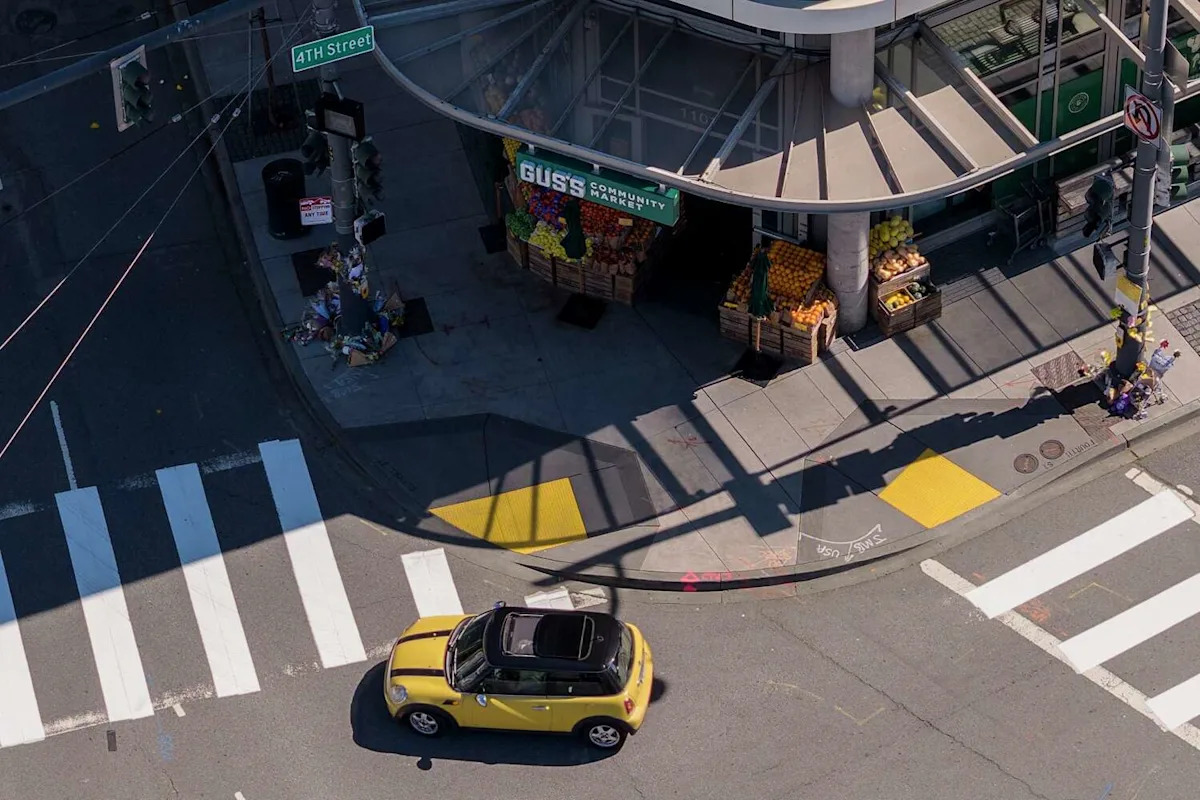
A lamppost in San Francisco’s Mission Bay neighborhood has become a makeshift shrine, decked with flower bouquets, a baby stroller and handwritten notes for the toddler who died there.
Steps away, on the busy artery of Fourth Street, city officials just installed a new piece of infrastructure: Plastic posts to protect the bike lane. Cyclists who zip up the road now have a buffer to separate them from car traffic. At the intersection of Fourth and Channel streets, crews repainted thick white stripes in the crosswalks.
Both of these safety features came too late and might not have prevented the Feb. 27 crash, in which a driver ran a red light and struck the two-year-old and her mother. The pair were crossing eastward when an SUV barreled in from the left-hand turn lane, killing the girl and leaving the woman severely injured. It was 9 p.m. on a Friday night. Residents said they heard her screams echo through their apartment windows.
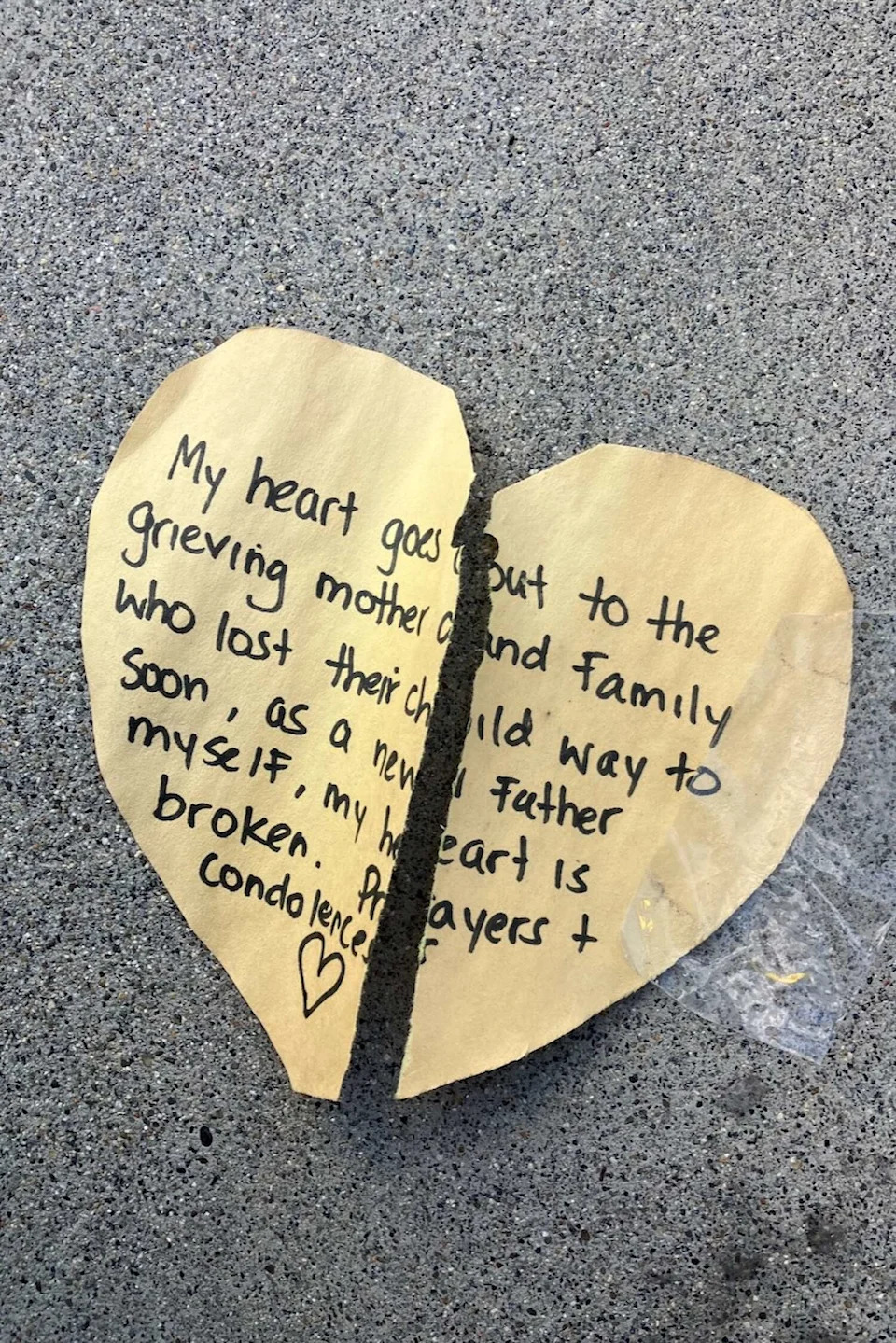
A broken heart memorial is left at the makeshift shrine for a toddler struck and killed in San Francisco’s Mission Bay neighborhood earlier this year. (Rachel Swan / S.F. Chronicle)
Police arrested the driver, Merih Fssha Solomon of Walnut Creek, on suspicion of vehicular manslaughter. Advocates, meanwhile, zeroed in on the street’s design. They noted the zig-zagging turns, the wide space for automobiles, and the absence of key technology like red-light cameras and traffic signals timed to give pedestrians a head start. Last month, the group Safe Street Rebel placed flexible stakes along the bike lane, mounting pressure on the city to respond.
Staff at the San Francisco Municipal Transportation Agency have since replaced those stakes with the new posts, creating a permanent “separated bikeway.” They promise other changes are afoot, many of which they will lay out during a town hall meeting at the Southern District Police Station on Thursday, hosted by Supervisor Matt Dorsey
Residents want the city to move faster.
“They wait for someone to get hurt,” a woman named Susan Holder insisted. She knelt by the lamppost memorial on Wednesday morning, arranging flowers and a pin wheel in the stroller. Glancing toward the bike lane posts, Holder shook her head.
“Those are all new,” she muttered.
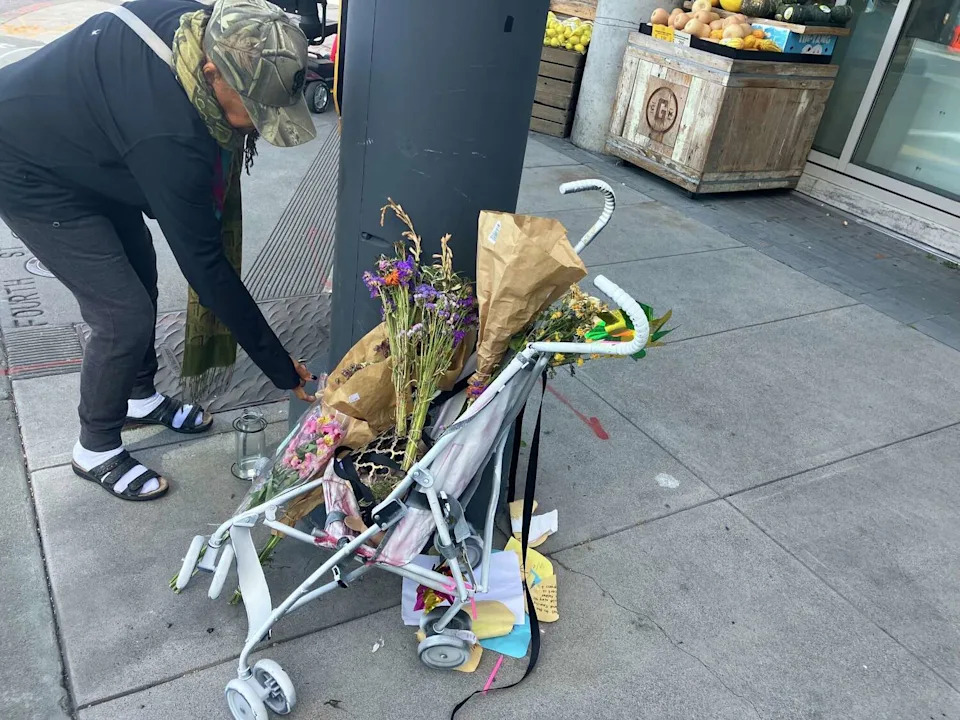
Susan Holder rearranges items at the makeshift shrine for a toddler struck and killed in San Francisco’s Mission Bay neighborhood earlier this year. (Rachel Swan / S.F. Chronicle)
But SFMTA administrators say they were aware of issues in the rapidly-developing Mission Bay neighborhood long before the February collision. Engineers had already begun “treatments” at Fourth and Channel streets, widening the traffic signals to make the lights brighter and painting stripes to show cars where to stop.
The day after the collision, SFMTA’s “rapid response team” swarmed in to identify other urgent needs. They observed the fading crosswalk lines and repainted them two days later. Additionally, the agency found a broken street light and flagged it to the Public Utilities Commission for repair.
Viktoriya Wise, director of SFMTA’s streets division, said the agency is planning additional upgrades further into Mission Bay. These include new reflective signs and a road diet for Channel Street, narrowing it from two lanes to one in each direction. Workers will also place a rapid flashing beacon in the crosswalk at Fourth and Long Bridge streets, a block south of the crash site. This safety device comprises LED lights that blink when a pedestrian is crossing.
“Mission Bay is a changing neighborhood,” Wise said, referring to the recent explosion of tech campuses, restaurants, sports venues and multi-family buildings in what used to be a sparse, industrial area. “As the neighborhood changes,” she added, “SFMTA is watching.”
People in Mission Bay are watching SFMTA’s work, as well.
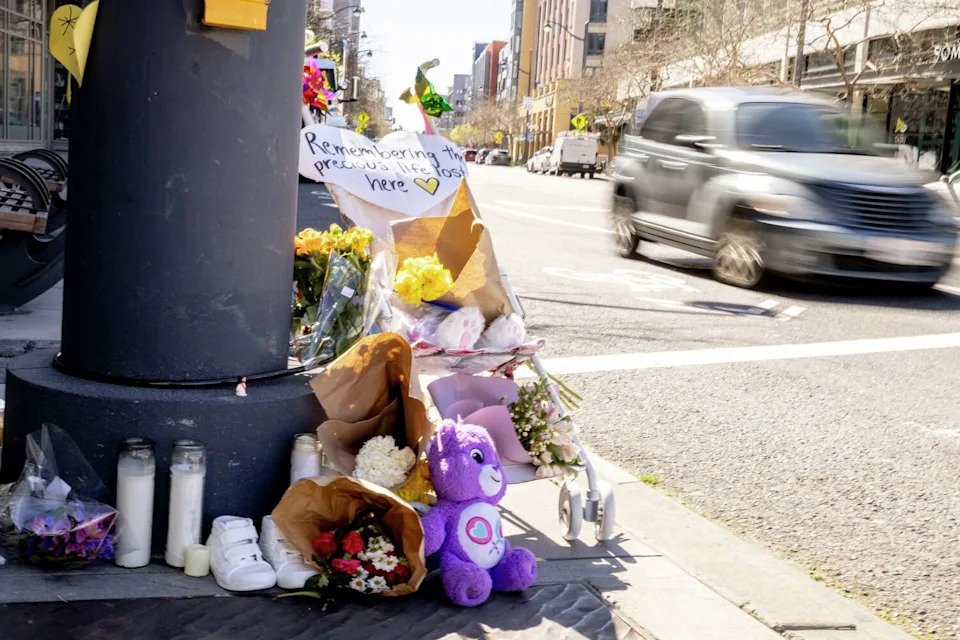
A memorial sat in March at the corner of Fourth and Channel street where a 2-year-old was fatally struck by a vehicle while crossing the intersection with a parent in February. (Stephen Lam/S.F. Chronicle)
“I saw them painting the crosswalk,” said Priyam Kulkarni, whose apartment overlooks Fourth and Channel. She heard the mother’s wails, and commotion of emergency responders, on the night the toddler was killed. The memory haunts her.
Despite all of SFMTA’s efforts, Fourth and Channel streets may always be a challenging location. It’s a pentagonal node where traffic moves in various directions, forcing motorists and pedestrians to jostle among bikes, scooters and Muni trains. On Wednesday morning, people hastily scanned for traffic and then crossed against the light. One man jogged diagonally across the street. A delivery worker flipped an illegal U-Turn and rolled his moped onto the sidewalk, leaving the motor running as he entered Gus’ Market.
“You have the Muni train, multiple lanes of traffic, everything set at a weird angle,” said Robin Pam, executive director of Streets for All San Francisco. “The streets in Mission Bay were designed in the ’90s, when we thought about street design in a totally different way. And they haven’t really been touched since then. That’s the real, fundamental issue here.”
She praised SFMTA for the improvements thus far.
“They are probably working as fast as she can,” Pam said. “The government moves at the speed of government. If they could move faster they probably would. Unfortunately, the damage has already been done.”
This article originally published at After a toddler’s death, S.F. rushes to fix a dangerous Mission Bay intersection.