
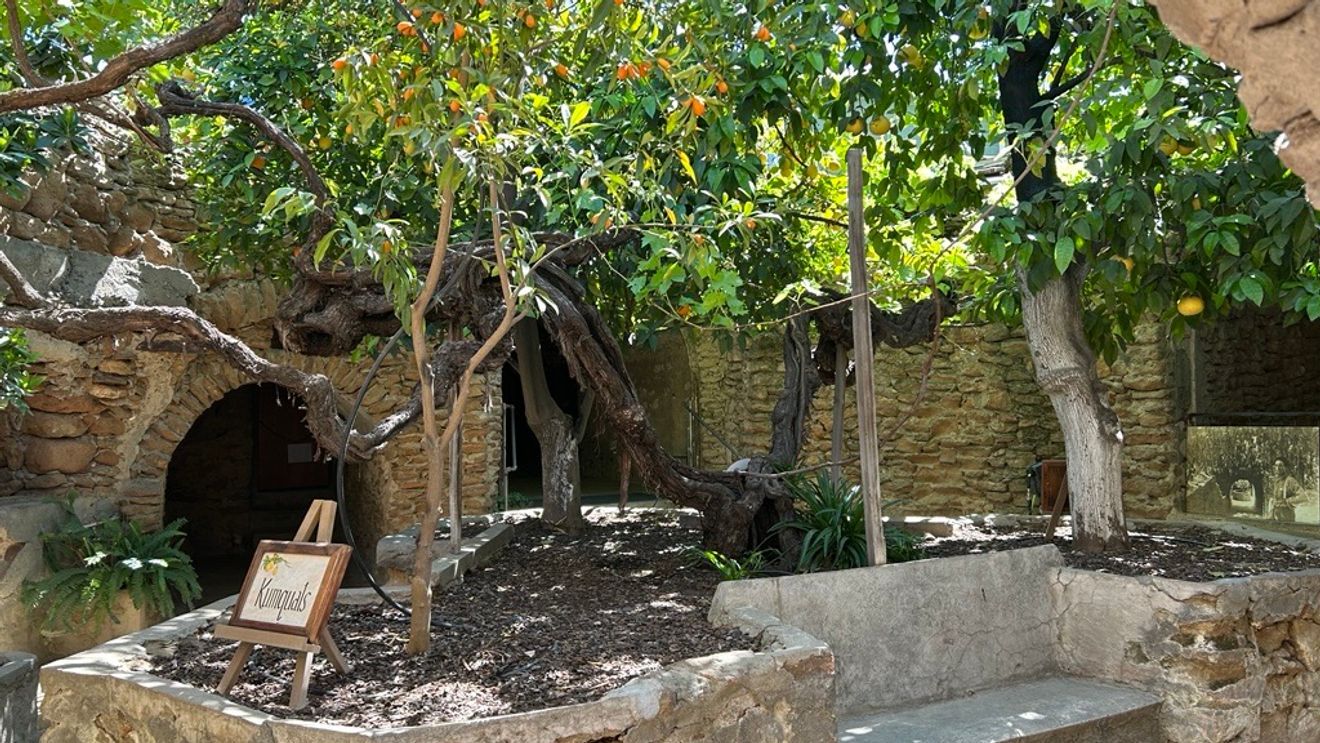
As America approaches its 250th anniversary, stories of perseverance, innovation, and the pursuit of opportunity are being highlighted across the country. In Central California, one landmark stands as a powerful example of that spirit: the Forestiere Underground Gardens.
Beneath the buzzing cars along Shaw Avenue in southwest Fresno lies a hidden world, carved entirely by hand. Long before Highway 99 cut through the region, this underground network began as one man’s response to hardship and ultimately became a historic treasure.
“It is a hidden gem a unique piece of American and Fresno history,” said Shera Franzman, director of operations.
The gardens are the life’s work of Baldassare Forestiere, a Sicilian immigrant who arrived in the United States in 1901 with a simple goal: to grow citrus.
After purchasing land near Shaw Avenue and North Golden State Boulevard, Forestiere quickly discovered the soil was filled with hardpan — a dense layer of rock that made traditional farming nearly impossible. Combined with the intense heat of the Central Valley, the conditions threatened to end his dream before it began.
Instead, Forestiere adapted.
“Out of necessity and desperation, he decided he was going to tunnel underground to make himself a home so he could escape the summer heat,” Franzman said.
What began as a way to stay cool evolved into an expansive underground complex of rooms, passageways, and courtyards. Over the course of 40 years, Forestiere used only hand tools to excavate nearly 20 acres, reaching depths of up to 25 feet below the surface.
“He expanded he made a large underground home for himself, and he started growing his citrus trees underground,” Franzman said.
Those trees are still producing today.
“Our trees are ranging between 80 to 100 plus, and they are still producing a lot of very good fruit,” she said.
Forestiere’s vision extended beyond his own needs. He imagined the underground space as a resort where others could escape the Valley heat. The Earth’s natural insulation made that possible.
“The temperature does drop about 10 to 20 degrees from ground level and even more in areas deeper underground,” Franzman explained.
After Forestiere’s death, his brother Giuseppe helped preserve the property, ensuring part of the underground gardens would survive as development expanded around it. Today, the site is protected as a California Historical Landmark and listed on the National Register of Historic Places.
Visitors can now explore the space through guided tours, walking through Forestiere’s underground home, a private chapel, and areas he envisioned for guests.
“Visitors go on an hour-long guided tour we see his underground home, his private chapel, and areas he imagined for visitors,” Franzman said.
More than a century after Forestiere first began digging, his creation stands as a lasting symbol of resilience and ingenuity.
“It is a beautiful story of someone coming to America with a dream and facing obstacle after obstacle but making something even more beautiful out of his life,” Franzman said.
Today, the Forestiere Underground Gardens remain not just a historic site, but a powerful reminder of what can be built through determination — even in the face of adversity.