
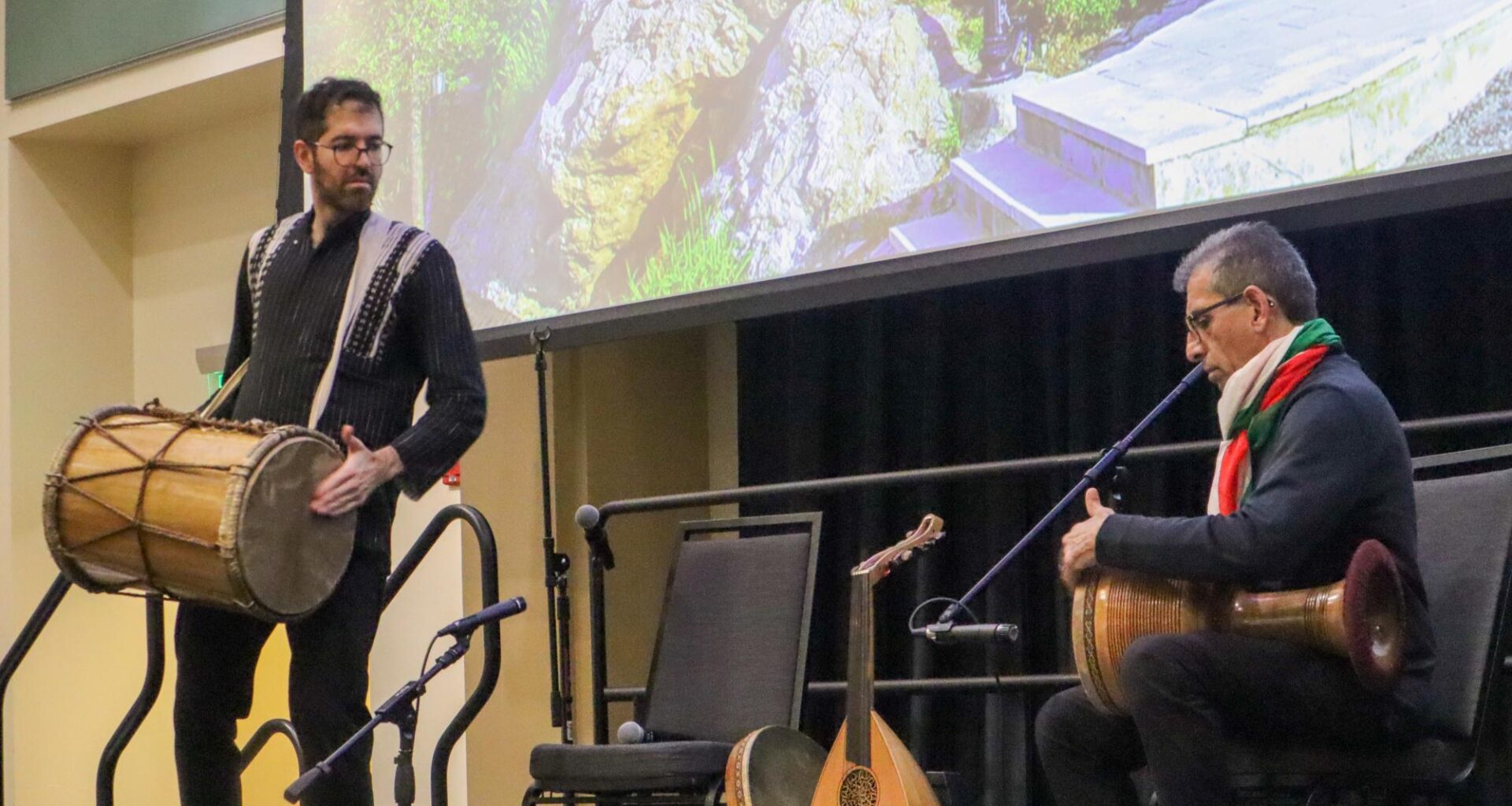
SWANA Week at Sacramento State kicked off with a cultural showcase on Monday, April 6, in the University Ballroom. The event had booths showcasing a vast array of cultural goods, fashion, art and food, all unique to the SWANA region.
SWANA refers to the Southwest Asian and North African geographical regions, a decolonialized term for the more commonly referred to Middle East. SWANA focuses more on the geography rather than on Western perspectives.
During the showcase, community members occupied the stage with musical and poetic performances.
Alumnus Nariman Assadi performed traditional Iranian music from all over Iran, such as the Khorasan and Shiraz regions. Assadi used traditional instruments like the daf, dammam and oud.
The Daf is an ancient Persian frame drum used commonly in folk and classical music. The Dammam is a double-headed cylinder drum used in Iraq and Iran for religious ceremonies. The oud is a fretless string instrument; the Iranian version is smaller, and has a long, rich history within the culture.
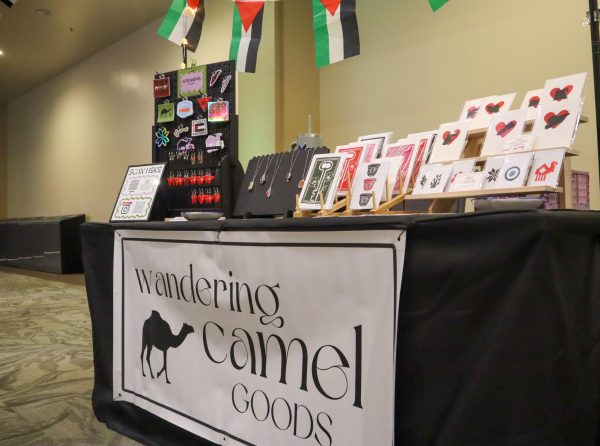 Decorated with flags, necklaces made from Palestinian pottery and custom-printed postcards, the Wandering Camel Goods booth awaits customers Monday, April 6, 2026. Students could purchase custom jewelry, stickers and postcards from Paige Austin, the shop owner. (Photo by Julian Panela)
Assadi is a local Iranian musician who teaches Farsi and music in the elementary school system.
“As an Iranian, we’ve also been going through this war. This Persian New Year has been in a different spirit because the people are mourning, Assadi said. “They don’t know what is going to happen. The music we play serves as a way to stand with the people for togetherness.”
Assadi expressed the importance of sharing his own culture at an event like SWANA’s “Kickoff: Cultural Showcase,” sharing moments of togetherness with other cultures and people. . In his case, he said he uses music as a tool for that freedom.
“We can use music as a powerful tool to show the work of our culture and influence people with the sound of our music, to show people they can also speak up and foster a healthier community so that everyone can talk about freedom,” Assadi said. “We have people from Palestine, Iran and other countries here. This community is very important in Sacramento.”
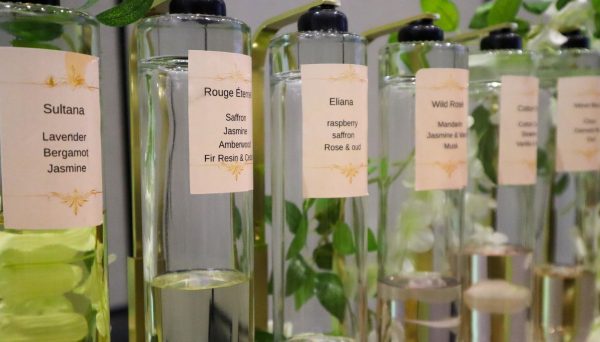 Perfumes are offered by Scented Moments Perfume and Oud Bar Monday, April 6, 2026. Souzan Morrar carefully mixes and creates her perfumes in-house, carefully selecting the top, middle and low notes to give each one its distinct smell. (Photo by Julian Panela)
Palestinian American artist Paige Austin, owner of Wandering Camel Goods, sells everything from custom pottery necklaces to postcards decorated with various countries.
“I’ve always been kind of crafty,” Austin said, “That’s what initially sparked my motivation, but I was also really passionate about being an activist for Palestine. I thought, ‘What better way to show the world the beauty of our culture than with art?’”
Austin uses broken pieces of Palestinian pottery from vendors, incorporating them into delicate metalwork. The pottery is sourced from Hebron, Palestine, with every piece of jewelry bringing a unique pattern, shape and color to the shop.
Walking around the SWANA kickoff event, students were greeted with a variety of food, music and fun activities. The event had full catering, serving iced tea, mint-infused lemonade, vegetable skewers, falafel bites, dolmas and tabbouleh salad.
Students stood around tables, enjoying their food and exploring the eight vendors scattered across the University Union Ballroom. Vendors sold everything from custom perfumes and embroidered clothing to snacks and decorative prints.
Souzan Morrar’s booth offered various perfumes and scents for sale. Her business, Scented Moments Perfume and Oud Bar, mixes its scents and perfumes in-house, acquiring the materials they need from abroad.
Besides vendor offerings, students could talk with Sana’s Henna Designs and receive custom henna.
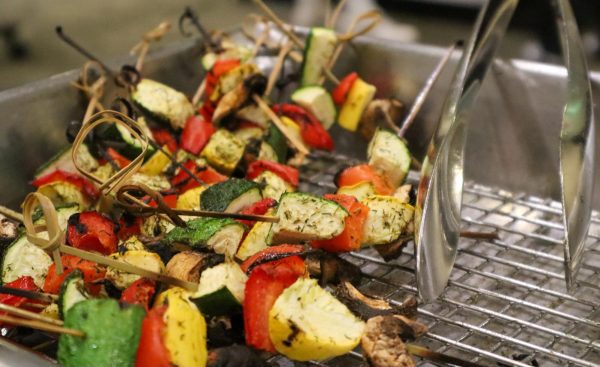 A tray of vegetable skewers is offered at the SWANA Center’s “Kickoff: Cultural Showcase” Monday, April 6, 2026. Vegetable skewers, or kebabs, are made up of various vegetables like bell peppers, zucchini and yellow squash. (Photo by Julian Panela)
Near the entrance of the University Ballroom, a small decorative olive tree stood next to the informational booth for the SWANA Center. Students were tasked with writing notes that answered two questions, then hanging them on the olive tree’s branches, symbolizing new beginnings. They reflected on “what are you rooted in?” and “what are you reaching toward?”
Aurungzaib Shahzada, a graduate student majoring in psychology, felt it is important to have events and activities like this for the SWANA community.
“Because the region has always had a background of turmoil or political unrest, having a space to appreciate the cultural qualities, food, gatherings, and the best parts of it – without having to separate it from the political aspects – is really important,” Shahzada said.
Shahzada also said having the SWANA Center as a resource on campus is good to foster a sense of community for students.
“Students felt like they didn’t have a central branch connected directly to the university,” Shahzada said. “So having a cultural center that’s an actual branch of the university is important and needed.”
RELATED: First-ever SWANA festival celebrates culture with regional treats and music
The SWANA Center is located in the Academic Resource Center (AIRC) in Room 1012. It offers a quiet space for students to hang out, study and connect with the community. The room is always stocked with coffee, tea and snacks.
“If you want to work on homework or connect with other students, as well as organize your own events, this is the place,” Shahzada said.
The SWANA Center is continuing the celebration the rest of the week, with a cafe event today from 12 to 2 p.m. and a reception on Friday, April 10 from 5:30 to 7:30 p.m.