
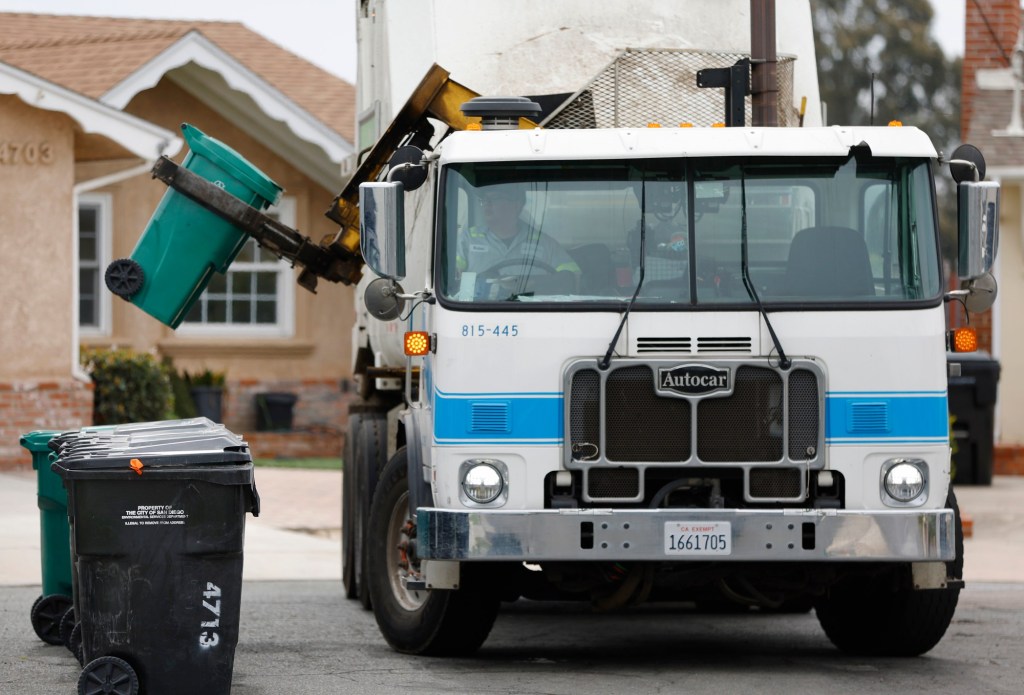
A San Diego judge has refused to dismiss a lawsuit challenging the legality of the annual trash fee put forward by Mayor Todd Gloria and approved by the City Council last year.
Following a court hearing Thursday morning, Judge Euketa Oliver upheld a preliminary ruling ordering that the legal dispute proceed to trial. The court case seeking to reverse the annual fee is scheduled to begin May 8.
“Plaintiffs have presented evidence raising substantial questions about the reliability of the city’s underlying assumptions, particularly with respect to the relationship between service demand and projected costs,” Oliver wrote in her tentative ruling.
Lawyers for the city filed what’s called a motion for summary judgment, arguing in effect that the claim was so weak it should not be permitted to move to trial.
But plaintiffs – a group of San Diego homeowners opposed to the trash fee – provided evidence to convince the judge there were enough questions about how the city calculated the fees that a trial was warranted.
If the homeowners prevail, the city’s estimated $120 million budget deficit could grow sharply. The new trash fee was placed on to the 2025-26 property tax rolls last year.
San Diego already has billed and collected some $117 million from homeowners through a special property-tax assessment imposed last year. The initial fee was levied at approximately $520 per year but is expected to climb past $700 annually over the next three years.
When Gloria and other city officials first proposed repealing what for 100-plus years had been called the People’s Ordinance – ensuring no extra charge for home trash service – they told voters the fee would be between $23 and $29 per month.
After the City Council adopted a roughly $43 monthly fee last June, with annual increases pushing the cost past $60 by 2029, a group of homeowners sued the city.
The lawsuit claims the city illegally boosted the cost of solid-waste disposal to increase the amount of money it could charge homeowners. Plaintiffs said the city’s own records show trash service cost $70 million last year but jumped to $140 million this year.
Under state law, any fees imposed by local governments must be directly attributable to the cost of providing the service.
The legal complaint asserts that the city violated the law in five separate ways.
Foremost, the lawsuit alleges that the collection fees charged by the city exceed the actual cost of delivering the service.
It also claims that revenue from the levy will be used for purposes other than trash collection; that the fee is higher than the per-parcel cost of trash service; that there was no immediate benefit to the property owners who paid; and that the charges will be spent on general government services.
The judge considered hundreds of pages of evidence and testimony from San Diego officials, homeowners and their lawyers and determined that the city had not met the burden for what is called summary adjudication in any of the five causes of actions.
Rather, the city’s argument “relies on presumptions not substantiated by the facts” and “relies on the same deficiencies discussed in relation to the second cause of action,” Oliver wrote in her ruling.
At the Thursday hearing, lawyers for both the city and homeowners briefly argued their cases.
Gabriel McWhirter, a private lawyer based in Oakland who was part of the independent legal team hired to defend the city, told the judge that the actual cost of solid waste collection over the first four years was more than $650 million.
The supplemental tax assessment imposed by San Diego is expected to generate some $590 million over four years, he said, meaning the city is still expecting to subsidize the service by some $60 million through the 2028-29 fiscal year.
“We provided detailed information about each individual cost category,” he told the judge.
But Maria Severson, one of the lawyers representing the plaintiffs, said the city was illegally moving jobs and spending categories into the solid-waste fund so the new revenue could be as high as possible.
The city position is, “Now that we are about to charge it on the backs of taxpayers, we will recommend things that will cost more money,” she said. “Think about that.”
Specifically, the lawsuit accuses the city of overestimating the number of homes that will pay for new trash fee. It also overestimated the number of people who will opt for the larger, 95-gallon trash cans and budgeted money for new jobs, new trucks and other equipment.
“If the city receives a profit by overcharging its customers, there is nothing stopping the city from thereafter pledging revenue for other obligations,” the plaintiffs’ lawyers said in a court filing. “The city shows motive, given its longstanding structural budget imbalance.”
San Diego has already raised city fees and cut back some services to tackle the major deficit it is facing for the budget year that begins July 1, including new parking fees for Balboa Park that have angered many residents and others.
The Lincoln Club of San Diego, a pro-business group run by former mayor Kevin Faulconer, announced last month that it has begun collecting signatures for a ballot measure that would suspend the trash tax for two years.
If the initiative qualifies and passes, and the homeowners’ lawsuit is successful, the city’s budget deficit would climb by millions of dollars.