
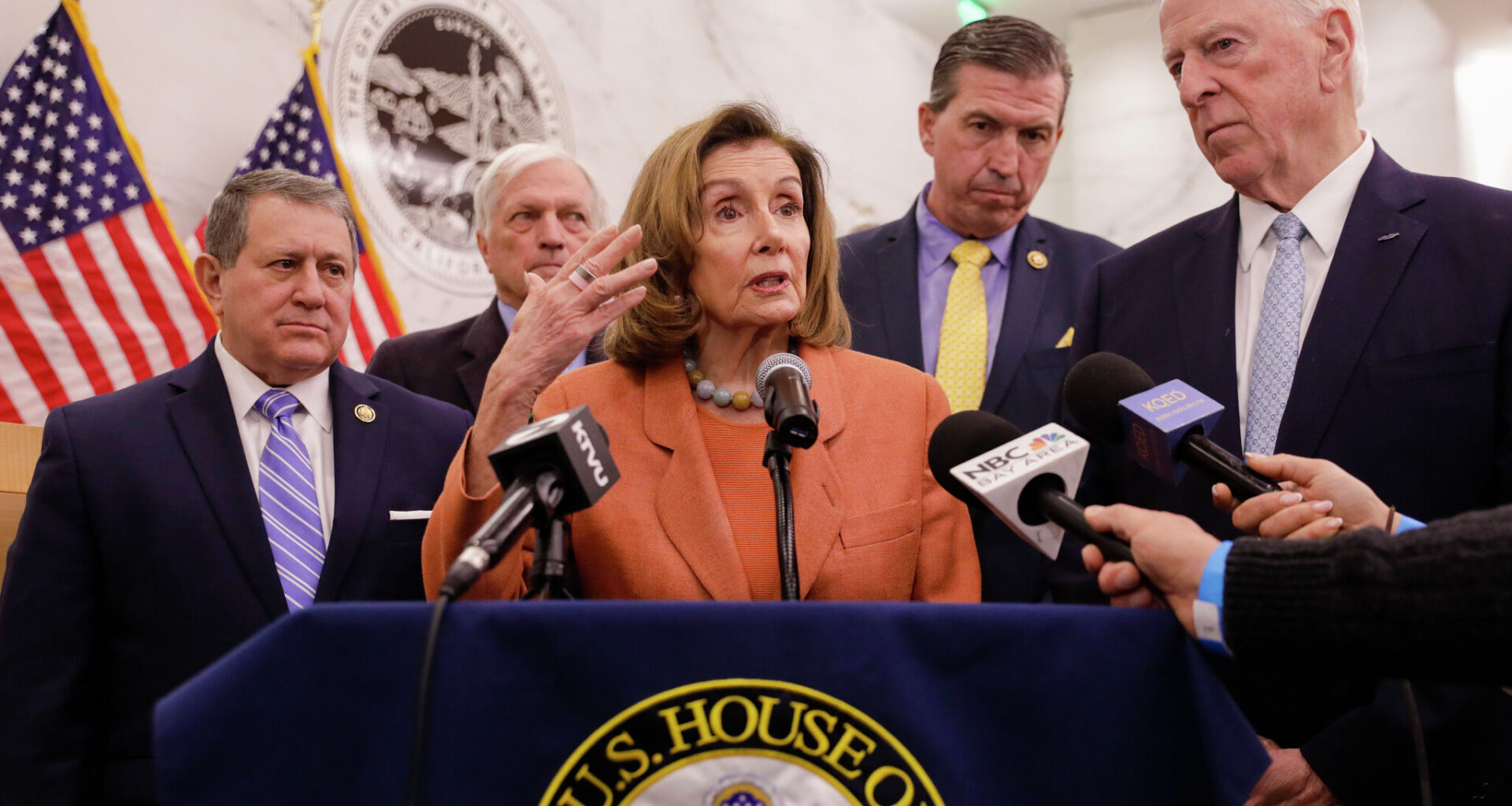
(From left) Ranking Member Joe Morelle (NY-25), Congressman Mark DeSaulnier (CA-10), Speaker Emerita Nancy Pelosi, Congressman Kevin MulIin (CA-15) and Congressman Mike Thompson (CA-04) hold a press conference following a “shadow hearing” on how House Democrats “will continue fighting to protect our democracy” with Speaker Emerita Nancy Pelosi inside the Baxter Appellate courtroom at UC Law San Francisco in San Francisco, California Thursday, April 9, 2026.
Jessica Christian/S.F. Chronicle
California House Democrats on Thursday said election officials across the country need to prepare for the possibility President Donald Trump and the federal government will intervene — or even seize ballots — during the midterm elections.
The warning came while Rep. Nancy Pelosi, D-San Francisco, and Rep. Joe Morelle, D-New York, led an unofficial House committee hearing at the UC College of the Law in San Francisco along with three other members of Congress.
Morelle, the top Democrat on the House committee that oversees federal elections, hosted a similar session in Los Angeles and another in Nevada, with more scheduled across the country. Legal and election experts on Thursday bemoaned Trump’s actions ahead of the November midterm races, especially a contested proposed federal law they say would disenfranchise voters and make it more difficult for many Americans to vote.
Article continues below this ad
“These battles right now are real,” said Rep. Kevin Mullin, D-San Mateo. “We have a president who wants to nationalize the vote … and many election officials at the local level are facing threats. We want to stand with those nonpartisan local election officials and make sure we have a free and fair election in November.”
Congressman Kevin MulIin (CA-15) attends a “shadow hearing” on how House Democrats “will continue fighting to protect our democracy” with Speaker Emerita Nancy Pelosi inside the Baxter Appellate courtroom at UC Law San Francisco in San Francisco, California Thursday, April 9, 2026.
Jessica Christian/S.F. Chronicle
The hearing came a day after the California Supreme Court ordered Riverside County Sheriff Chad Bianco to halt his investigation on hundreds of thousands of ballots he seized from the county registrar. Bianco, a Republican candidate for governor, and his office credited a conservative election denial group’s claims about last November’s statewide election as its justification for confiscating 650,000 ballots.
“One of the things that we’re going to do is remind and educate local judges and local election administrators what the laws are so that they’re not in any way intimidated,” Morelle said in response to fears over ballots being seized.
San Francisco Chronicle Logo
Make us a Preferred Source to get more of our news when you search.
Add Preferred Source
Brittany Stonesifer, a voting rights advocate with nonprofit California Common Cause, credited California’s “strong ballot chain-of-custody laws” for why legal action to halt Bianco’s investigation happened swiftly. Every state has election material custody laws, which generally ensure ballots are handled by the right people at each step, from where they’re printed to where they’re stored. She said other states worried about actions similar to Bianco’s can look to California’s laws to strengthen their own.
Article continues below this ad
Stonesifer encouraged state or county election offices worried about possible intimidation from the federal government to have thorough training and plans covering volunteer poll workers, state attorney general’s offices and registrars. Mullin said that’s work that is already happening across the country.
Rep. Joe Morelle (D-NY), the top Democrat on the Committee on House Administration, speaks alongside his colleagues during a press conference following a “shadow hearing” on how House Democrats “will continue fighting to protect our democracy” with Speaker Emerita Nancy Pelosi inside the Baxter Appellate courtroom at UC Law San Francisco in San Francisco, California Thursday, April 9, 2026.
Jessica Christian/S.F. Chronicle
Elected officials and experts Thursday also staunchly supported protecting Americans’ ability to vote by mail, which upwards of 80% of California voters do.
Last week, Trump signed a sweeping executive order that directed the U.S. Postal Service to send ballots only to voters who appear on a list created by states after an individual’s citizenship is confirmed by the Department of Homeland Security. The order is already facing multiple legal challenges and the president, by law, has a limited role over elections.
“I think it’s just an indication of how little the president actually understands any of this, but also how much he is focused on making certain that certain Americans can’t vote,” Morelle said.
Article continues below this ad
Trump has claimed, without evidence, that voting by mail is riddled with fraud. He’s attacked it for years, blaming it for why he lost the 2020 election.
Brian Renfroe, President of the National Association of Letter Carriers testifies during a “shadow hearing” on how House Democrats “will continue fighting to protect our democracy” with Speaker Emerita Nancy Pelosi inside the Baxter Appellate courtroom at UC Law San Francisco in San Francisco, California Thursday, April 9, 2026.
Jessica Christian/S.F. Chronicle
Brian Renfroe, the head of the National Association of Letter Carriers union, testified Thursday that the U.S. Postal Service isn’t even sure how it could meet the order’s requirements because it doesn’t have any such mechanisms in place. Renfroe said the Postal Service is currently complying with the order as the legal challenges go through court.
“But it is very concerning to attempt to invoke a beloved agency that has always been free of any sort of partisan political activity — that the American people trust — to do something, such as verify voter eligibility,” Renfroe said.
Experts, such as Rory Little, a constitutional law professor at UC Law in San Francisco, slammed the Trump-backed SAVE Act, or Safeguard American Voter Eligibility Act, that would require documents to prove citizenship beyond just a driver’s license or state ID.
Article continues below this ad
“The legislation should be called the Fool America Act, because it fools many Americans and fuels paranoia with foolish falsehoods,” Little said. “If enacted, it will have fooled many Americans who will soon discover they are harmed by it.”
Professor Rory Little, UC Law Cotchett Chair Emeritus and Sullivan Professor of Law sports a tie depicting the famous painting Scene at the Signing of the Constitution of the United States from 1942 on his necktie while testifying during a “shadow hearing” on how House Democrats “will continue fighting to protect our democracy” with Speaker Emerita Nancy Pelosi inside the Baxter Appellate courtroom at UC Law San Francisco in San Francisco, California Thursday, April 9, 2026.
Jessica Christian/S.F. Chronicle
Little pointed to those who have changed their names after getting married. Many women who have changed their last names following marriage might be surprised to learn the proposed law would require them to go to an election office to register in person in order to vote, he said.
Stonesifer said those who have changed their last names would need to get an updated document in order to vote — the birth certificate with a maiden name would not suffice, for example. New documents cost money.
“Like a poll tax,” Stonesifer said.
Article continues below this ad
The SAVE Act passed the House in April but faces roadblocks in the Senate, where it requires bipartisan support to pass. Democratic leaders Thursday said even if it doesn’t pass, it still symbolizes Trump’s priorities and attitude ahead of the midterms.
Brittany Stonesifer of California Democracy Project and California Common Cause testifies during a “shadow hearing” on how House Democrats “will continue fighting to protect our democracy” with Speaker Emerita Nancy Pelosi inside the Baxter Appellate courtroom at UC Law San Francisco in San Francisco, California Thursday, April 9, 2026.
Jessica Christian/S.F. Chronicle
Democrats told the hearing’s attendees, who were mostly law school students, to check their voting registration now and to vote early this election cycle so the party can take back control of the House.
Pelosi said she regularly is asked by constituents whether “there will even be an election” this November. She answers with, “of course,” but said that Democrats need to be prepared for Trump and Republican leaders to challenge the results. That’s why the so-called “shadow hearings” are crucial, leaders said. Shadow hearings like Thursday’s are unofficial hearings held by the minority party in the House to investigate topics the majority party won’t hear.
“Our biggest strength is our outside mobilization,” Pelosi said, “that people know that something is being done to protect the election and that we all have to be a part of it, whether that’s being a poll worker … or just encouraging people to vote.”