
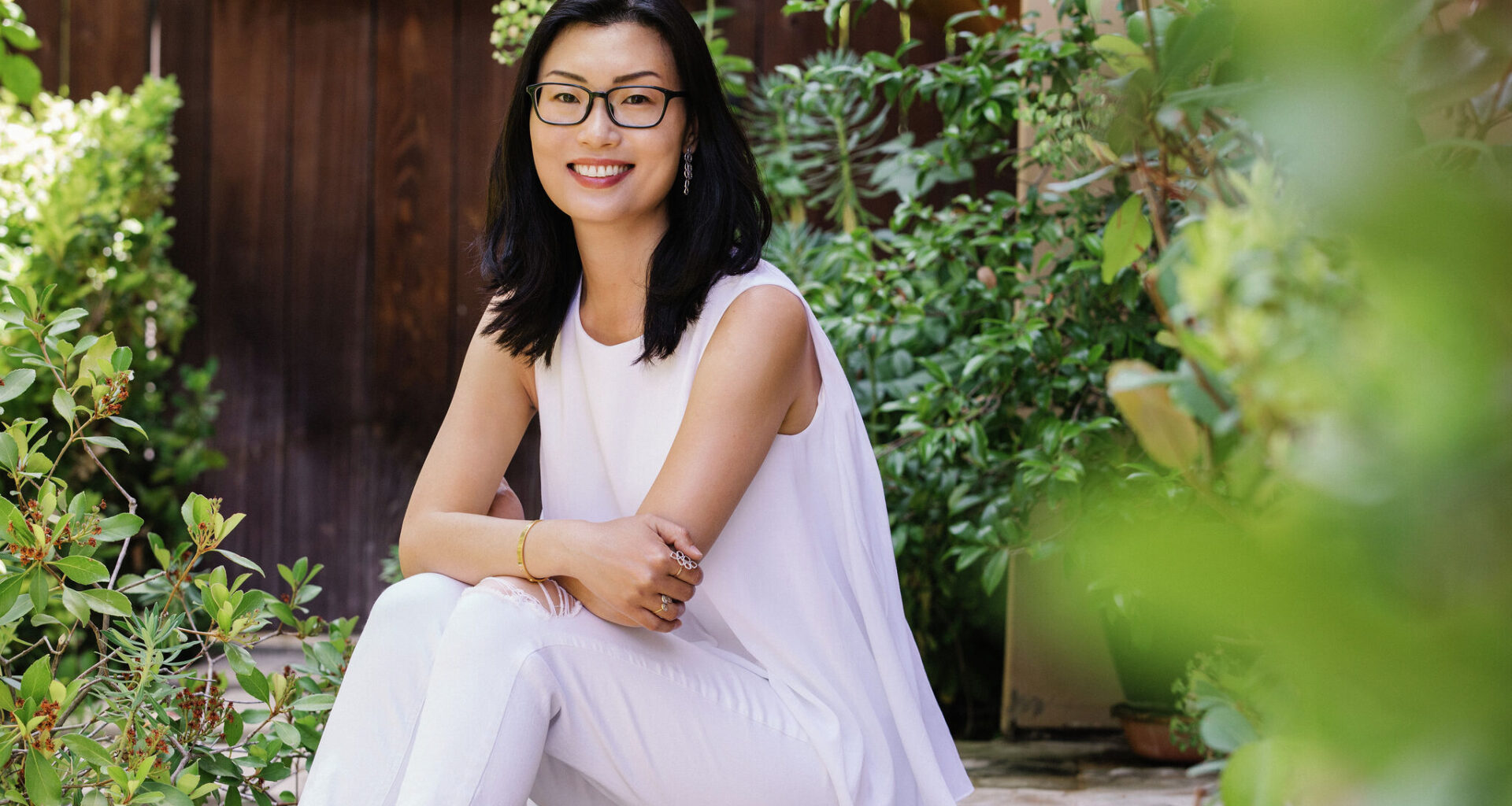
Jessica Sample
In Kelly Yang’s latest novel, “The Take,” two women swap blood as part of an experimental antiaging therapy that’s suddenly fashionable in California’s high-income districts. A vibrant skewering of our youth-obsessed culture, it’s quite the detour for a children’s book author known for boldly blazing new trails.
“I really wanted to tell a specific story about aging,” the 41-year-old told the Chronicle about her new book, out Tuesday, April 14. “I had a somewhat unconventional experience with aging, and that made me hyper-attuned to how people judge — especially women — when it comes to their age.”
The Take
By Kelly Yang
(Berkley; 368 pages; $30)
Kelly Yang in conversation with Mychal Threets: 7 p.m. Wednesday, April 15. $21.99 general admission; $45.09 general admission and book; $11.49 student/low income. Kepler’s Books, 1010 El Camino Real, Menlo Park. www.keplers.org
Bay Area Book Festival presents Kelly Yang: Staying True to Our Futuristic Minds. 11:45 a.m. May 30. Free. Berkeley Public Library, 2090 Kittredge St., Berkeley • Dreams Can Be Deceiving: Asian American Identities. 4 p.m. May 31. Free. The Freight, 2020 Addison St., Berkeley. www.baybookfest.org
“Somewhat unconventional” might be an understatement. Like the 10-year-old Chinese immigrant heroine in her “Front Desk” series of middle grade novels, Yang was in elementary school when she began running the desk at the Southern California motel where her parents worked. (Collectively, the books have sold 2 million copies.)
Article continues below this ad
At 13, having aced an early entrance exam, Yang enrolled as a freshman at California State University Los Angeles in 1998. Two years later, she transferred to UC Berkeley, where she made lasting impressions.
Bruce Cain, a Berkeley political science professor at the time, taught Yang and then hired her “as one of my research assistants over the summer because she was one of the best students, even at the age of 15,” he told the Chronicle. She graduated in 2002 at just 17.
San Francisco Chronicle Logo
Make us a Preferred Source to get more of our news when you search.
Add Preferred Source
Next came Harvard Law School, where, as she revealed in a 2020 essay, Yang was sexually assaulted by a classmate and pressured by administrators to recant her complaint. Yang graduated at 20 but was “really disillusioned with the law. I definitely didn’t want to sell my soul to corporate law firms.”
For most of the next two decades, she worked as a journalist and educator in Asia. Today, now living back in Los Angeles, she loves to write for young readers. But “the only way to really tell a story about aging is to have adult characters who’ve aged.”
Article continues below this ad
“The Take” by Kelly Yang.
Berkley
Enter the protagonists of “The Take.”
Maggie Wang, 23, feels the pressure of being “the perfect Chinese daughter” to overworked immigrant parents. Student debt and uninspiring jobs prevent her from pursuing her dream of becoming a writer.
Ingrid Parker, a wealthy, white 53-year-old Hollywood producer, wants to stay atop her youth-focused profession. A largely untested blood therapy purports to make her look much more youthful, but she needs a partner — a woman decades younger.
Maggie responds to Ingrid’s deliberately vague ad and agrees to share her blood with Ingrid for $3 million. The procedure requires just “two needles,” Ingrid’s doctor tells Maggie, “One taking blood out of you, and one going into you.”
Article continues below this ad
But things aren’t so simple. The procedure, Maggie learns, might cause her to age more quickly, intensifying her feeling that time’s not on her side.
Side by side on transfusion days, the women discuss ideas for books and movies. But their give-and-take is shadowed by a power imbalance that threatens to turn toxic as they grow more enmeshed in one another’s lives.
Longing is a powerful theme that runs throughout Yang’s work, noted her literary peer Kate DiCamillo, the Minneapolis-based author of “Because of Winn-Dixie” and other bestselling children’s books.
“That is where so much of the magic is for her — that ability to remember exactly what it’s like to be a kid and to want desperately,” said DiCamillo, who co-hosts the podcast “StoryKind” with Yang. “That translates into the adult novel. So much of what she does is about becoming, about how do we become ourselves?”
Like Maggie, circumstances have frequently forced Yang to be age-conscious.
Article continues below this ad
In college, Yang was initially able to downplay her youth because she’s been 5-foot-7½ since sixth grade. When classmates inevitably learned her age, “it became a point of hyperfixation.”
“I was proud, but I was also worried,” she admitted. “What happens when the most fascinating thing about me — the fact that I’m young — is no longer a fact?”
In the novel, Maggie arrives at similarly stressful junctures, realizing that the treatment is indeed accelerating her biological clock. It’s a plot point that pivots on a frustration familiar to Yang, an “existential crisis of being super young and told you have all the time in the world.”
Years ago, when she encountered such well-intended condescension, she felt “almost this homicidal rage.”
“You do have time, but it’s infuriating because you have no money, you have no leads, you have no connections, you have no experience,” she went on. “I remember feeling so impatient.”
Author Kelly Yang shifts from young readers to adults with her novel “The Take,” in which she tackles youth-obsessed culture and power imbalance in America.
Courtesy of Richard Knapp
But since publishing her first book in 2018, Yang’s success as an author has been accompanied by new challenges. With her children’s novels featuring sympathetic portrayals of immigrants, people of color and LGBTQ+ characters, they’ve been targeted by conservatives seeking to ban books that don’t align with their worldview.
Article continues below this ad
Yang has addressed the matter several times on her widely read social media pages. In one post from 2020, she shared a letter she sent to a Pennsylvania school district that claimed her work was “teaching racism.” In 2021, parents in a New York school district complained “Front Desk” espouses critical race theory. She also rallied the “kidlit” community to stand up for its rights.
To DiCamillo, Yang’s advocacy was “deeply moving.”
“That’s what we need to do,” DiCamillo said, noting that book-banning efforts “thrive in silence if you don’t say something. She did it in a very dignified way, but she did not take it sitting down.”
Yang is similarly unbowed after her “limited and horrific experience working for Hollywood.” Her debut “Front Desk,” was optioned to be adapted for film but never got produced. The time she spent trying to write a screenplay informs scenes in “The Take,” which features cutthroat industry bigwigs mistreating young, powerless writers.
But Yang’s shift to adult fiction isn’t permanent. While she said she plans to write more for adults, she is already working on a new series for young readers.
“I get daily emails from kids saying how much they love my books,” she said.
Her young fans will be pleased to learn that she’s not aging out of kidlit.
Kevin Canfield is a freelance writer.