
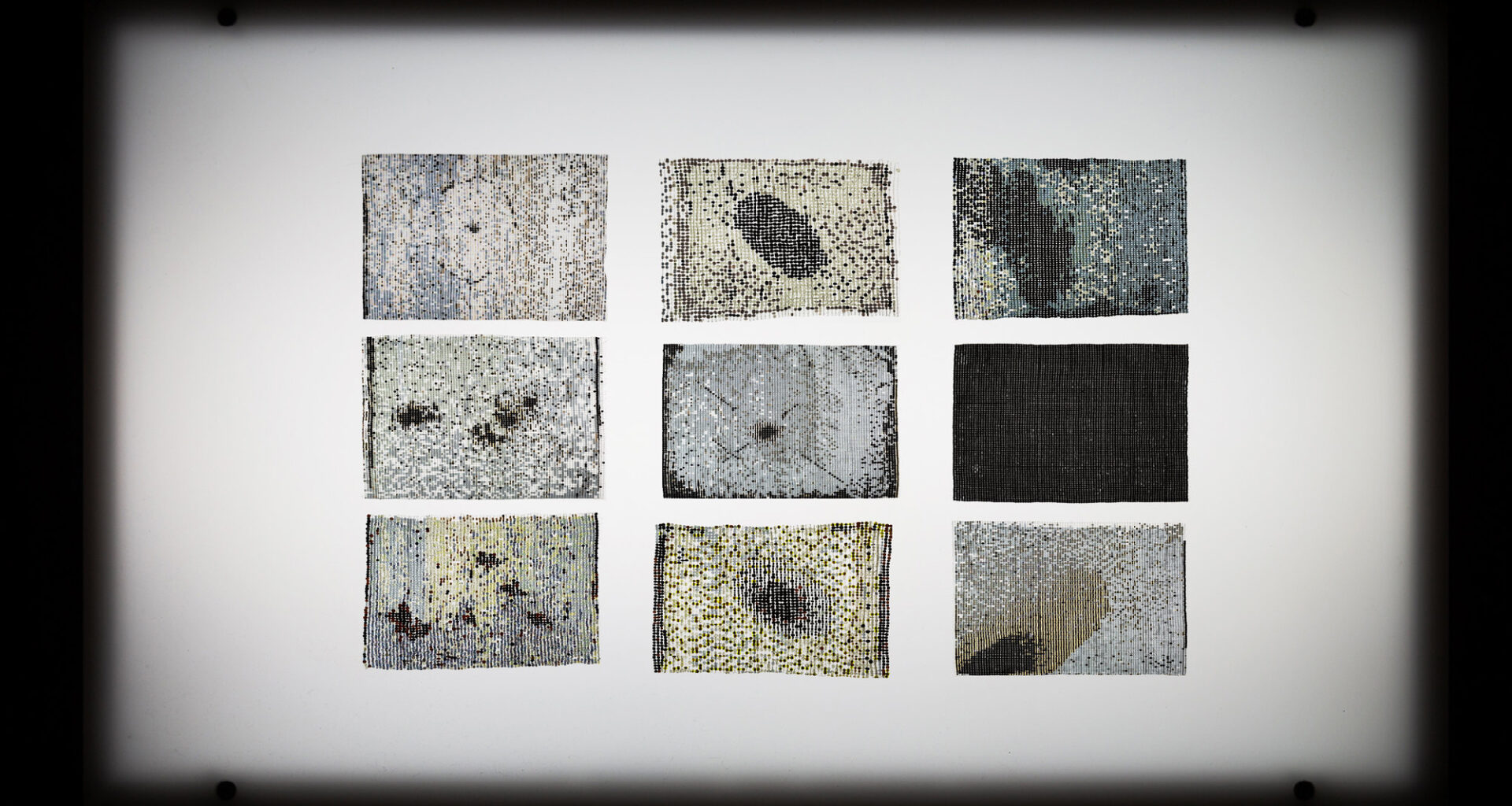
References to weaving and embroidery abound in Motherboards. There’s no escaping how the Jacquard loom and its punch cards influenced the development of computing. Textiles also provide a handy material reference that pulls technology out of the digital realm and into physical space. Because behind every cloud, every wireless and invisible process is real labor, much of it repetitive and underpaid.
Amor Muñoz’s video and embroidered textiles present a project in which she offered women in Mexico sewing work for the U.S. minimum wage, then documented their output and timecards as proof of labor that would otherwise go unseen. Marilou Schultz’s remarkable weaving Replica of a Chip employs Navajo techniques to render a hugely blown-up version of an Intel microchip. The piece is the result of a long relationship between Navajo women and tech companies that have made use of that population’s “nimble fingers.”
As lovely as some of the works in Motherboards are — and there are many stunning pieces, including Sarah Rosalena’s luminous bead work, the textiles on Ahree Lee’s steel framework and Sonya Rapoport’s poetic use of computer paper — the show is mostly somber in tone.
 Tania Candiani, ‘Four Industries’ (still), 2020; Three-channel video installation with quadrophonic sound, 25:03 minutes. (Courtesy of the artist)
“Computers” of course, weren’t always hunks of plastic and metal. (We learned this from Hidden Figures.) They were people, often women, who performed long and tedious calculations by hand. And yet there remains a general lack of knowledge about women’s central role in the industry. It’s an imbalance that has yet to be corrected. After reaching a high of 36% in the mid-’80s, women accounted for just 22% of computer science degrees in 2021.
It’s nice, then, when a work in Motherboards hits all the right notes, including delight. Unfolding across three channels, Tania Candiani’s video Four Industries features an all-women choir based in Cincinnati. Using just their voices, the performers “resurrect” the sounds of the city’s former industries: metal casting, meatpacking, printing and woodworking. (Yes, they mimic animal squeals.)
They sing rhythmic machine sounds, whistles and thumps, acting like foley artists to replace bygone soundscapes. It’s an absurd and wholly engaging performance, and a highlight of the show.
Even for those super well-versed in the history of Silicon Valley, Motherboards will contain discoveries. Here’s a potential one: So prevalent were female computers that “kilogirls,” 1,000 hours of a woman’s computational labor, was once a unit of measurement. The strength of the show is seeing how artists have taken their own experiences and discoveries and turned them, through kilogirls of careful labor, into impactful works of art.
‘Motherboards’ is on view at the San Jose Museum of Art (110 South Market St., San José) April 10, 2026–Jan. 10, 2027.