
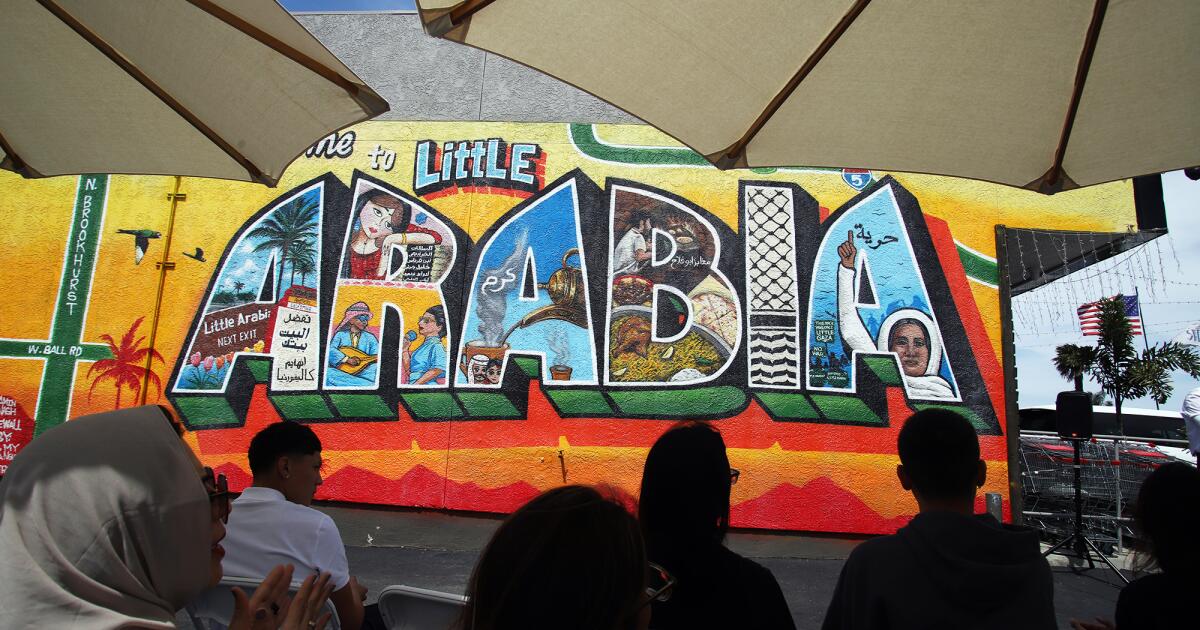
Anaheim’s Little Arabia district recently unveiled a new greeting that offers a more colorful splash upon arrival than its beige freeway signs.
A warm orange, red and yellow palette serves as the backdrop to the stunning “Welcome to Little Arabia” postcard mural that adorns Al-Karmel Meat Market’s wall and celebrates its vibrant culture.
Community activists, local high school students and city officials attended the mural’s official dedication on April 3, which doubled as an Arab American Heritage Month kickoff event.
“I hope this mural is like an invitation,” said Amin Nash, policy and advocacy coordinator for the Arab American Civic Council based in Anaheim. “It shows that there are images that represent the community. Hopefully, that will create more acceptance and beautify the district.”
After years of advocacy from the Arab American community, Anaheim officially designated Little Arabia in 2022. The mile-long stretch of restaurants, cafes, grocery stores, clothing and dessert shops is the only designated ethnic enclave in Anaheim and the sole of its kind for Arab Americans in the nation.
Professional artists Joshua Flores and Giese Amaya helped guide Magnolia High School art students through the project, as it transformed from a mock-up sketch to a mural last month.
Al-Karmel Meat Market’s owners donated the wall for the effort. The Arab American Civic Council networked with Magnolia High School art teacher Vanessa Fogelquist for the collaboration.
Flores, a muralist registered with the city, was proactive in responding to the civic council’s search for an artist. He previously painted a mural at El Pollo Fino restaurant in downtown Anaheim, but the permitting process proved quicker this time around.
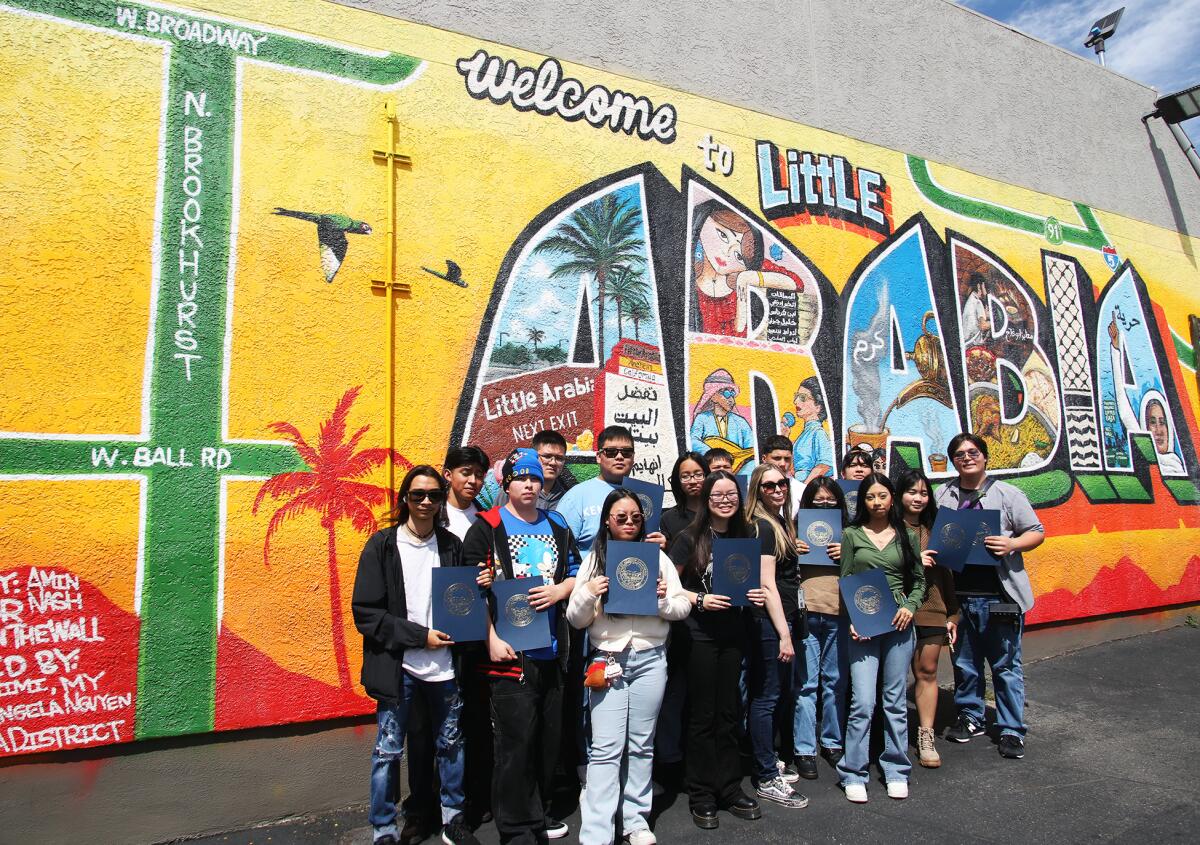
Magnolia High School art students pose in front of the mural during the dedication ceremony.
(James Carbone)
The mural project also served as an invitation for him and the students to learn more about the district.
“I didn’t really know too much about Little Arabia,” said Flores, an L.A.-based artist. “I took a liking to the food. I’m always looking for shawarma spots!”
For years, restaurant owners commissioned artwork within their establishments — from grand depictions of the Citadel of Aleppo in Syria to the Old City of Jerusalem.
Little Arabia took a front-facing turn with public art in 2022 when “Hijabi Queens” murals depicted Muslim women in headscarves around the district and became selfie hot spots.
As the newest addition, the “Welcome to Little Arabia” mural isn’t just a greeting to tourists and visitors, but also tells the story of what makes it a beloved cultural destination.
Flores suggested that the original bold lettering of “Arabia” on the postcard should curve at the top as an homage to the written Arabic language.
“A lot of postcard art that other artists do features simple, block letters,” he said. “We did almost the same thing but made sure it looked more Arabic.”
But that’s not the only tribute.
Artists, students and business owners met several times to discuss what stories should be told through portraits within each letter.
“Students toured Little Arabia and took pictures” Nash said. “That was of our inspiration. As we met, we thought each letter should have a theme like immigration, food and generosity.”
Depictions of Little Arabia’s freeway sign, a stack of books in Arabic, coffee and a heaping plate of mandi, a traditional Yemeni dish, offer a taste of the district’s treasures.
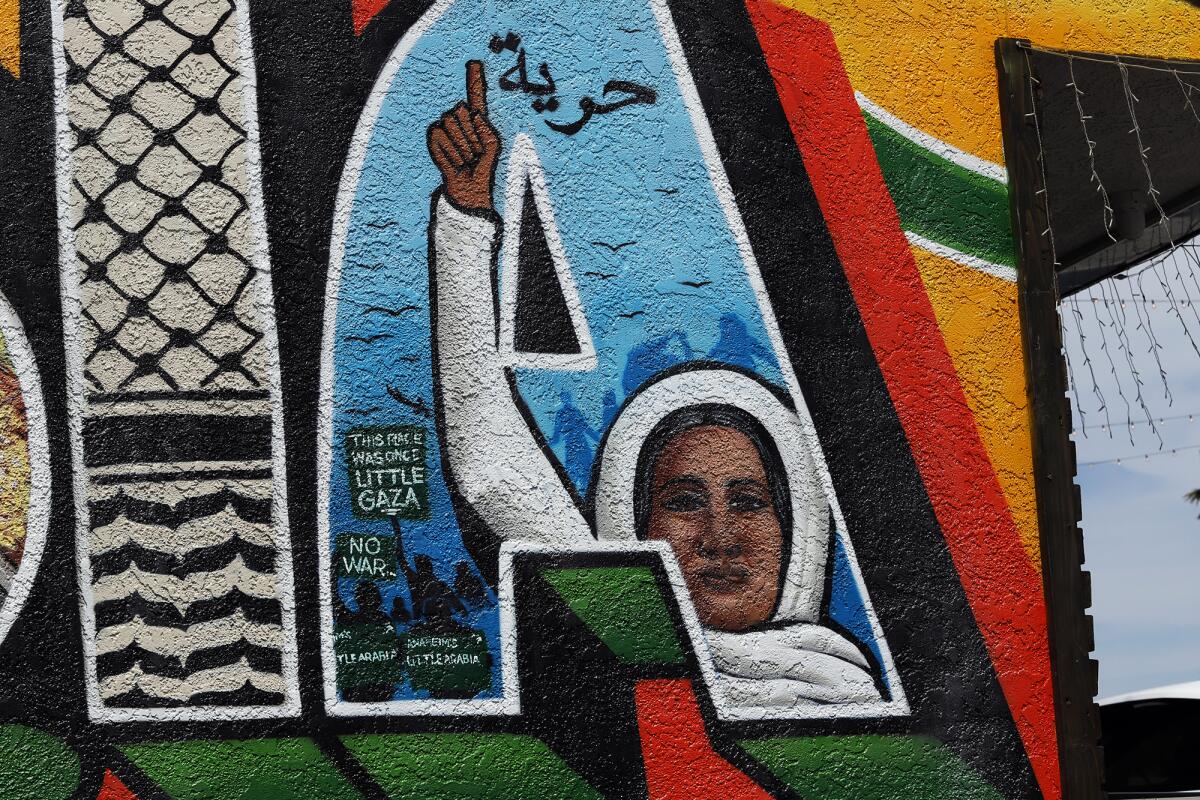
The mural also depicts Little Arabia as a hub for politics.
(James Carbone)
“Your home away from home,” is written in Arabic on a portrait of Little Arabia Plaza’s main business strip.
The mural also depicts a hijabi woman with a fist raised up next “freedom” written in Arabic while offering a brief history lesson of the district’s early, unofficial “Little Gaza” moniker.
It’s also a direct nod to how Brookhurst Street has also been a longtime hub for Arab American civic engagement, whether organizing for Little Arabia’s official recognition, protesting travel bans on Muslim-majority nations or expressing solidarity for Palestinian statehood.
But whatever offerings beckons people to the district — food, books, culture — the postcard mural awaits as its newest attraction.
“The hope is that Little Arabia is another stop when people are traveling around the state,” Nash said, “a stop where they take pictures next to the mural.