
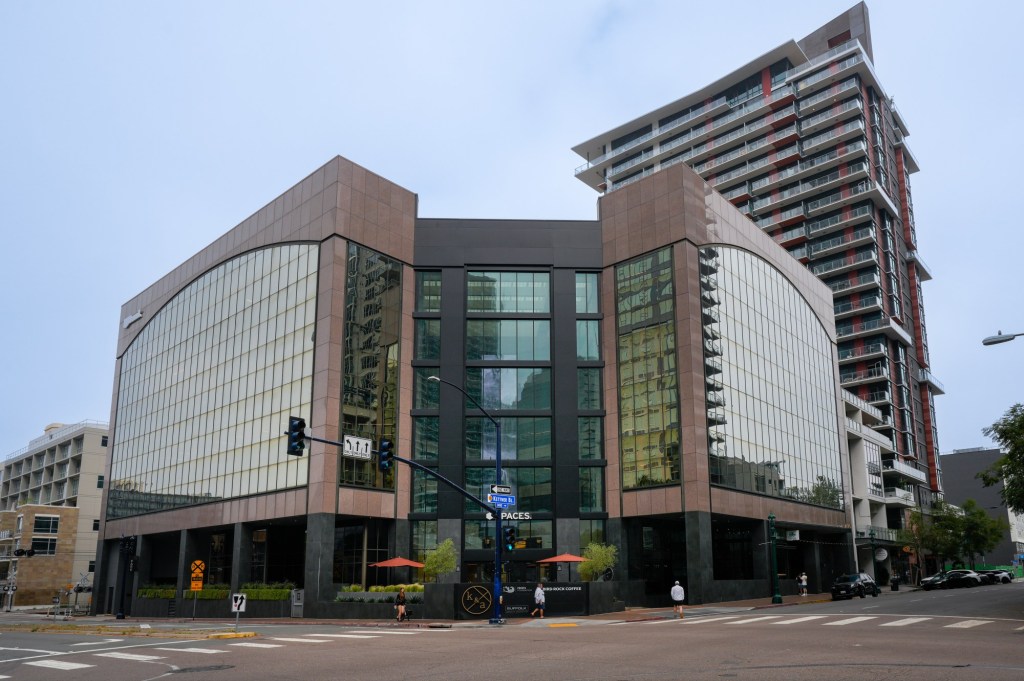
The billion-dollar nonprofit banking on a renaissance of downtown San Diego has purchased its Little Italy headquarters, with the building buy said to be a symbol of the organization’s dedication to the region.
Friday, Prebys Foundation purchased the seven-story office building at 1420 Kettner Blvd., branded as Kettner & Ash, for $30.5 million in cash and debt, Grant Oliphant, the foundation’s CEO, told the Union-Tribune.
The seller is DivcoWest Real Estate Services, which purchased the property in partnership with Ocean West Capital Partners, in two separate transactions — an $18.5-million leasehold acquisition in August 2017 and an $8-million land buy in March 2018 — for $26.5 million, according to property records. The previous owner spent millions more to convert the former bank building into a top-tier office property. The transaction and improvements were financed with a $45.9 million loan from Deustche Bank AG, property records show.
Prebys’ Kettner & Ash purchase, valued at $250 per square foot, is the second building purchase in a year for the San Diego-based foundation. The nonprofit bought the Wells Fargo Plaza tower at 401 B St. last April as an initial investment in the city’s ailing central business district.
“We’re genuinely not trying to build a real estate empire, but we are trying to use our balance sheet and our assets to make a statement about our commitment to downtown,” Oliphant said. “We like the building. We like the location. We like the idea of controlling the destiny of the building where our headquarters is. And we think it’s a good complement to 401 (B St).”
Built in 1985, the 122,290-square-foot building at 1420 Kettner Blvd. was the former home of U.S. Bank — and National Bank before that — before it was remodeled and rebranded by DivcoWest and Ocean West as a boutique office property.
The building, on the edge of downtown’s Little Italy neighborhood, features a glass wall curtain with views of San Diego Bay from the top floors, as well as an indoor-outdoor tenant lounge with a dedicated kitchen on the third floor. The building’s most distinctive feature is the five-story LED screen in the center atrium. The atrium is a structural remnant of the former bank. There is also a two-level, underground parking garage with 124 spaces.
Prebys Foundation, which moved into the building in 2023, occupies the entire seventh floor, or 19,015 square feet of space. Other building tenants include co-working concept Spaces, Suffolk Construction and payroll software-maker Paycom. Bird Rock Coffee is on the ground floor. The building was 70.8% leased at the time of the sale, according to real estate tracker CoStar.
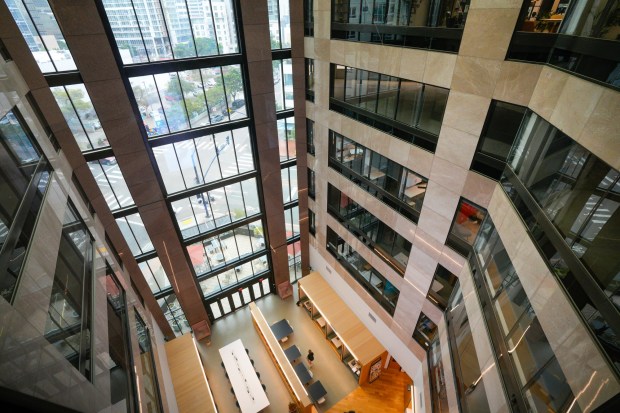 The 1420 Kettner building includes a central atrium, which is a structural remnant of the building’s origin as a bank. (Nelvin C. Cepeda / The San Diego Union-Tribune)
“It is a premier asset. The repositioning and the ZIP code make it a one-of-one type building,” said Matt Carlson, an executive at CBRE who helped orchestrate the deal. “It’s not that often that a user who’s already in the building turns around and buys it, especially in this environment. That’s unique to anything that we’ve seen in downtown.”
Established in 2016, after the death of local developer Conrad Prebys, the Prebys Foundation is the philanthropic outgrowth of the namesake estate. In 2021, the organization sold Prebys’ portfolio of 66 residential complexes to Blackstone Group for more than $1 billion, in a move said to fuel its charitable gift giving.
The foundation ended 2024 with $1.2 billion in assets, according to the organization’s most recent Form 990 filed with the Internal Revenue Service. That same year, the nonprofit doled out $54.9 million in grants and charitable gifts, with a focus on health care, medical research, the arts and childhood development. In 2025, the organization broadened its scope to include equity investing with the launch of the Prebys Ventures Impact Fund. The fund is set up to invest $50 million, over five years, in local technology and life science startups.
Prebys has also, in recent years, used its financial heft to craft a new vision for San Diego’s Civic Center in the hopes of spurring redevelopment of the municipal compound as an arts and education hub.
The foundation is also looking beyond the central business district to connect downtown’s disparate neighborhoods in a more meaningful fashion. The organization’s building buys are said to align with that mission.
“We continue to really lean into the idea of a revitalized, coherent vision for downtown, stretching from the waterfront through the traditional business district all the way to Balboa Park,” Oliphant said. “Both of these buildings fit in that space, and they complement each other nicely.”
Prebys is part of a new era in downtown building ownership, where high-net-worth individuals and family offices are buying distressed properties at discount pricing and replacing institutional real estate investors.
“This downtown reset is actually turning into a fairly positive thing,” Carlson said. “We bounced off the bottom in the middle of last year, and this is just a further example of us accelerating with momentum.”
Prebys Foundation’s Little Italy office building purchase is a real estate investment, with the organization essentially shifting a portion of its endowment to a different asset type. The transaction does not come at the expense of the organization’s annual grant-making, Oliphant said. The foundation funds grant-making from the revenue it generates from its investment portfolio, which amounts to at least 5% of total assets each year.