
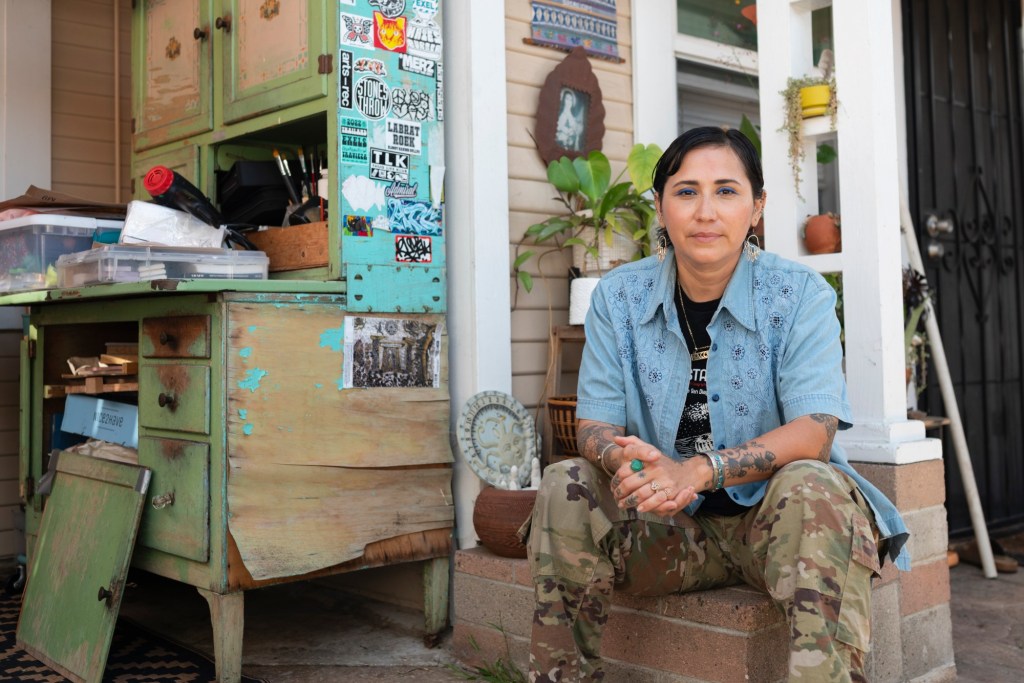
All around, in their family and in their community, Irie Zepeda ”]saw people making things. They remember their mom always drawing in her notebook, and their uncles were deep in the practice of passing around their black books.
“That’s a big part of my community. All of my friends are artists, we all carry black books, which means we would pass around this notebook where we all share a drawing or some writing or a tag, something that we put in this black book. That’s a long, cultural tradition where I come from, that we pass around black books,” they said. “My uncles always had their black books, and I was a kid and it was always fascinating to see. I was too young to draw anything, but just to look at the art was really inspiring.”
Growing up in Barrio Logan, that inspiration was all around for Zepeda, whose grandparents were from Mexico and their mom was born in Tijuana. Their memories include watching their grandparents gardening, working the land, making tortillas by hand, making ladders by hand.
“I heard somewhere a long time ago that, in a lot of native cultures, there is no word for artist because everyone, everything is art. Everything you make with your hands is art, so that’s how I see art,” they said. “When you can make your life your art, then you’re the ultimate artist. That’s what I try to do with my life—everything I bring into my life, the way that I live, the way that I move, the way that I practice, it’s all a part of my art.”
Zepeda, 40, is a multidisciplinary artist, printmaker, and facilitator who founded and operates Por La Mano Press y Arte, leading workshops, creating cultural events and creative projects for their community, and using their education in fine arts and art therapy to build spaces for connection and healing. They’ve also curated a new exhibition opening at the Chicano Park Museum & Cultural Center on Saturday (a reception will take place from 4 to 8 p.m.), titled “Print As Protest/Grafica En Resistencia.” This group art show features work that centers on the practice of using print as a form of “resistance, solidarity, and community storytelling” to show how artists use printmaking “as a powerful tool for voice, visibility, and collective action.” Zepeda, who lives in Barrio Logan with their two bunnies, Valentina and Tapatio, took some time to talk about their work and the power of building skills and a craft for the benefit of a community.
Q: Tell us about Por La Mano Press y Arte.
A: When I first started, I got my bachelor’s in fine arts in 2016 from the University of Texas at San Antonio. After that, I was like, ‘What am I going to do?’ so I started producing art shows, community events. As I started these productions, I wanted all of this to live under something. But I don’t want to call the work I do a business because I don’t want to follow in the footsteps of something that sounds so capitalistic. It’s my work, it’s my passion, it’s my life’s work and my purpose. So, yeah, this came about, about 10 years ago. I started producing art shows, community events, and then I started thinking about how can I also give back, besides just sharing my art, promoting my work. Then, skill sharing has always been important to me; as an older sibling of five, I’ve always been in, like, a mentor role. It’s always important to me to kind of lead with that in the work that I was doing. So I was like, ‘Ok, I’m also going to add in my skill sharing, so I’m going to teach what I know.’ That’s really important because I really didn’t know I was the artist that I am today because I had a lack of resources growing up. I grew up with a single mother of five, and although I grew up in Barrio Logan with the murals and all that, it didn’t feel very obtainable or accessible to me to ever be on a mural, or just to know how are these murals created? There was not enough education and resources, so that’s why I went to school for my bachelor’s in fine arts because it was like a gift to my inner child. It was like a way for me to be able to give myself the things that I didn’t have in terms of that structure, the discipline, the resources, the education in art. Going to school really showed me my potential. After obtaining all of that information and those resources, later on with Por La Mano, I felt like it’s important for me to give back. It’s my privilege to go to school and I want to be able to share what I know with folks that may have felt the way that I did when I was growing up, without a lack of education and resources. So, how can I make printmaking accessible? It’s already a very DIY, accessible form of making art. I started putting together classes, workshops where I would teach printmaking and talk about accessibility of it. Anything that I know how to do, I kind of put it together and started sharing that with community. And that’s really the base of Por La Mano Press.
What I love about Barrio Logan…
It’s one of those special places in San Diego where I can run into one of my friends who is an artist, a maker, a DJ, or whatever kind of creator at any given moment. Somebody knows my name and it feels like a place where I belong, where I’m seen. It feels like a place that is inspiring and creative. There’s always something going on, there’s always little pop-ups or vendors, and I love the smells of food at every corner where there’s someone selling burritos out of their house, or tacos out of their house. Those special little nook-and-cranny things that you don’t find anywhere else — the tamale lady, just this specialness and the humanity of living in Barrio Logan.
Q: How would you describe the kind of art you create?
A: I work primarily as a printmaker, in relief printing. That is something I learned and gravitated toward. I have to draw, I have to then carve, and then after I carve it, I have to ink it, I have to pull it, and then I get results. It’s a whole process and it just felt so rich and deep. It’s analog, something super old school, which I connect to. The things that are made through artists, through craftspeople, through folk art, I see that in the ways that my grandparents worked with their hands. They were farm workers, they tended to land, they were always growing their garden, so I saw them in that process. That’s my studio practice.
On top of that, I consider myself an arts and cultural worker, so I bring in my print making and then I create shows and events around that, that are community centered. I will have an event with music, I will highlight local artists, local makers, local vendors, just folks who are in community producing, making. I’ll create a whole event, an art show community event that’ll have my art included, and I’ll bring other folks and invite them to use that space as a platform for them and myself. We are collaborating together and I see that as an extension of my art and my work. These are spaces for folks not only to promote our art, to highlight our art, to uplift other artists, but also to rejoice. I feel like our communities need spaces where they can see their best versions of themselves reflected back at them. Community spaces, POC-centered, led for us and by us where we can see the best parts of ourselves reflected back at each other through music, art, movement and culture.
Relief printing is basically like you’re carving out a surface. I work with linoleum, but this comes from a wood block tradition. So, with wood, you would basically draw on that surface, and then you carve out your design on the surface in reverse. Now, you’re working with negative and positive space. Anything that you carve out from your design is going to be the negative space. After you carve, you’re going to ink the plate, and then whatever you did not carve out is going to absorb the ink. Essentially, you’re making a stamp, so after you put the ink on, you connect it with paper, either by hand or using a press. When it puts pressure on it, you pull it and the ink is applied to the paper, and then you get the design.
Q: You’ve curated the exhibition “Print As Protest/Grafica En Resistencia” for the Chicano Park Museum & Cultural Center. Can you walk us through a bit of your research and creative process for putting this show together?
A: Late last year, in 2025, I was invited by one of the directors at the museum to come and activate one of the spaces there. They have a print studio that is dedicated to Armando Cid, who was part of the Royal Chicano Air Force (a Chicano arts collective from the 1960s that used graphic arts and printmaking as a political tool) to support farm workers and the Chicano rights movement. This space, there’s a studio with a printing press, and they wanted to activate that space and get it prepped and ready for a future residency. Since I was doing that, they were just like, ‘Hey, it makes sense to have a print exhibition.’
It felt like extra research didn’t feel necessary for me, per se, because my work is rooted in storytelling and resistance, the work that I already create is rooted in print as protest and in a way of using my creations, my work, to share and say my message. On top of that, the print studio that is dedicated to Armando Cid, his legacy and his history is part of the Royal Chicano Air Force and how they used print as protest to support the Farm Workers Movement and the Chicano Rights Movement; and knowing that legacy and also thinking about the times that we’re in right now and how communities of color are being silenced and we have all these ICE raids and all this heavy oppression that’s coming into our neighborhoods right now, folks are looking for ways to say what they feel. Art has always worked hand-in-hand with movements, so we’re going to take from this long legacy of print as protest.
Q: Can you share some examples from the show that reflect this “living practice of resistance, solidarity, and community storytelling”?
A: Brian Mazatl Nicolás-Espinoza has a display case and a couple of illustrations. I feel like his work is rooted in an indigenous practice, Mesoamerican and Mixtec; in his indigenous roots, which are mixed. A lot of his work is about directly connecting the past to the present and uplifting and upholding the stories of his ancestors, and how those are resembled and reflected today. How we are fighting the same fight, or a similar fight and sort of carrying that baton.
He has one illustration that is on a sweater that he printed from an original relief print. He has one piece with the mariachi plaza in Boyle Heights (in Los Angeles). It’s a cultural landmark, so I think this is where these things start to weave together. It’s not in Barrio Logan, but we understand the significance of cultural landmarks and the importance that they have to our communities as gathering spaces. So, this specific landmark is a historical site for Mexican American culture. It has been a cultural hub there since the 1930s. These spaces, right now through gentrification, are being threatened and dismantled. All of the people that were residents of these communities from Mexico and Central America, indigenous families, they were born and raised in these spaces. These are the spaces that they have gathered around through many generations. So, I think about this connection that we can understand the story of gentrification and these different places. Gentrification is different in Boyle Heights than it is in Chicano Park, in Barrio Logan, but we understand that we are in the same flight and connected through history and legacy. We think about the people that made these spaces so important, where were our extended community and ancestors traveled from different places to steward these spaces and these lands so that we can call these places our home. Now, they’re being dismantled, so that legacy is what he’s talking about; his ancestry and how they’ve come and landed in these places, and how he’s inspired by them, but also worries that they will not be there for the future. That is the solidarity aspect because we can understand that plight and he is speaking for us as a community.
Q: What kind of influence has your upbringing, your culture, had on the art that you create? Are there ways that you see your upbringing as having informed your art practice?
A: Just honoring craftsmanship and artisanal folks that make everything with their hands. There’s a word in my community, in Spanish, called “rasquache” and it means “you make the most with the least.” When I think about my grandmother’s home, they did not have furniture that they bought from a warehouse or store; it was rasquache, it was something my grandmother made, it was very DIY. That is the basis of my life and my work. Even printmaking is do-it-yourself, so that’s why I love the printmaking process because it’s something that needs minimal tools in order to create from. Like, if the end the world came, I could technically still create. I can make my own ink, I could carve into a board; it’s basically the minimal amount of tools in order to create. That’s, fundamentally, one of the principles of my work, to do it yourself, DIY. I grew up watching my parents, my grandparents, create in that form, in that way, their whole lives. If we don’t have it, we make it, we create it in my super resilient community. That’s even how Chicano Park came to be, out of an active resilience and resistance. People decided that we’re not going to have a highway here, or a police station, but we’re going to create a park, we’re going to do it ourselves. If you’re not going to give it to us, we’re going to make that ourselves. So, that resilience, that initiative and way of thinking, that’s the essence of my work and everything that I do. All of that is inspired by my community and my family.
Q: What is the best advice you’ve ever received?
A: My mom has always said, “Don’t regret anything that you do in life, just don’t do it again.” So, learn from your mistakes.
Q: What is one thing people would be surprised to find out about you?
A: That I fell from a 40-foot cliff and I survived. This was in Ocean Beach, I was 29, and I’m lucky to be alive. I was helicoptered out and my back broke right in the middle. When they picked me up, they said I may not walk again, but I am. It was a nightmare and it took a long time to recover.
Q: Please describe your ideal San Diego weekend.
A: Friday would be a fun dance night at Whistle Stop in South Park with my friends, probably some cumbia, or one of my friends DJing. On Saturday, taking it pretty chill in the morning, maybe go get my vegetables at Food Shed in City Heights. Then, probably have brunch with friends somewhere, maybe in South Park. Come home for a regroup and then go out for an art show. Ideally, it’s a second Saturday, maybe in Barrio Logan where there are multiple art shows, going from art show to art show. Then, on Sunday, waking up and having some sort of brunch or breakfast and then going to hang out at a park, like in Golden Hill, or going to Ocean Beach.