
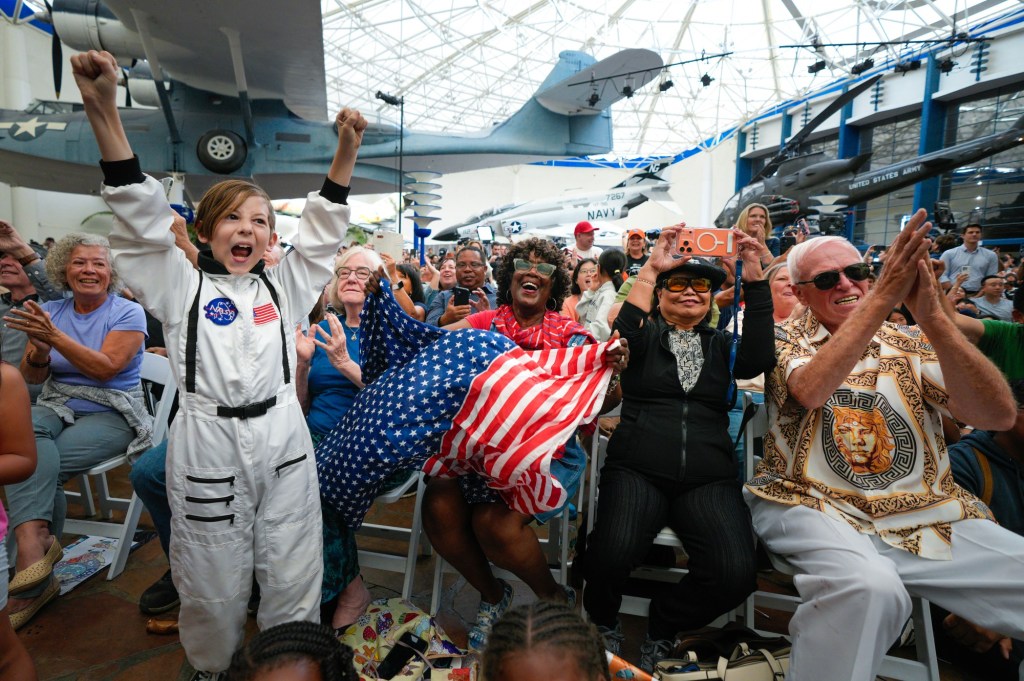
Hundreds of people gathered around large screens at Balboa Park’s Air & Space Museum, collectively holding their breath as they watched the Artemis II space capsule splash into the sea Friday.
As the three parachutes opened and the Pacific Ocean came into view, some people cheered while others wiped away tears.
When it hit the water, the room exploded into yells, applause and chants of “USA!”
George Ray sat in the front row at the viewing party. His company, LaFiell Manufacturing, provided parts for the Artemis mission, and he’d attended the Florida launch in person.
A former NASA employee, Ray said he’d worked on building spacecraft for NASA for 64 years, dating back to the Apollo missions.
“I think the most important thing, probably, is all the technology that these guys have produced and what the future is for all these kids,” he said. “It’s just amazing. It’s a great feeling to just be part of it in the history.”
The NASA spacecraft that captivated the nation’s attention landed roughly 50 miles from San Diego into the Pacific Ocean at 5:07 p.m., wrapping up a journey that laid the groundwork for future travel into deep space.
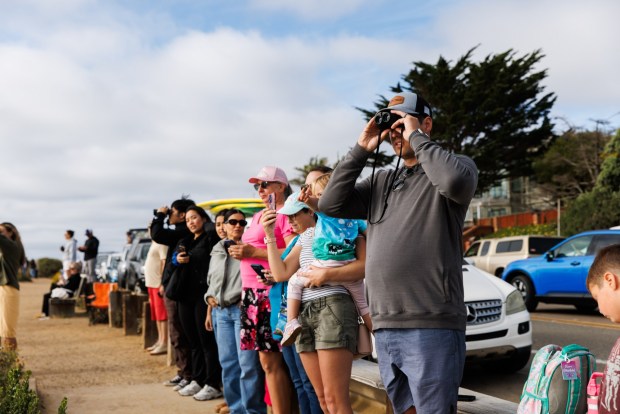 People gather at Sunset Cliffs to try to get a view of the Artemis II splashdown on Friday. (Kristian Carreon / The San Diego Union-Tribune)
Navy teams from the San Diego-based USS John P. Murtha recovered the crew nearly 90 minutes after splashdown, with plans to transport them by helicopter to Naval Air Station North Island.
The Reuben H. Fleet Science Center in Balboa Park also showed a live feed of the splashdown in its giant dome theater. Beforehand, attendees checked out a special Artemis II exhibit featuring 3-D models of the spacecraft and an interactive systems control module.
Josh Oliver from La Jolla brought his elementary school-age son, Joe. The family had been following the Artemis mission since its launch on April 1.
“We’re excited about space travel in general,” Oliver said. “He builds lots of spaceships with his LEGOs.”
 Shauna Aguirre, 60, and her brother Richard Aguirre, 58, try to spot the USS Murtha aiding the Artemis II crew after splashdown at Sunset Cliffs on Friday. (Kristian Carreon / The San Diego Union-Tribune)
Joe said he enjoyed watching the takeoff and how the astronauts went about day-to-day operations on their way to the moon.
“I support the notion that, one day, we’ll be an interplanetary species,” Josh Oliver said. “And I think this is just the next step toward that goal.”
Nine-year-old Vihaan Malapareddy from San Francisco, who was also at the Fleet to watch the splashdown, said he wanted to be an astronaut and go to space. His 7-year-old brother said he’d pass on that opportunity.
Their mom, Preeti Anday, said she hoped her sons would pursue a career in STEM and possibly in space travel.
“I would love for them to get to know more about space, find out what else is there and what they can do in the future,” she said.
People also lined San Diego’s shoreline, trying to get a view of the capsule and its bright orange parachutes, but a thick marine layer made even a glimpse impossible. So they turned to their phones. The only sounds at Sunset Cliffs were the waves and the NASA livestream.
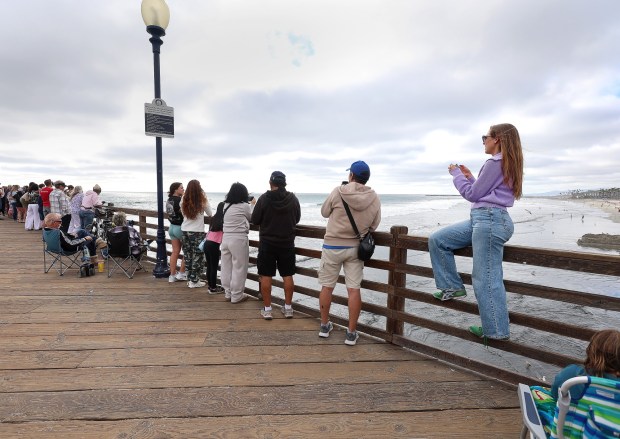 Spectators wait in and around the Oceanside Pier for a glimpse of the re-entry of Artemis II Friday. (John Gastaldo / For The San Diego Union-Tribune)
“We were hoping to see or hear something happen, but also we’re just generally excited to be a part of the history of it landing, especially because it was just off the coast, so it felt like we were kind of included in the landing,” said Faith Talamantez, who came from Grant Hill to watch.
Jorge Gardea, a student at Southwestern College, drove from Chula Vista to try to watch the splashdown. He said he’d wanted to be an astronaut since he was a kid.
“If I’m not able to be an astronaut, I’m going to be an astronaut-biologist, so I’m going to study to put people there, instead of actually going to space,” he said. “To see something like this is life-changing.”
Forty miles north, at the Oceanside pier, Daniel Day and his neighbors joined dozens of others who’d brought cameras and binoculars.
“We’re not going to see anything, it’s so cloudy,” he predicted.
He said he and his family have been watching the astronauts on the news all week.
“We might hear the sonic boom, though,” he said. However, that was not to be, as predictions of a possible sonic boom didn’t come to fruition in the San Diego area.
Earlier in the day, airport officials let residents of La Jolla, Point Loma and Pacific Beach know that they might hear more airplane noise than usual due to flight paths being temporarily adjusted for the splashdown.
A Navy medical dive team from the San Diego-based USS John P. Murtha successfully recovered the crew nearly 90 minutes after splashdown.
Lt. Cmdr. Jesse Wang, Senior Chief Hospital Corpsman Laddy Aldridge, Chief Hospital Corpsman Vlad Link and Hospital Corpsman 1st Class Steve Kapala opened the Orion’s hatch, quickly assessed the crew and helped them exit the capsule.
MH-60S Seahawk helicopters hoisted the astronauts from a floating platform attached to the capsule and took them to the ship.
The mission is a critical step in NASA’s goal to return humans to the Moon and, eventually, send them to Mars.
“This is our generation’s opportunity to explore and to build from what Apollo did,” said Johnson Space Center Director Vanessa Wyche in an interview broadcast by NASA before splashdown.
The crew included Commander Reid Wiseman, pilot Victor Glover and mission specialists Christina Koch and Jeremy Hansen.
Koch is the first woman to travel into deep space, while Glover is the first Black astronaut assigned to a lunar mission. Hansen, from Canada, made Artemis II an international effort.
Artemis II wasn’t without scrutiny. Even before launch, there were questions about whether the capsule’s heat shield would hold up during reentry through Earth’s atmosphere.
Artemis III, slated for launch in mid-2027, aims to land astronauts on the Moon for the first time since 1972.
But unlike Apollo’s shorter visits — Apollo 17 astronauts spent a record three days on the moon — NASA plans to establish something more permanent.
“We’re going to have a Moon base,” Wyche said. “We’re going to learn how to live there. We’re going to go to Mars. It opens up all of the universe.”
Staff writers Abby Hamblin, Gary Robbins and Philip Diehl contributed to this report.