
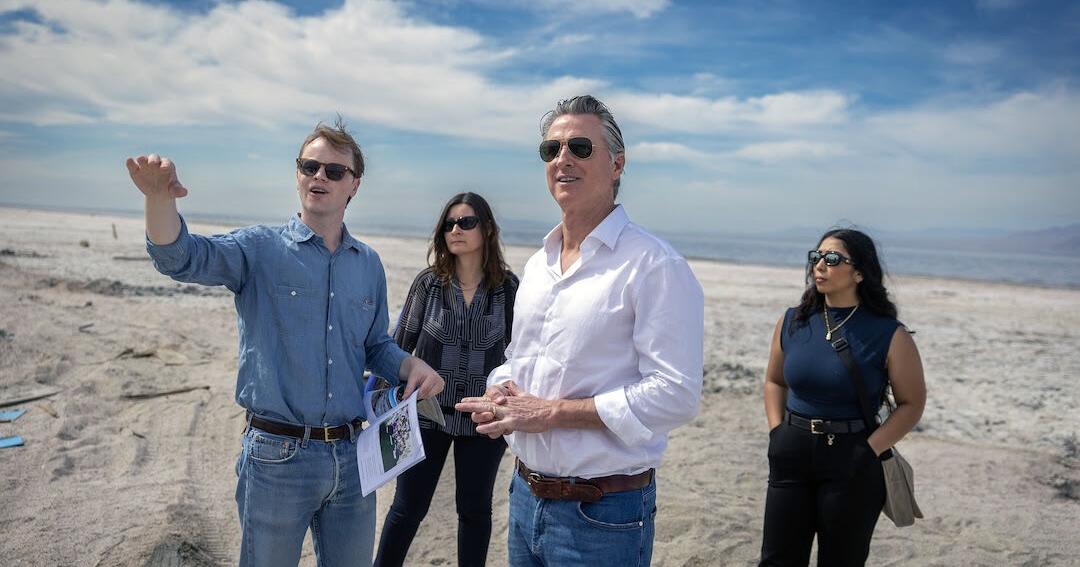
SACRAMENTO — For decades, the Salton Sea has served as a shimmering but stark reminder of California’s environmental precariousness. On Friday, Governor Gavin Newsom moved to change that narrative, signing legislation to establish the Salton Sea Conservancy—the state’s first such agency created in more than 15 years.
The move, formalized through Senate Bill 583, aims to transition the region from a cycle of “neglect and delayed action” to one of permanent stewardship. The Conservancy will oversee the long-term management of massive restoration projects designed to suppress toxic dust, restore vanishing wildlife habitats, and protect the health of thousands of residents in the Imperial and Coachella Valleys.
“For too long, communities around the Salton Sea have carried the burden of environmental challenges,” Gov. Newsom said in a statement. “Today, California is changing that… ensuring the work we’ve started creates lasting opportunities for Salton Sea communities.”
A race against dust and time
The Salton Sea, California’s largest inland body of water, was created by an accidental breach of an irrigation canal in 1905. In recent years, it has become a looming public health crisis. As the sea shrinks due to reduced inflows and a warming climate, thousands of acres of lakebed have been exposed.
The resulting playa releases fine particulate matter into the air, contributing to some of the highest childhood asthma rates in the state. For the families living on the front lines, the Conservancy represents more than just a bureaucratic shift—it represents a seat at the table.
“The communities most impacted—families dealing with air pollution, children with asthma—have felt the weight of delayed action,” said Silvia Paz, executive director of Alianza Coachella Valley. “The Conservancy gives us the structure to change that… and finally align resources.”
Scaling up restoration
The creation of the Conservancy comes as the state hits its stride in physical restoration efforts. A year ago, officials began flooding the species conservation habitat project, a massive undertaking that now spans roughly 9,400 acres—an area the size of 7,200 football fields.
The project uses a sophisticated network of engineered ponds and berms to suppress dust, nesting islands to support millions of birds on the Pacific Flyway, and water delivery systems to stabilize salinity levels.
While state agencies have historically focused on building these projects, the new Conservancy is designed to maintain them. California Secretary for Natural Resources Wade Crowfoot noted that the agency will provide “long-term stewardship,” allowing other state departments to focus on breaking ground on future phases of the Salton Sea Management Plan.
Local control, global stakes
State Senator Steve Padilla (D-San Diego), who authored the bill, emphasized that the Conservancy ensures local voices have a say in how hundreds of millions of dollars in state and federal funding are spent.
“Local representatives need to be at the table when project priorities and funding decisions are being made,” Padilla said.
Since 2019, the Newsom administration has secured over $500 million in combined funding for the region, the governor’s office said in a statement. Beyond the environmental fix, officials are also eyeing the Salton Sea as a future “Lithium Valley,” hoping that the mineral-rich brine beneath the sea can fuel the state’s green energy economy while the Conservancy protects the air and water above it.