
By the time he announced his return to the Long Beach Post in 2018, Brian Addison had become one of Long Beach’s most professionally successful and widely-read writers, with work featured by KCET, the LA Weekly, the OC Weekly, and the Long Beach Business Journal — not to mention his website Longbeachize.com, which he noted was receiving 85,000 visitors per month.
He spoke with gratitude of his writing career, which he said was “largely a part of Long Beach itself and, in this sense every piece of news is inherently connected to both its author and the community it is about.” And he valorized good journalism, which he noted is “paired with a trust from the community — and in a time when social media dominates the interpretation and consumption of news in such a way that it puts everyone, myself included, into philosophical silos, good local journalism is a crucial cog in the functioning of our future.”
Considering Addison’s prominence in the local media landscape, a recent flap about his ethical failings opened up a discussion of what kind of a cog he’s been. Because those failings have recurred again and again.
***
On March 16, Addison wrote about a possible new business venture from the owners of Gusto Bread. A day later, Gusto Bread created a post on Facebook and elsewhere apparently referencing the article, though without naming Addison, saying in part:
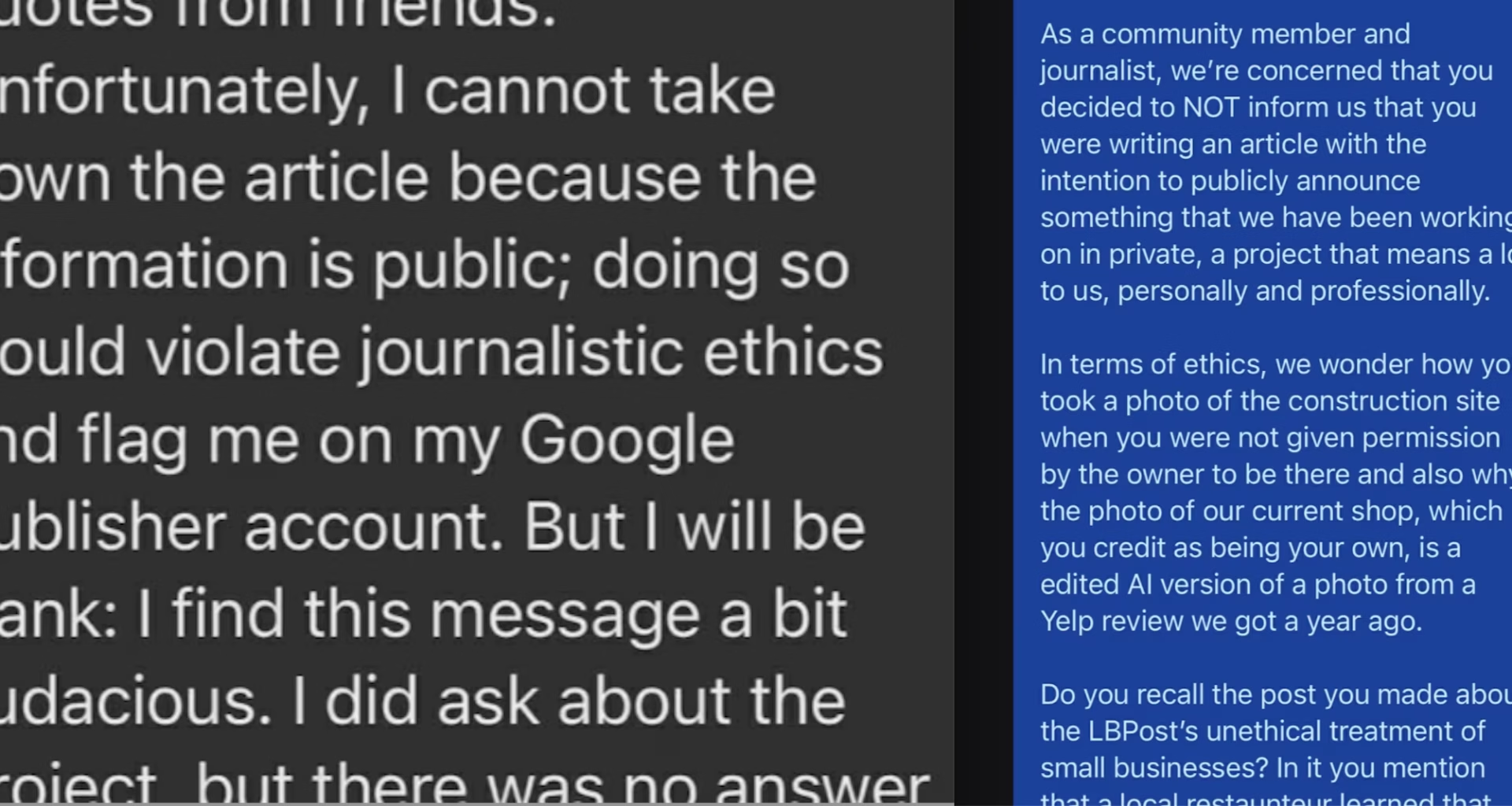
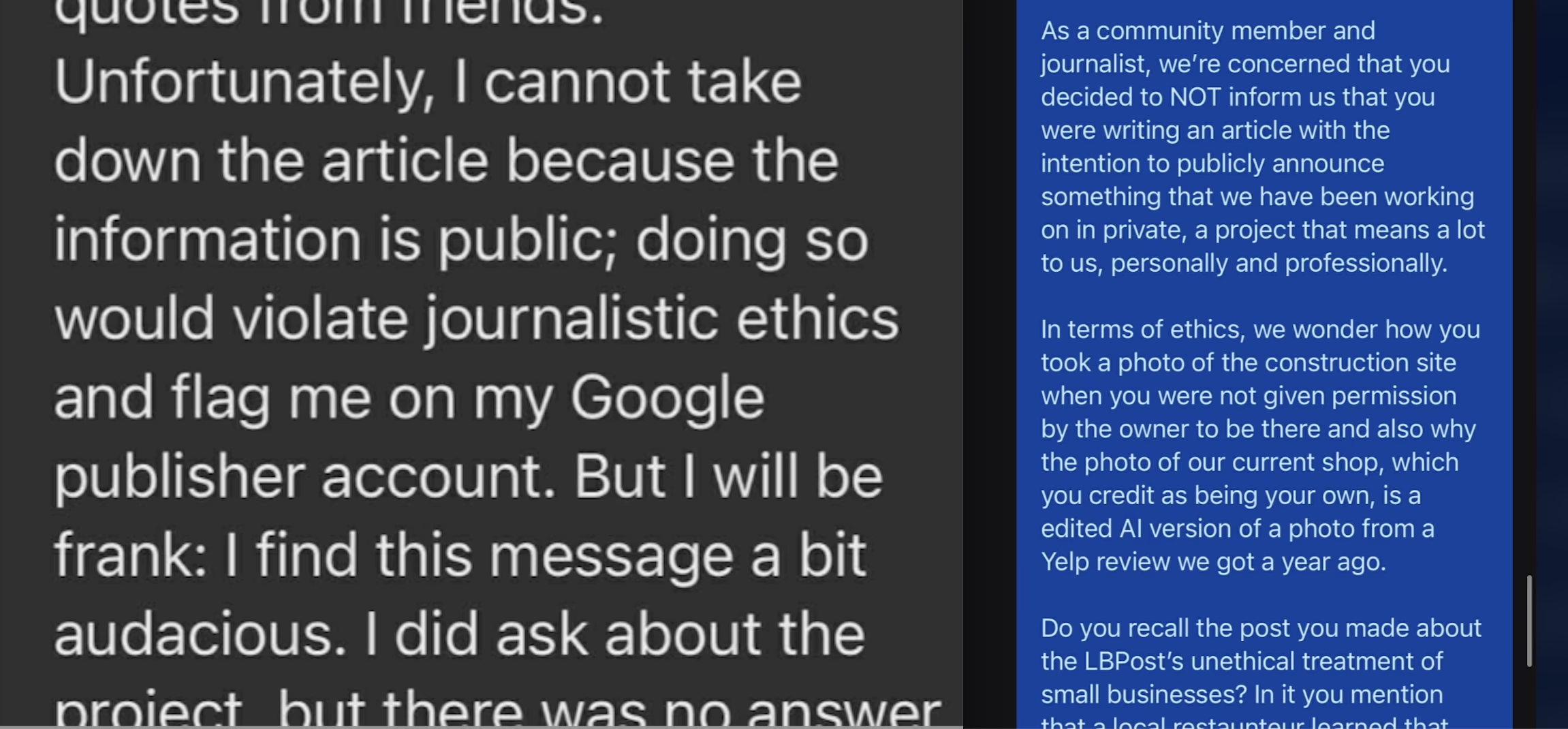
The information shared in [the] recent article was not corroborated by us, nor were we interviewed. The person who wrote it also did not inform us beforehand that he was writing the article. [… W]e reached out and kindly asked that the article be removed. But our request has been refused[,] citing “journalistic ethics.”
The post goes on to cite other ethical concerns with the article: “One photo of the construction site could only have been taken by someone who entered without permission. Another photo (although credited to the author) is sourced from someone else’s Yelp review of our business, badly edited by AI to remove our employee and the photographer’s reflection in the original image.” (Random Lengths News has verified the latter allegation.)
Because Gusto Bread has become a beloved Long Beach institution with national acclaim, condemnation from the community was swift. Addison initially addressed this “odd explosion” in Long Beach Food Scene, a large Facebook group he moderates, protesting “I did reach out to Gusto for my piece” (although his own text history with Gusto, which he shared online ostensibly to support this claim, shows only a single inquiry (“Any further info on the Café Cuate project in DTLB?”) a mere four hours before his article went live — exactly what he did in 2023 regarding the pending closure of MADE in Long Beach).
However, by March 19 he had shifted into damage-control mode, removing the article and issuing a mea culpa in Long Beach Food Scene:
So, I come humbly — genuinely. And I admit: I let my passions and ego get the best of me and I apologize. Sincerely. Woke up with a clear head and heard you loud and clear. I was contradicting even my own standards — and I can’t tell you how much I appreciate the comments, be they critical, supportive, or, even more, both. [¶] My only intention is to support and uplift my community — and my actions clearly did not do that. As always: Eat well, be kind.
But over the course of his journalistic career, Addison’s “standards” have sometimes allowed for writing articles without conducting basic research, failing to correct factual errors even after being made aware of them, fabrication, and plagiarism.
I first became aware of Addison’s willingness to cross such ethical lines during my time with him at the Long Beach Post. In February 2012, an article by the late Bill Pearl, publisher of LBReport.com, alleged that the Post had run a press release from then-State Senator Alan Lowenthal’s office regarding SB 1243 as if it were original Post content, with the byline “Brian Addison.” Pearl’s article included a side-by-side comparison of the press release and Addison’s article, which were identical, save for cosmetic changes to the first two paragraphs (namely, shuffling around a half-dozen words in the opening line, the addition of an Oxford comma, and the removal of a comma and quotation marks from around “gas stations”). Stunned, I tracked down the press release to independently verify Pearl’s claim: it was true.
Although typically plagiarism is a capital offense in the world of journalism, resulting in immediate termination of the guilty party, Addison’s services were retained, and much to my chagrin it became accepted practice for the Post to run press releases as news articles — sometimes with a slightly reworded opening line, sometimes verbatim, always without attribution. Because the usual byline was “Staff Reports,” I could not be certain that Addison was always the culprit; however, his LinkedIn description of his Post duties at the time includes “Oversee and execute published content,” which is accurate.
In May 2012, I stumbled across an even worse instance of plagiarism while copy editing the Post’s print edition, which was among my duties at the time. Reviewing a “Staff Reports” article concerning a no-hitter thrown by a Long Beach City College pitcher, I thought it could do with a bit more detail (as far as I was aware, some “Staff Reports” articles were content original to the Post). In attempting to obtain additional information from LBCC, I came across the exact same article, published anonymously on the LBCC webpage dedicated to its sports program. With the Post reduced to a skeleton crew at this time, Addison was the only person in a position to engineer the misappropriation of the LBCC article. I brought the matter to Post co-founder/publisher Shaun Lumachi’s widow, Deziré (filling in as best she could to keep the Post afloat after Shaun’s tragic death despite no journalistic inclinations of her own), apprising her of Addison’s pertinent history of such actions, and received permission to kill the story for the print edition. However, the article had already been posted to LBPost.com — with an alternative headline (a meager attempt to disguise the plagiarism?) — where it remains to this day.
(Sidenote: One of the first stories I wrote for Random Lengths News was on the Post’s history of such misattribution, wherein I mistakenly situated Addison’s plagiarism of the Lowenthal press release as taking place in 2011 due to Pearl’s piece’s being erroneously dated 2011. The 2012 date of Addison’s “article” can be cross-referenced with articles about SB 1243 in other local publications, along with pertinent California legislative records re SB 1243, to confirm that 2012 is the correct year.)
In the years after I left the Post in 2013, when asked about Addison, typically I would confine my remarks to something along the lines of, “Well, he sure is an enthusiastic cheerleader for Long Beach” (absolutely true), hoping against hope that, as he matured and gained experience, he would move beyond such ethical lapses. And on occasion I appreciated his work, such as a 2017 Longbeachize piece (which I shared on Facebook) criticizing a tone-deaf satirical(?) video by Grunion Gazette Executive Editor Harry Saltzgaver suggesting we put on a “homeless mobile home” contest. But generally I wasn’t a fan and so wasn’t keeping tabs on his progress.
Nonetheless, grumblings about his “standards” would reach me from time to time, and occasionally I did come across evidence that his lapses persisted. A prime example came on October 30, 2018, when I saw an article Addison penned for the Post on the closure of Linden Public, an East Village Arts District coffeehouse. As an almost-daily patron of Linden Public until literally the day it went out of business, it was readily apparent to me that not only had Addison made no effort to obtain the facts, he even created out-and-out fiction:
He stated that Linden Public closed in October; it had actually shuttered in September.He named Hend Elarabi as Linden Public’s owner, when in fact she had sold the business more than six months previous, as even cursory fact-checking would have revealed.He claimed that “multiple closures labeled as ‘remodeling’ [took place] this year. In fact, a remodeling notice still hangs in the window below the space’s new leasing signs.” While two closures had occurred (making “multiple” a technically correct exaggeration), it was a complete fabrication to say that “a remodeling notice still hangs in the window”: that notice (actually located well inside the building — his own picture shows no such notice where he describes) was not put up until after the closure. Prior to that, the last remodeling notice had been taken down over two years earlier after Elarabi rebranded The Greenhouse as Linden Public.
In my own Facebook post and in the comments section of his, I noted these issues, and at least one other commenter on his post joined me in pointing out that Elarabi had not owned Linden Public for over half a year. But rather than acknowledge this, Addison deleted our comments and made no corrections to the article.
***
Because I’ve never laid eyes on the vast majority of what Addison has written, I’m in no position to comment on additional allegations of ethical shortcomings and how rare or frequent such acts may be. (I’m told a forthcoming Long Beach Watchdog piece will further explore this terrain.) For his part, Addison did not reply to multiple requests to comment for this article. But regarding the Yelp photo of Gusto Bread he credited to himself, Addison said (in response to criticism in the comments of his Long Beach Food Scene mea culpa) this was a simple mistake, that he placed it there as “a holder image in the hopes I get [sic] my own of the same style — and I didn’t have time.” He averred that he “never intended to reuse a photo and claim it as my own. [… A]s a photographer who has had my own stuff stolen, I get it.”
If that’s true, we might wonder why he would give an extensive digital makeover to a “holder image,” as well as how exactly the same thing happened just four days earlier. For a March 12 news item about The Hare, Addison apparently took someone else’s photo (Beveldine Stained Glass, showing off their handiwork [really nice!] for The Hare), digitally edited it (warping and eradicating some of The Hare’s architectural features in the process), and claimed “Photo by Brian Addison” in the caption. (Random Lengths News has confirmed that Addison did not shoot the Beveldine photo, nor did he obtain permission to use the image, AI-altered or otherwise.)
Considering that Addison’s recent ethical lapses comport with earlier failings, there no longer seems to be any point in not spotlighting them in the hope that he will self-correct. To piggyback on his mea culpa, I too believe in supporting and uplifting my community — and openly discussing the quality and integrity of the reportage in and about my community seems to me a means to that end. Because I could not agree more with what he wrote in 2018: “good local journalism is a crucial cog in the functioning of our future.”
We rely on local journalists to faithfully inform us about what they see in our community, and we trust — or want to trust — the integrity of their work. But who watches the watchers? Maybe that’s something I heard on Buffy the Vampire Slayer, or a newspaper motto, or an ethicomoral philosophical chestnut — but who cares, because seriously: who? Maybe the answer is: we watch (and watch out for) each other. Maybe we hold each other — and ourselves — accountable. Maybe it’s up to us.
Addison himself apparently agrees. His piece on the Saltzgaver video is one example. Another came just four months ago, when he took to Long Beach Food Scene to “rant” to his 90,000+ group members against the Post (from which he had been fired — for the second time — four years earlier) because “it is worth stating out loud [that] the egregious way in which the Long Beach Post approached small businesses is outright unethical.” The specific allegation that triggered his diatribe was not that the Post had engaged in anything as serious as reporting false information or plagiarism, but that they did not comply with a restaurant’s request to hold off publishing a story about forthcoming changes to their business. “There was zero need for [the Post] to rush this story,” Addison wrote, “or force it out when business transactions were on the line. [… T]his charade that they are ‘community-centric’ is, at this point, absolutely absurd.”
Maybe your journalistic integrity is nobody’s business if what you’re doing is for a private newsletter with a circulation of 50 (although isn’t scope — or subject matter, or whether the person/company you’re writing about is paying you — beside the point?). But when you admin a public forum with a membership size equivalent to 20% of the population of Long Beach (U.S. Rank by Pop. (2020 census): #41), when you’ve got 175,000 followers across your socials, when you run a website claiming to be “Upholding authentic and community-centric integrity” that you yourself say is “more than just a media outlet; it’s a community hub” with readers who are “passionate, [and] want to be informed,” maybe it is somebody else’s business. Maybe it’s the community’s business.
Love him or hate him, Brian Addison is a prominent part of our local media landscape. And although his primary beat is the food scene, he regularly writes about more “newsy” issues such as housing, commercial development, and City of Long Beach projects and policy. In 2024, he received multiple Absolute Best of Long Beach Awards. Last year he was feted by Downtown Long Beach Associates for being a “Distinguished journalist” whose work is “enriching” downtown. And let’s say it again: he sure is an enthusiastic cheerleader for Long Beach. But in a city that is vastly underserved journalistically, Addison enjoys an outsized presence — deserved or otherwise.
At least one community member concerned about the integrity of local journalism has hurled a pointed epithet Addison’s way: “Unethical blogger.” Addison was amused enough to use it as a self-descriptor on his Facebook and Instagram pages — quotation marks inclusive, tongue firmly in cheek.
Considering certain aspects of his journalistic record, for some the irony is impossible to miss.
Like this:
Like Loading…
Related