
By Kira Olsson
For The Union-Tribune
Did you know that San Diego County is officially the “bee capital” of the U.S.? In May 2025, the Xerces Society for Invertebrate Conservation designated San Diego as a Bee City USA, recognizing our city’s commitment to protecting the incredible biodiversity found right in our backyards.
Bees are a primary reason why our local ecosystems and backyard veggie patches are so productive and vibrant. From the almonds in your pantry to the tomatoes on your vine, our survival is intimately linked to theirs.
Beyond the classic honeybee, our local canyons and gardens are teeming with tiny, unsung heroes, as San Diego County is home to over 650 species of native bees. If you look closely at your flowers, you might spot the stunning, metallic-green sweat bee, a fuzzy bumble bee, or even a leafcutter bee trimming perfect circles out of your rose leaves to line its nest.
The specialist superstars
Most of our native bees are solitary, meaning they don’t live in big, social hives with a queen. Instead, individual females work tirelessly to build small nests for their young. Many have evolved a “specialist” relationship with our local flora, visiting only one specific kind of flower. This evolutionary bond is one of the coolest things about San Diego’s ecology.
For the vegetable gardeners among us, the squash bee (Peponapis pruinosa) is a fan favorite. These bees are early risers, making pre-dawn visits to the newly opened blossoms of summer and winter squash, pumpkins and gourds. If you find a bee “napping” inside a wilted squash flower in the afternoon, it’s likely a male waiting for the next morning’s bloom. The morning glory digger bee (Diadasia bituberculata) is a specialist that relies entirely on our coast morning glory (Calystegia macrostegia), raising generation after generation in the exact same patch of garden.
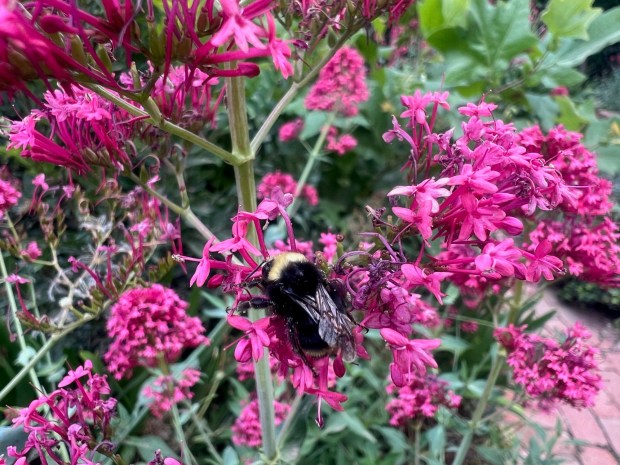 A yellow-faced bumble bee (Bombus vosnesenskii) on red valerian (Centranthus ruber). (Kira Olsson)
Turning your yard into a bee paradise
The great news is you don’t need to be a beekeeper to make a massive difference; you just need to think like a bee! If you plant native “drifts” (large clusters) of California buckwheat (Eriogonum fasciculatum), Cleveland sage (Salvia clevelandii), desert globemallow (Sphaeralcea ambigua) or California poppies (Eschscholzia californica), you are essentially opening an all-you-can-eat buffet. Native bees love native plants!
Aim for a seasonal sequence of flowers from February through October. The UC Agriculture and Natural Resources Publication 8498, “How to Attract and Maintain Pollinators in Your Garden,” is a fantastic resource with a comprehensive plant list to help you curate a garden that supports bees with year-round sources of pollen and nectar.
Beyond food, bees also need “real estate”: 70% of our native bees live underground. A few sunny patches of bare, unmulched soil will provide prime nesting ground for these species. For cavity nesters, leave 12 to 18 inches of hollow, pithy stem stubble when you trim spring perennials. Stacked rock walls, old logs and well-placed bee “hotels” provide even more “rooms” for these vital neighbors.
Finally, provide water. A shallow dish filled with pebbles and water, or a birdbath with added rocks, gives thirsty bees a safe landing pad so they can hydrate without drowning. Refresh the water regularly to prevent breeding mosquitoes.
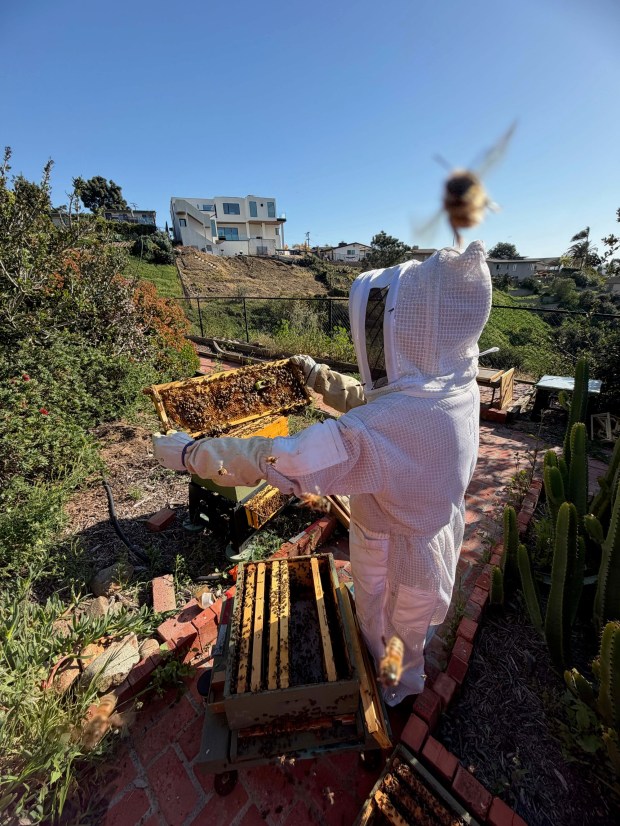 Beekeeper Amy Weinheimer requeening one of her Bay Park bee hives. The feral queen is being replaced with an Italian queen who was mated in Hawaii. (Kira Olsson)
Our partners in the hive
While native bees are the quiet, solitary workers, the European honey bee (Apis mellifera) is the pollinator generalist with a “wild side.” Because of our mild climate, feral bees have become locally adapted over decades, creating a genetic hybrid zone. They are incredibly hardy survivalists, which makes them excellent pollinators, but that can also lead to more defensive behavior when protecting their hives and honey. These feral bees (Apis mellifera scutellata) share genetics with Africanized bees, giving them a resilient edge that allows them to thrive in our canyons without any human help.
Fortunately, our local beekeepers are citizen scientists who help keep our neighborhoods friendly by routinely “requeening” their hives with gentle genetics to dilute those “spicy” traits, ensuring that our bees stay strong but manageable. If a wild swarm does move in, please don’t call a pest control company. Instead, check out the San Diego Beekeeping Society’s list of professionals who can safely ensure live removal and relocation.
Curious about keeping your own hive? The society is a welcoming community for classes and mentorship. Free monthly meetings are open to the public. Come make friends with a whole group who get excited about pollen colors and fascinating bee behavior. An added benefit: Researchers have found that the combination of physical activity, mindful focus and exposure to hive products can reduce stress and improve overall health.
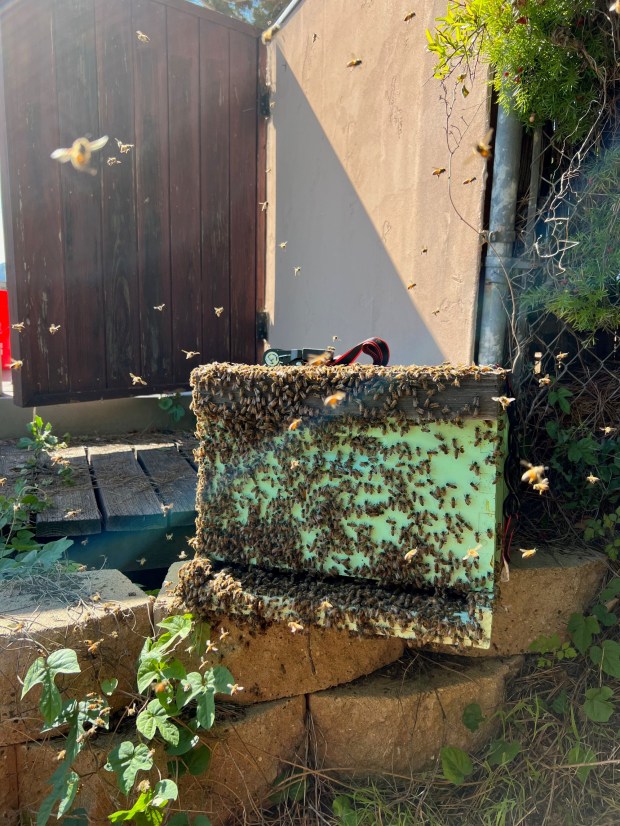 Another successful rescue for the San Diego Bee Sanctuary. These honey bees were living under a pine tree in Bay Ho and now are happily pollinating avocados in Valley Center. (Kira Olsson)
Protect the pollen
The most important tip for a bee-friendly garden is to avoid pesticides. Check the UC IPM website to learn how to manage pests using the least toxic methods. When shopping for new plants, always ask if plants were treated with systemic pesticides. These chemicals are absorbed into the plant’s tissues, making the nectar and pollen toxic to the bees you are trying to help.
Whether tending a hive or planting a few sages, you’re making San Diego a buzzier, more beautiful place. After all, one-third of the food we eat depends on these fuzzy little aviators.
Olsson, a UC Master Gardener since 2014, is a San Diego native, much like the adorable yellow-faced bumble bee. Passionate about sharing her love of all insects and edibles, she presents in classrooms and at events across the county. She works with San Diego Bee Sanctuary doing live rescues and volunteers with the San Diego Beekeeping Society to promote responsible beekeeping.
Get free gardening advice
UC Master Gardeners of San Diego County hotline: 858-822-6910