
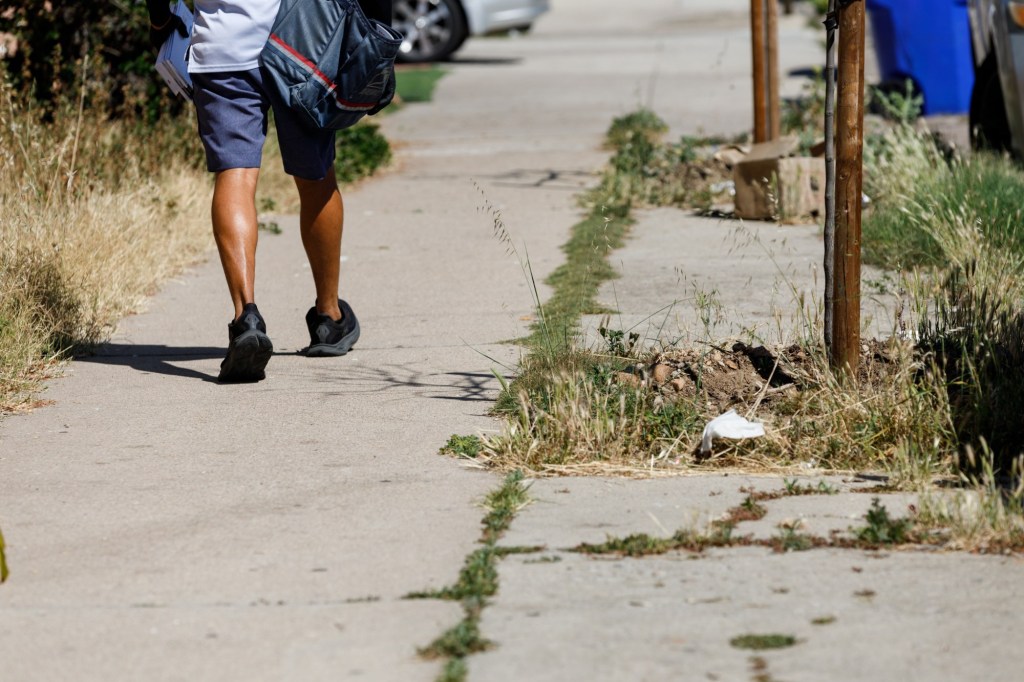
San Diego Mayor Todd Gloria is prioritizing funding for sidewalks, streetlights, potholes and other Transportation Department projects despite the city facing a $120 million deficit.
Gloria is proposing a $10 million increase to transportation funding in the budget he will unveil Wednesday for the new fiscal year, contending such funding is too important to city residents to be cut.
But funding for road repairs, which comes mostly from outside sources like the state gas tax instead of the city’s general fund, would drop from about $80 million to $66.5 million in the proposed budget.
While that’s a 17% reduction, aides to Gloria say that amount will keep the city on track to hold overall road conditions steady until more money is available to get them up to national standards.
The proposed budget does include some cuts that could increase repair backlogs for things like sidewalks, but funding would increase for tree trimming and remain steady for weed abatement and graffiti eradication.
Gloria said he ranked transportation funding second behind only public safety funding when making the tough choices this winter and spring about what should and shouldn’t get cut in the city’s $2.2 billion annual budget.
“I think this aligns with the priorities of San Diegans,” the mayor said in a phone interview. “I’m acutely aware of the conditions of the city’s roads. It doesn’t matter the neighborhood, all of our communities have road repair needs.”
A resident survey being conducted this spring by the city shows transportation projects are the No. 1 priority — even over public safety.
The mayor was quick to point out that prioritizing transportation and public safety means deeper cuts in other areas of the budget that also matter to people.
“I don’t want to represent this as all good news,” he said. “There will be cuts that will be painful and regrettable.”
While the mayor hasn’t revealed what those cuts will be, the city has historically targeted libraries and parks for budget reductions during lean times.
But the mayor and his staff have indicated they plan to make cuts in nearly every city department in the new budget.
The proposal to increase transportation money in the general fund from $121.2 million to $131.3 million includes a $3.3 million increase for tree trimming and a $1.7 million increase for employee overtime.
The rest of the increase is mostly the result of pay raises employees receive for hitting seniority milestones and increased costs for equipment and supplies like asphalt.
The increased money for tree trimming would help the city meet its climate action plan goals by boosting its tree canopy. In addition, the money would help the city comply with a recent settlement with the local Air Pollution Control District.
Gloria said he veered from initial plans to reduce spending on weeds and graffiti because of the message it sends to both residents and outsiders when a city neglects such things.
“They are early tells to our taxpayers that we have our priorities right,” Gloria said. “Job creators may think twice about investing in San Diego if they are at an intersection and see potholes, weeds and graffiti.”
Funding for weed abatement would remain at $1.6 million and funding for graffiti removal would stay at $2.2 million. The average response time to remove graffiti scrawls would stay at five days.
Gloria said those expenditures are low enough to make the return on investment impressive and worthwhile.
The increase to employee overtime from $2 million to $3.7 million is crucial, officials say, noting that $2 million is an unrealistic number the Transportation Department reached quickly during the ongoing fiscal year.
Emergencies after hours or on weekends require a large overtime budget, officials say. And overtime money is needed to shrink long repair-request backlogs for sidewalks and streetlights.
Through the end of February, some of those backlogs had reached startling levels: 7,142 for streetlight repairs, 8,285 for sidewalk fixes, 6,738 for road striping and signage jobs, 2,350 for stop signs and speed bumps and 6,765 for code-compliance issues like graffiti.
Transportation officials have said $6 million would be an ideal amount for overtime, so the jump from $2 million to $3.7 million is only a partial solution.
The overtime increase would also allow the city to build on recent success it’s had with an in-house paving team. An alternative to outside paving contractors, the team has completed 30 lane miles of work this fiscal year.
The proposed budget would also devote $551,000 to upgrades at the city’s most dangerous intersections, which have been identified by local nonprofits and a new city analytical tool that uses crash statistics to predict future incidents.
The upgrades would likely include features like crosswalks, flashing beacons, colored curbs and roundabouts.
The budget doesn’t include $2.4 million to buy and install new signs announcing lower speed limits in neighborhoods across the city that the City Council recently approved.
But aides to Gloria said they expect the funding to be added during budget season, perhaps when the mayor revises his budget in May or during negotiations with the council over a final budget.
Gloria said it’s important to upgrade dangerous intersections and lower speed limits.
“It’s a matter of life and death,” he said.
The budget also anticipates accelerating some transportation projects by increasing use of a city program that buries power lines underground to boost safety and aesthetics.
Funded by a surcharge paid on power bills, the program pays for undergrounding projects and related efforts that sometimes include streetlight repairs, paving and sidewalk upgrades.
The city will have the most ever neighborhood undergrounding projects launched in the upcoming fiscal year – nine total projects. That will leverage $92.5 million in funding for neighborhood upgrades.
On roads, the news is less positive.
The proposed funding drop from $80 million to $66.5 million would cover $39.5 million in slurry seal efforts and $27 million in more extensive overlay work.
Transportation officials created an ambitious plan two years ago to spend $1.7 billion over 10 years — $1 billion more than the city is projected to spend — to get city roads up to a pavement score of 70, which is the national standard.
The last comprehensive street survey, completed in 2023 by an outside consultant, showed that the city’s rating had dropped from 71, which is “satisfactory,” down to 63, which is “fair.”
The budget crisis has forced a retreat from plans to increase the city’s overall rating to 70, with city officials hoping instead to maintain a score of 65 until more funding is available.
A report on the city’s latest road ratings, which is expected to show a decrease below 65, is scheduled for the April 23 meeting of the council’s infrastructure committee.
Transportation officials say that without new sources of money for fixes, the overall condition of the city’s streets will steadily decline to a “poor” rating of 53 by 2035.
Gloria is scheduled to release his proposed budget Wednesday, with council hearings slated for May 4-8 and a final vote expected in June.