
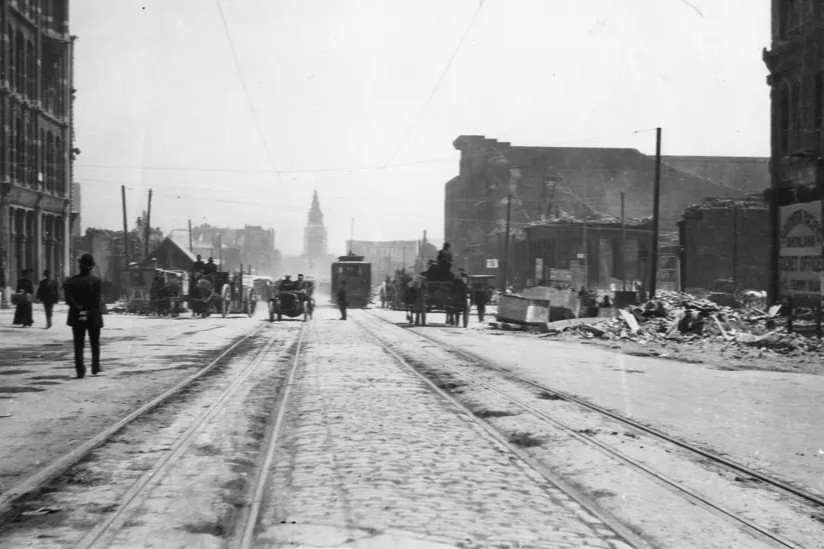
The tower of the Ferry Building at the foot of Market Street remains intact in the aftermath of the 1906 San Francisco earthquake and fire.
S.F. Chronicle
Streetcars crowd Market Street at Geary Street in the mid-1940s.
S.F. Chronicle
The Winchester Hotel in downtown San Francisco burns after the 1906 earthquake.
Library of Congress
San Francisco Sheriff Paul Miyamoto speaks at Lotta’s Fountain during the 2024 commemoration of the 1906 earthquake and fire.
Camille Cohen/For the S.F. Chronicle
The bust of Mayor James “Sunny Jim” Rolph is displayed at San Francisco City Hall last December. Rolph was a member of the South of Market Boys, a fraternal organization comprising survivors of a major neighborhood destroyed in the 1906 earthquake.
Lea Suzuki/S.F. Chronicle
As seen from the Ferry Building, cable cars crowd Market Street in August 1905, months before the 1906 earthquake and fire changed San Francisco life forever.
S.F. Chronicle
Norma Norwood, a 1906 earthquake survivor, is escorted to the stage at Lotta’s Fountain during the 2006 commemoration of the 1906 earthquake and fire. Norwood died in 2006.
Frederic Larson/S.F. ChronicleThe annual predawn gathering commemorating the 1906 earthquake will take place next Saturday, continuing a San Francisco tradition that began in 1925.The 1906 earthquake and fire destroyed the flimsy buildings that occupied the area now known as South of Market, but survivors kept the spirit of the neighborhood alive.The South of Market Boys, once a 3,500-member organization of former residents, played a major role in city social life and earthquake remembrance events for decades.
One of the most famous movies about San Francisco is one of the oldest — a silent film shot from the front seat of a moving cable car heading down Market Street toward the Ferry Building. It’s a slice of life in the past century — a street full of people, delivery trucks, bikes, other street railway vehicles, even a few automobiles of the day, cutting in and out of traffic. Pedestrians jaywalk and step in front of moving vehicles, only to jump aside at the last minute.
The film is important, too. It apparently was shot only days before the great earthquake and fire of April 18, 1906, so it is a last look at what the writer Will Irwin called “The City That Was.”
Article continues below this ad
The film is called “A Trip Down Market Street,” and you can see it for yourself on the internet.
A few things are familiar: the Ferry Building at the foot of Market Street, the way those old San Franciscans paid no attention to traffic.
Donna Ewald Huggins, center, sings “San Francisco” along with the Guardians of the City during last year’s ceremony at Lotta’s Fountain commemorating the 1906 earthquake and fire.
Lizzy Montana Myers/For the S.F. Chronicle
But to the right of the cable car is a vanished world: South of Market, home to about 60,000 people then. Market Street was in every way a dividing line: the best people lived in the northern half of the city. The others were on the wrong side of the tracks. In San Francisco, that meant the cable car tracks, with a characteristic slot between the rails that allowed access to the cable running under the street that pulled the cars along. That gave the district its name: South of the Slot.
San Francisco Chronicle Logo
Make us a Preferred Source to get more of our news when you search.
Add Preferred Source
This, of course, was before SoMa or East Cut, or the glittering mostly empty glass towers along Mission Street, before skyscrapers on Rincon Hill, and before the mixture we have now: the clubs, the leather district along Folsom Street.
Article continues below this ad
South of Market had its own mix: The world-famous Palace Hotel was on the south side of the street, there was the Grand Opera House on Mission Street, and a granite U.S. Mint, full of gold. There were also big wooden flats packed with families lining the little alleys: Mina, Natoma, Tehama, Clementina, Stevenson — slums, really, kids playing in the street. Cheap hotels, flophouses, a crowded district full of life. They had their own distinct accent South of Market — the words all run together, mangled up a bit so it was “Southa Market,” and “Potrera Avenoo” for a street that led out of town on the way to Sannazay. They said “yeah” a lot. But it didn’t always mean “yes.” So watch it, kid.
Robert O’Brien, who wrote a column called Riptides in the Chronicle, thought South of Market was the heart of the city.
That city died on the morning of April 18, just 120 years ago next Saturday. The earthquake wrecked the flimsy buildings. The fire destroyed the rest. “That was the end of South of the Slot; that was the beginning of the San Francisco we see today,” O’Brien wrote.
The Admission Day Monument in the foreground and Flood Building in the background, both on Market Street in San Francisco, survived the 1906 quake.
S.F. Chronicle
The people who lived South of Market moved away — to the Mission, the Richmond, the Sunset, even to Oakland. Most never returned. They did not see themselves as victims, but as survivors, keepers of the spirit of the city. They never forgot.
Article continues below this ad
In the fall of 1924, Peter Maloney, a well-connected police officer and civic leader, helped organize the South of Market Boys, open to anyone who lived in the district before the fire. “There’s a laugh in it, there’s a tear in it, and there’s a rock-bottom fellowship in it,” he wrote in the first issue of the South of Market Journal.
Peter Maloney was the group’s first president, and he no doubt presided over the first annual gathering before dawn at Lotta’s Fountain on April 18, 1925. The gathering has become San Francisco tradition and will be staged again just after 5 a.m. next Saturday.
It’s a grand old event, and a little haunted, too. At 5:13 a.m., the fire trucks at the ceremony will set off their sirens, the wail bouncing off the tall buildings, loud enough to stir up the ghosts of another vanished city.
A vintage cable car, one of the originals that survived the 1906 earthquake, carries passengers during Muni Heritage Weekend in September 2017.
Amy Osborne/S.F. Chronicle
The South of Market Boys were pretty lively ghosts. They believed in drinking a toast to the old city and having a good time in the new one. They had grand ceremonies, including a South of Market ball every year. They sponsored baseball games at Seals Stadium, they sponsored a shelter for the down and out, and they helped the sick and the old folks at Laguna Honda Hospital.
Article continues below this ad
All the top people belonged, including the mayor, James “Sunny Jim” Rolph. All the other politicians, too. Most of all, the South of Market Boys were a great networking organization, 3,500 strong, as big as any social organization in the city.
One of the big shots — as they used to call them — was Tommy Maloney, Peter’s older brother. He and his brother were the sons of a saloonkeeper from County Kildare. Neither brother had more than a sixth-grade education, graduates of “the college of hard knocks,” as Peter put it.
Tommy was elected to the state Senate in 1924, the year the South of Market Boys were founded. He then transitioned to the Assembly, where he was speaker pro tem, a solid supporter of union causes, workers’ comp and other issues. He represented San Francisco in Sacramento for 32 years.
He was one of those old-time retail politicians: He went to wakes and weddings and every fancy ball. He never forgot a friend, a real South of Market Boy.
Article continues below this ad
William Del Monte, a survivor of the 1906 San Francisco earthquake and fire, commemorates the 105th anniversary of the disaster in 2011. Del Monte, the last San Franciscan remaining from the earthquake, died in 2016.
Liz Hafalia/S.F. Chronicle
Eventually, time got them all. Leo Sapienza was the last president of the South of Market Boys; for nearly 50 years, he ran the 1906 commemoration. He died at the great age of 95 in 2014. His daughter Karen took the event over, but she passed away as well. And in 2016, William Del Monte, the last San Franciscan who was alive in those days, died at age 109.
And now the guard is changing again. After 39 years of organizing the event, lining up the civic leaders, setting up the space, doing a thousand things, Lee Houskeeper is stepping away. This is his last 1906. Next year it will be someone else. Houskeeper is a unique San Franciscan: the survivor of the survivors.