
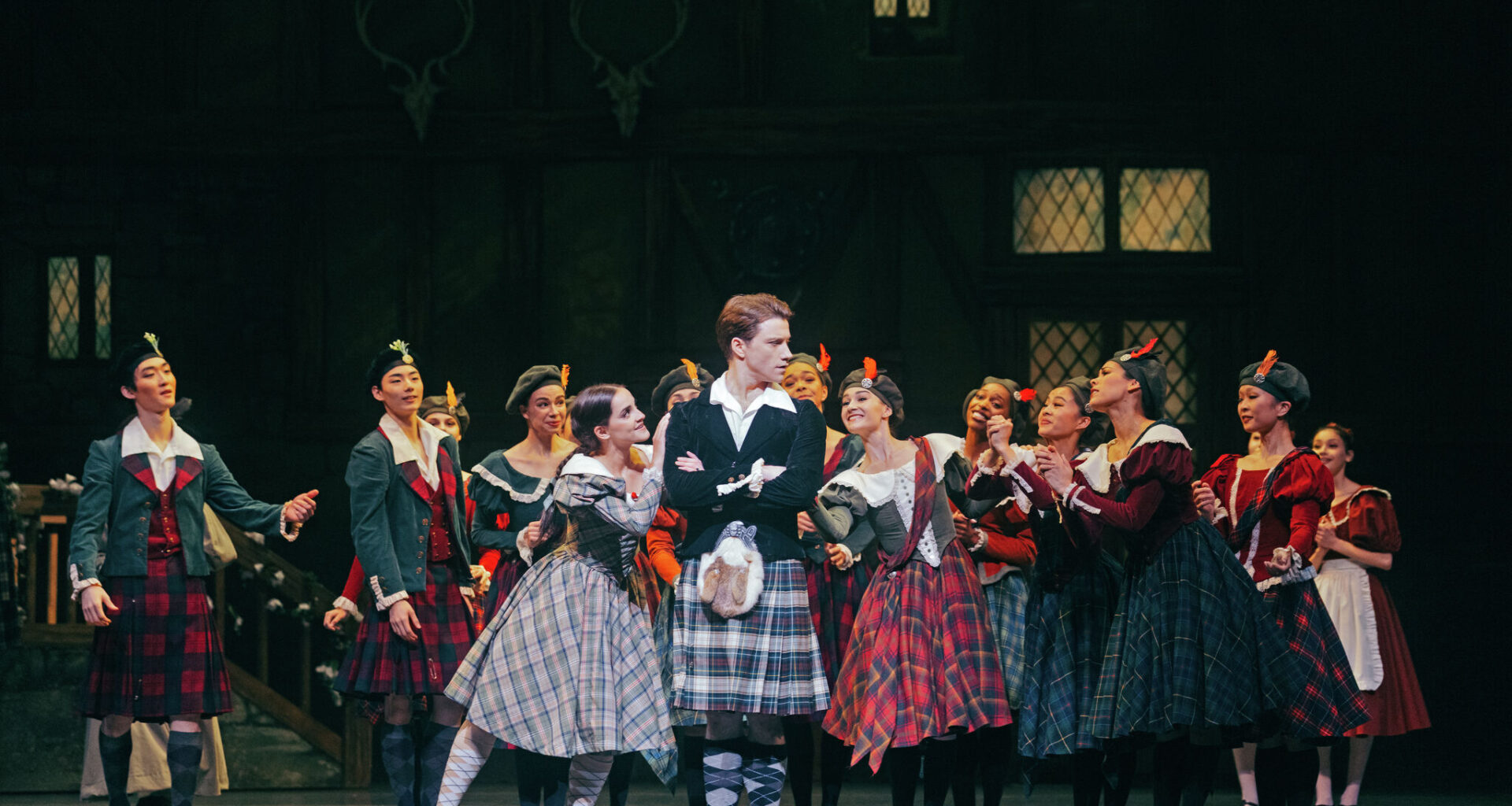
Alban Lendorf, center, in August Bournonville’s “La Sylphide.”
Lindsey Rallo/San Francisco Ballet
“La Sylphide” could come across, to the casual ballet-going public, as a San Francisco Ballet program to skip this year. Some may assume it’s just a quaint, fusty museum piece squeezed in as a kid-friendly addition to fill time before the avant-garde “Mere Mortals” returns to close out the season.
Well, OK, “La Sylphide” is indeed quaint. But dismissing it as fusty would be an unfortunate act of self-deprivation.
“La Sylphide”: San Francisco Ballet. Through Thursday, April 16. $35-$595. War Memorial Opera House, 301 Van Ness Ave., S.F. 415-865-2000. www.sfballet.org
On Friday, April 10, when those winged sprites took to the War Memorial Opera House stage for a seven-performance run, the whole tartan-and-gossamer fable felt more alive than ever.
Article continues below this ad
“La Sylphide” is the ballet that brought about the very invention of the pointe shoe when Marie Taglioni danced its Paris premiere in 1832. Sure, its world can seem twee, reflecting Scandinavian values of community and modest domesticity. (“La Sylphide” has been continuously performed by the Royal Danish Ballet since August Bournonville re-choreographed it there in 1836.) It’s also true that the ballet’s virtuosity — fluttering jumps that bound, rainbow-like, across the stage — is of a gentler sort than all those whiz-bang Marius Petipa works like “Don Quixote,” with their grinding, grueling 32 fouettes.
But what a beautiful style this is, especially danced with such miraculous softness and loft by Wona Park. And what a surprisingly timeless story this is, moral yet endlessly nuanced.
Wona Park in Bournonville’s La Sylphide // © San Francisco Ballet, photo by Lindsey Rallo
Lindsey Rallo/San Francisco Ballet
The setting is Scotland — very exotic to Danes back in the 19th century (not to mention great for showing off a male dancer’s petit batterie beneath a flapping kilt). The extraordinary former Royal Danish Ballet principal Alban Lendorf performed as James on opening night, dreaming by the fireplace on his wedding day as Park’s sylph waited to tempt him away from his fiancée, Effie.
San Francisco Chronicle Logo
Make us a Preferred Source to get more of our news when you search.
Add Preferred Source
Rising soloist Fernando Carratalá Coloma was a charming standout as Gurn, the simple young man who wishes he could marry the wholesome, lovely girl James has spurned in favor of fantasy. Meanwhile, as Effie, Carmela Mayo did a marvelous job keeping the mime passages in character but also broad enough to make every plot point discernable in a vast venue.
Article continues below this ad
But one of the most exciting performances was Nathaniel Remez’s lankily crooked rendition of Madge, the village witch who gets revenge on James by preparing a poisoned scarf she claims will enable him to finally possess the sylph in the flesh.
(Spoiler alert: The scarf actually kills her, though alas the 19th century stagecraft didn’t function quite according to plan on Friday, with one of Park’s dainty wings dropping before Lendorf wrapped her up.)
Alban Lendorf, left, and Wona Park in August Bournonville’s “La Sylphide.”
Lindsey Rallo/San Francisco Ballet
The lesson is clear: never forget that a fantasy is, by very definition, unattainable.
But how can we judge James too harshly when we remember ourselves at just 18 or 19 years old, not yet mature enough to reckon with the existential terror of finite existence? Or, consider the other rich readings of the moral that are possible if we consider the sylph as connected to the sublimity of nature. Perhaps we should see James more generously, as a seeker of not only of erotic romance, but also nature’s transcendence. Perhaps his tragedy is that he is not content to merely exist among nature, but instead seeks to possess and control it.
Article continues below this ad
San Francisco Ballet’s former artistic director Helgi Tomasson made “La Sylphide” one of his earliest priorities, adding it into the repertoire in 1987. But the vitality of these current performances is largely due to Ulrik Birkkjaer, who trained with the Royal Danes from age 6, danced James in Denmark, and then finished his career at San Francisco Ballet.
Birkkjaer first staged and coached “La Sylphide” here in 2022, before he retired from performing. In recent weeks, he returned to San Francisco to touch up this staging. His care shows not only in the mime so closely tied to Herman Severin Løvenskiold’s score, but also in the style of the 19 sylphs, whose torsos bend gently from their waists, just as Taglioni’s does in those Romantic-era lithographs. Kamryn Baldwin shone as their leader Friday, rolling down from pointe with impressive control.
Alban Lendorf in Augst Bournonville’s “La Sylphide.”
Lindsey Rallo/San Francisco Ballet
The Ballet Orchestra, close to wrapping its 50th anniversary season, sounded especially sonorous in the score’s horn passages.
This run, through Thursday, April 16, will bring three other James/Sylph pairings. Wei Wang will do double-duty, dancing with Jasmine Jimison and Nikisha Fogo in different shows. But only Lendorf is the real-deal product of Danish training — and Park, capping one of the best seasons since her rapid rise to principal, could not be lovelier opposite him. They’ll dance one more time, at the Sunday, April 12, matinee. You just might walk out floating, too.
Article continues below this ad
Rachel Howard is a freelance writer.