
The Long Beach boardwalk is a major attraction for visitors and a part of the daily routine for most residents. In the coming months, the boardwalk experience may take a turn toward the tipsy.
The City Council has voted unanimously to amend two city ordinances which currently limit the opening of bars and restaurants and prevent the sale of alcohol at the boardwalk. The change will create an opportunity for new establishments to open throughout the city and, just as important, to allow boardwalk-facing businesses to sell alcohol.
City Manager Dan Creighton began Tuesday’s council meeting by explicitly stating what the amended ordinances would not allow. “To be clear, if adopted, these changes would not, I repeat, not, allow the sale or consumption of alcohol on the boardwalk or beach.”
The ordinance amendments will allow businesses “that have an opening to the boardwalk” to serve beverages, alcoholic and otherwise, as well as food. It will affect concession-style cafes and restaurants that face the boardwalk, with the expectation that beverages will be consumed on the premises and not taken elsewhere. The amendments also permit new bars to open anywhere in the city, even those with functional bars or “service areas’ more than 10 feet long — a limitation in the current ordinance.
A similar proposal to expand alcohol sales was considered in February 2017. The council at the time, which had none of the current members, upheld the ordinances and their restrictions in a 4-1 vote.
The ordinances were first implemented in 1986. Sporadic variances, or exemptions, have been allowed in the years since. The city’s corporation counsel, Greg Kalnitsky, noted recent legal precedent. “In the last 13 years, the zoning board has heard 18 applications for new establishments or establishments looking to extend the size of their bar,” Kalnitsky said, “and they have approved all of them.”
The Allegria Hotel, which opened in 2009 and has operated without notable incidents, was referred to throughout the meeting as an example of a boardwalk-facing business that sells liquor. Those who favored lifting the ordinance saw the Allegria as a testament to responsible beach-adjacent liquor sales.
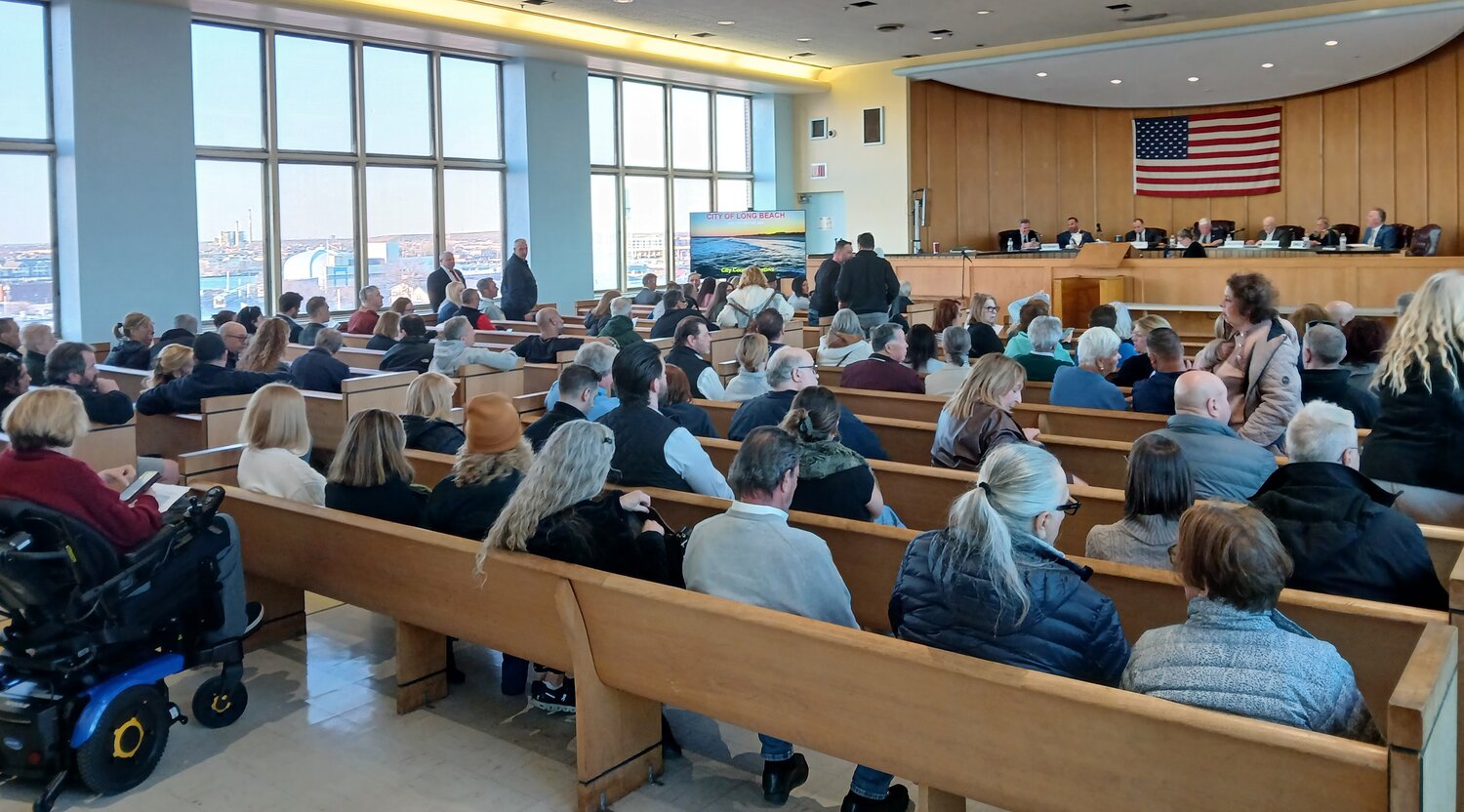
More than 200 concerned residents, advocates and business owners attended the meeting to voice opinions on both sides of the argument. The single agenda item took over three hours to resolve. Anyone who wished to address the council was allowed to do so, with dozens of residents taking the opportunity to speak for up to three minutes at a time.
Denis Kelly, the first to speak, is the attorney for Riptides 11561, a boardwalk-based cafe that submitted a still-pending application to the State Liquor Authority last November with the hope of adding alcohol to its menu. Kelly addressed rumors circulating through social media, and clarified that Riptides would not be open for late-night liquor sales, and would not host DJs or create a nightclub environment.
Next to speak was Nicolas Geeraerts, owner of Tulum Tacos & Tequila, which has locations in Baldwin and Mineola. Geeraerts is set to expand to the boardwalk this summer, and hoped to alleviate worries about his business. “Our lease prevents us from being open past 11 p.m. at night,” he said. “We are not opening a nightclub. We are opening up a first-class establishment. A Mexican eatery and speakeasy.”
Mike Murphy, a Long Beach resident, noted a simple benefit of revising the ordinances. “If we all take a look outside, you can see the boardwalk. You can see it’s a million-dollar view,” Murphy pointed out. “I’m sober over 30 years. I would like to take my wife on the boardwalk for a ride at sunset, have a drink — I’ll have a soda, she’ll have a drink — and enjoy that million-dollar view.”
Other residents expressed concerns about an overabundance of bars in the area. “Except for the poor people on Illinois, Ohio and Nevada, everybody in the West End is within one traffic light of a bar,” Jack Ryan, a West End resident, said, with some hyperbole. “Those poor people have two traffic lights to get to a bar. We don’t need any more.”
“The research is very clear,” said Judi Vining, executive director of Long Beach Aware, a nonprofit focused on reducing underage drinking. “There is a direct correlation between the number of alcohol-serving businesses in an area and the amount of underage drinking. The data backs this up. Look at the Boston School of Public Health, the Center on Alcohol Monitoring and Youth and Dr. David Jernigan’s research on ‘Alcohol Outlet Density Impact.’”
To further address misunderstandings and misinformation, City Council President Brendan Finn re-emphasized the facts of the ordinance amendments. “Alcohol is still not, not, permitted on the boardwalk or on the beach,” Finn stated. “Open containers are not permitted on the boardwalk or on the beach.”
The ordinance amendments will go into effect immediately.
Have an opinion on the City Council’s decision? Send a letter to ccolucci@liherald.com.