
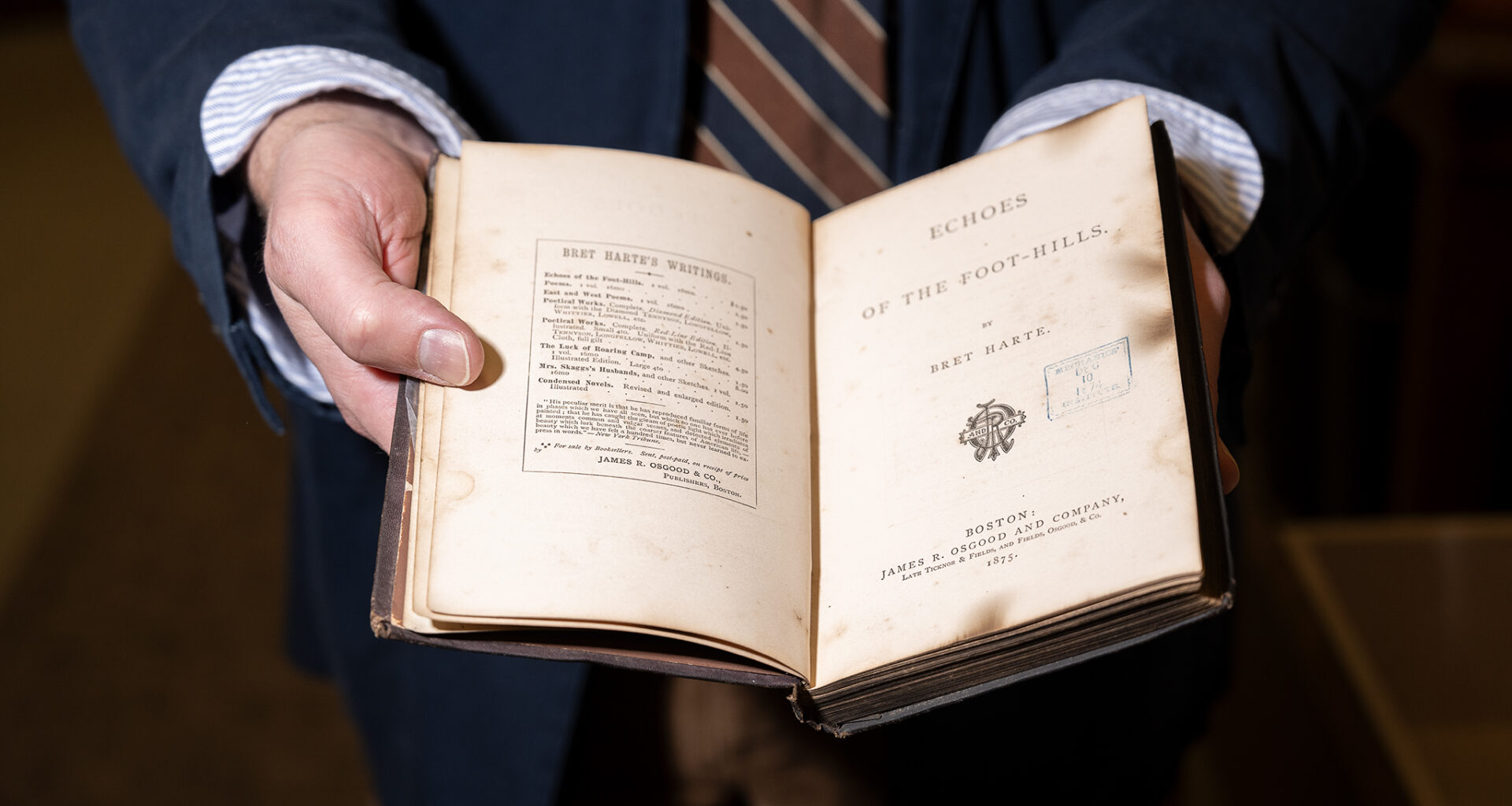
Mechanics’ Institute library manager Myles Cooper takes a key from his pocket, unlocks a display case and picks up a soot-stained copy of “Echoes of the Foot-Hills,” published by San Francisco writer Bret Harte in 1875. The book of poetry begins by setting the scene with a series of rhyming couplets about the Presidio.

“Looking seaward, o’er the sand-hills stands the fortress old and quaint, by the San Francisco friars lifted to their patron saint,” it reads. It’s the type of view that might’ve been enjoyed by a certain Agnes Quigley, whose name appears hand-written on one of the title pages.
The book was part of the Institute’s collection of 200,000 volumes, which burned in the aftermath of the 1906 earthquake. And until last year, it was presumed to be lost forever.
Article continues below this ad
“Echoes of the Foot-Hills by Bret Harte,” stamped by the Mechanics’ Institute in 1874, at the Mechanics’ Institute in San Francisco, April 7, 2026.
Lance Yamamoto/SFGATE
Library manager Myles Cooper shows writer Dan Gentile “Echoes of the Foot-Hills by Bret Harte,” which was stamped by the Mechanics’ Institute in 1874, at the Mechanics’ Institute in San Francisco, April 7, 2026.
Lance Yamamoto/SFGATE
Library manager Myles Cooper holds “Echoes of the Foot-Hills by Bret Harte,” which was stamped by the Mechanics’ Institute in 1874, at the Mechanics’ Institute in San Francisco, April 7, 2026.
Lance Yamamoto/SFGATE
It’s just one of the many relics hiding in the private library, social club and ground zero of the Bay Area chess community a block from Market Street. The organization was founded in 1854 as something of a roaming trade library where Gold Rush era workers could research new crafts, complete with a huge patent library consulted by budding inventors. It also hosted chess tournaments.
Article continues below this ad
After years of pop-up exhibitions, the organization built its first permanent home in the late 1800s, only for it to be destroyed by fires, on the lot where its current one stands today. It was rebuilt in 1910 in the Parisian beaux arts style by architect Albert Pissis, who designed other notable San Francisco icons like the Flood Building and Hibernia Bank. It repopulated its shelves using a generous grant of $10,000 for new books from land baron James Lick (approximately $340,000 today).
Library manager Myles Cooper holds printing blocks in the archives at the Mechanics’ Institute in San Francisco, April 7, 2026.
Lance Yamamoto/SFGATE
Library manager Myles Cooper holds printing blocks in the archives at the Mechanics’ Institute in San Francisco, April 7, 2026. This image was processed to show what the printing block might have looked like after it was stamped on paper.
Lance Yamamoto/SFGATE
Interior of the library at the Mechanics’ Institute in San Francisco, April 7, 2026.
Lance Yamamoto/SFGATE
Today, the library operates on a membership system, with yearly individual memberships costing $150 ($225 for households, and $80 for students ages 35 and under). It currently boasts 2,900 household memberships. On a recent Tuesday afternoon, the three-story library space was filled with a mix of quiet readers, laptop workers and small groups having meetings. A bulletin board lists upcoming member events, including movie screenings of classics like “West Side Story” followed by salon discussions and chamber music performances.
Article continues below this ad
A picturesque spiral staircase leads up to the third floor where the institute’s chess club, holding the title of the longest-running chess club in the United States, is headquartered. Wooden tables with chessboards built into the surfaces fill a spacious room, plus there’s a smaller annex packed with memorabilia like framed vintage copies of Chess Life magazine. If you catch the staff on a slow day, they may pull out relics like a copy of the 1985 Apple II computer game Paul Whitehead Teaches Chess, designed by the institute’s former chess room coordinator.
The chess club at the Mechanics’ Institute in San Francisco, April 7, 2026.
Lance Yamamoto/SFGATE
A Paul Whitehead Teaches Chess game made for Apple II at the chess club at the Mechanics’ Institute in San Francisco, April 7, 2026.
Lance Yamamoto/SFGATE
More historical treasures hide downstairs in a basement, perfumed with the unmistakable odor of aging paper. Inside a massive safe lies hefty gold medallions awarded to winners of the Institute’s industrial expositions, a commemorative ivory-handled trowel that was used to lay the cornerstone when the building was rebuilt, ornate printing blocks and a copy of the 1855 bylaws saved from the fire. The sliding stacks of the basement also hold an exhaustive collection of chess literature, with periodicals dating back to 1880. More contemporary collections include what the Institute believes to be the world’s largest accumulation of children’s literature featuring LGBTQ characters.
Article continues below this ad
Make SFGATE a preferred source so your search results prioritize writing by actual people, not AI.
Add Preferred Source
But of all the treasures kept within the walls of the Mechanics’ Institute, “Echoes of the Foot-Hills” had the strangest journey. It lives in a case along the wall of the main library floor, beneath a hanging 1854 map of San Francisco that was saved from the fire because it was kept in a safe. The book was recovered by collector Randy Tarpey-Schwed, who found out about the Mechanics’ Institute after hosting Cooper at his monthly bibliophile meetup group. Knowing the history of the Institute, he did some digging through online antique bookseller sites, and found a worn book with a stamp signifying ownership by the Institute.
A map of San Francisco from 1854 hangs at the Mechanics’ Institute in San Francisco, April 7, 2026.
Lance Yamamoto/SFGATE
Library manager Myles Cooper shows writer Dan Gentile “Echoes of the Foot-Hills by Bret Harte,” which was stamped by the Mechanics’ Institute in 1874, at the Mechanics’ Institute in San Francisco, April 7, 2026.
Lance Yamamoto/SFGATE
Library manager Myles Cooper at the Mechanics’ Institute in San Francisco, April 7, 2026.
Lance Yamamoto/SFGATE
“The description I think is hilarious,” Tarpey-Schwed said. “It says it’s in poor condition, outside surfaces of book blackened by fire, interior pages soot-spotted but otherwise clean … and I thought, ‘Oh, I need to buy this.’”
Article continues below this ad
Schwed paid $35 for the book, and once it arrived, began investigating the mysterious insignia of Agnes Quigley on the title page. He said he found an 1898 advertisement in the San Francisco Call and Post from Quigley where she announced, “Young girl from East wishes situation as chambermaid and care of children” — in other words, a job-seeking posting. It’s unclear if Quigley herself was the one who checked out the book, as the Institute doesn’t keep records of checkouts for privacy reasons, but it somehow wound up in her hands, and then back in the collection at the Institute as a living piece of history.
“Sometimes even really great historical events, they become kind of abstract in our minds, but when we have an actual physical artifact it kind of helps you experience it a little bit more,” Tarpey-Schwed said.
Catch up on Bay Area culture every week
Sign up for our Fogcutter newsletter to receive all of SFGATE’s best culture stories in your inbox.