
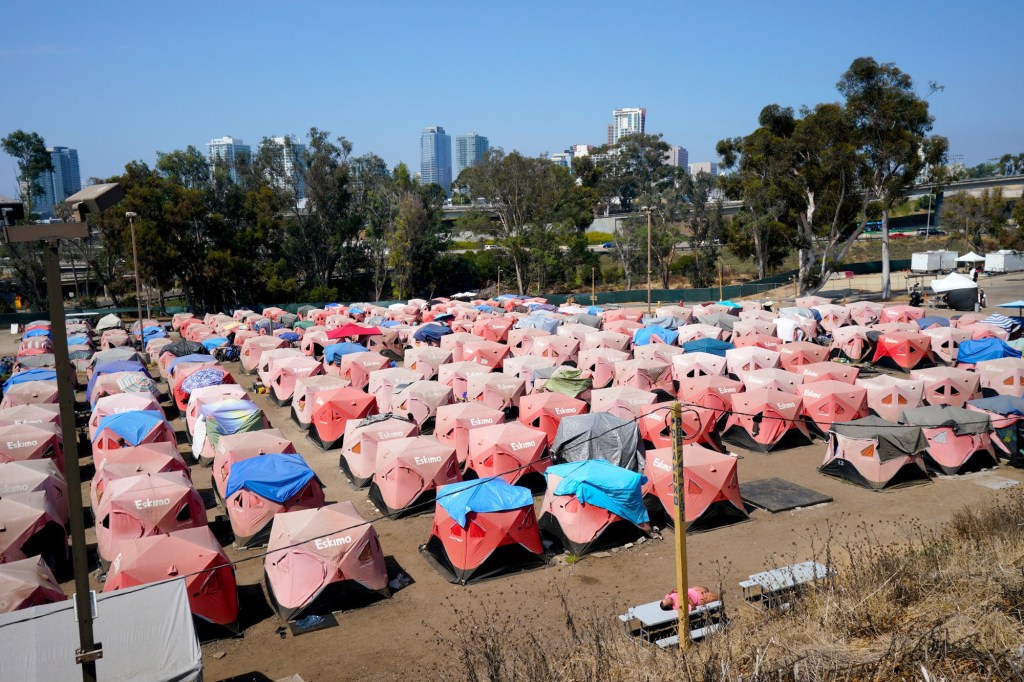
Mayor Todd Gloria again recently highlighted legitimate improvements in addressing San Diego’s homelessness.
Since the beginning of the year, the mayor and the Regional Task Force on Homelessness have touted various statistics that show a reversal in the long trend of a growing unhoused population.
Given how deep the hole has been, the signs of climbing out of it could be described as modest. But credit is deserved. Some things appear to be working, even if detailed analyses of various programs show uneven progress.
Unfortunately, the glimmer of light at the end of the tunnel may be an oncoming train of funding cuts at the state and federal levels. That could force San Diego and other regions into a worsening climate for homelessness, potentially forcing a more reactive than proactive approach.
Gloria discussed some of this in a budget memo to the City Council on April 3, according to David Garrick of The San Diego Union-Tribune.
The message was somewhat curious because the mayor urged against cutting funding for homelessness programs in the budget, yet council members have not been talking about such cuts, at least not openly. The state and federal governments are a different matter.
Meanwhile, the city is facing a $120 million budget shortfall.
The mayor went on at length about the need to find cost efficiencies and reductions. The data he presented suggested possible efforts to increase city-authorized outdoor safe sleeping sites and even safe parking lots, where people are allowed to sleep in their cars.
The memo says the city-run tent sites cost the city $48 per person each night to operate and the parking sites $26 per person each night, while the weighted average for shelter beds is $68 per bed per night. (The document noted that some costs were not included, such as for evacuations due to flooding or other natural disasters, or special services for specific populations.)
The intent of the comparison, according to the memo, “is to help the City make data-informed investments and reductions as well as identify areas to increase cost efficiencies.”
The administration was noncommittal when asked if it will seek to replace shelter beds with less-expensive alternatives.
“We are looking at cost-savings across the system, not just at safe sleeping and safe parking, but cost-efficient traditional shelter beds as well,” Gloria spokesperson David Rolland said in an email.
For years, critics of San Diego’s and California’s approaches have complained that millions and billions, respectively, have been spent to reduce homelessness, yet things just kept getting worse. Some officials announced the recent reversal with a bit of boastfulness, others with a hint of relief.
The Regional Task Force on Homelessness last year reported a roughly 7 percent drop in homelessness countywide in last year’s point-in-time count, from about 10,605 people in 2024 to about 9,905 in 2025. In the city of San Diego, homelessness dropped by 13.5 percent.
The figures for the January 2026 count are expected to be released in a matter of weeks.
Gov. Gavin Newsom said the 9 percent decrease statewide was the first reduction in 15 years. He said that shows state investments and pushing local governments to clear out illegal encampments are working.
In a first locally, at least since this data has been collected, the number of people becoming homeless about matched the number of people becoming housed in 2025, according to a task force report in January.
Officials didn’t sugarcoat the fact that much more needs to be done.
Now for some momentum killers. In recent years, the state has distributed about $1 billion annually in Homeless Housing, Assistance and Prevention (HHAP). Right now, that’s expected to be cut in half, though various groups and local officials, including Gloria, are lobbying furiously to restore full funding and make the temporary program permanent.
Further, local governments must meet specific goals to qualify for the reduced funding. Earlier this year, the Union-Tribune’s Kelly Davis detailed why San Diego officials believe the region is well positioned to grab a share.
Still, funds may dry up for efforts such as the collaboration between the state and local governments to clear out encampments on Caltrans property that was widely deemed successful.
Pandemic-era grants have been depleted and more recent federal homeless funding has been cut and restructured. Money has been squeezed for federal Section 8 housing vouchers, which provide subsidies for low-income residents, causing agencies across the region to close the program to new applicants. The wait for vouchers had already reached 15 years in San Diego.
The San Diego Housing Commission, also facing a budget crunch, recently finalized a round of layoffs.
The vouchers are considered an effective way to keep people from falling into homelessness. Other preventive programs have been initiated or bolstered in recent years. Experts say it’s more cost-efficient, and certainly more beneficial to individuals and society, to pay upfront to stop people from losing housing than to pull them out of homelessness.
Perhaps idealistically, there was hope in some quarters that such efforts eventually would become the dominant focus in the fight against homelessness.
Now those programs are at risk, along with food stamps, health care and other services for people of lesser means that are targeted in federal budget cuts.
There is some positive news amid the grimness. An apartment building boom has resulted in rent decreases, though not necessarily uniformly across the region. Anything helps, but San Diego is still expensive. Further, the city will finally reap the benefits of the 2020 voter-approved hotel tax for homeless services, road improvements and a convention center expansion.
The $33 million expected annually for city homeless programs will be a boon, but may serve as funding backfill rather than additional money as originally intended.
There are high hopes that the new point-in-time count results will show a continued reduction in homelessness, further suggesting that San Diego generally is on the right track.
If so, staying on course won’t be easy.
What they said
French President Emmanuel Macron.
“Europe is an extremely attractive continent. For months I’ve been saying this, and thanks to our American friends, I now have an unprecedented selling point: We are predictable.”