
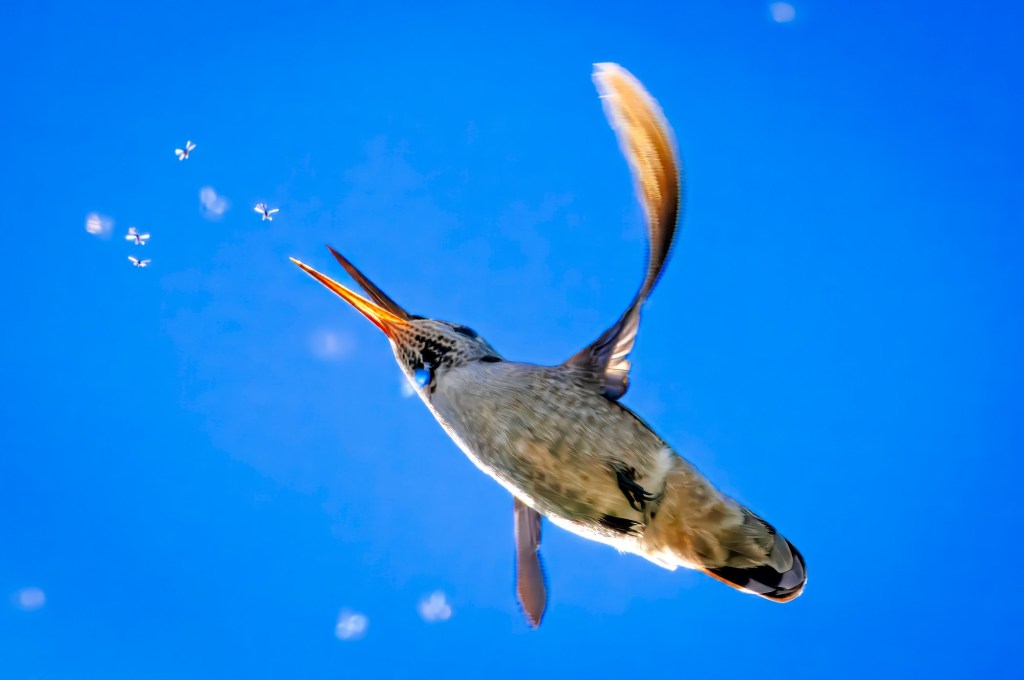
I’ve written a lot about hummingbirds recently because they are mesmerizing to watch and spring brings a delightful aerial tango as both resident and migrating species compete for nectar at my feeders.
But something new showed up recently in the form of a nearly invisible cloud hovering above a tree located next to the Mt. Hoo hummingbird feeders.
On one of our recent warm spring mornings the slowly swirling cloud caught my eye in the early morning sunlight while I was enjoying the feeding hummers.
Suddenly, a hummingbird darted up into the insect swarm, rolling, diving and maneuvering in what was obviously an attempt to catch some of the very tiny bugs.
While other hummingbirds seemed primarily focused on the nectar, some occasionally broke off and darted into the insect cloud.
This was something I had never seen before, and after getting some photos I began researching what I might be seeing.
My go-to source for answering nature questions is the experts at San Diego’s Natural History Museum.
I sent a message with photos of the insect cloud to NAT entomologist Rachel Allingham who confirmed that hummingbirds eat insects and spiders. However, due to their small size, she could not positively identify this cloud of critters without field collection.
“I think your initial instinct that they’re some kind of fly is correct. Nematocera is the suborder for small, elongate flies that aggregate in these clouds,” Allingham said.
Further research gave me some valuable insight into what our little hummingbird friends were doing.
Let me explain further.
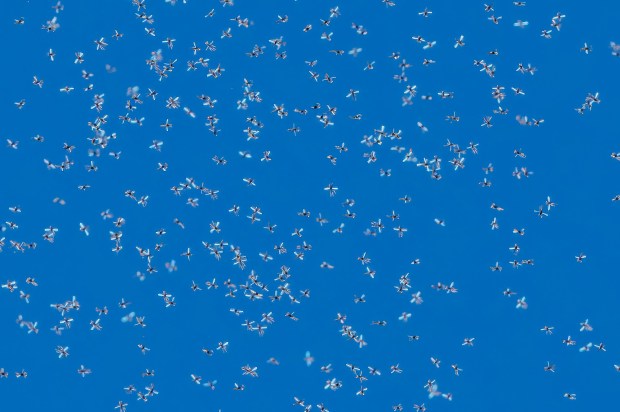 A swarm of midges. (Ernie Cowan / For The San Diego Union-Tribune)
I get lots of email from readers who worry about going on vacation and what might happen to their hummingbirds if feeders are not being filled.
The short answer is, “nothing will happen.”
First, and most importantly, don’t leave feeders full if you are going away for some time. Sugar water can spoil, sickening the little birds.
While you are gone, the hummingbirds will not starve.
Blooming flowers will provide natural nectar sources, but hummingbirds primarily eat bugs, including an assortment of gnats, mosquitoes, crane flies, midges and spiders.
A healthy garden will provide all the food they need.
It’s easy to think nectar is their only source of food, since that’s typically all we see them eating.
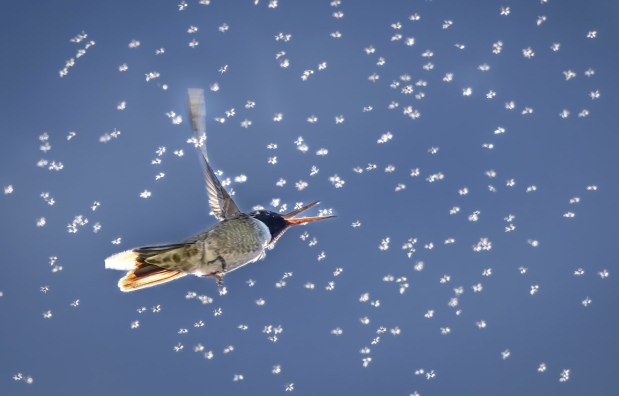 A hummingbird feasts on insects. (Ernie Cowan / For The San Diego Union-Tribune)
Avian expert Doug Tallamy considers the hummingbird to be primarily an insect eater, as insects comprise about 80% of their food. Hummingbirds simply supplement their diet with nectar, which provides quick energy for their high metabolism and nearly constant motion. The insects and spiders offer essential proteins, fats and minerals needed to sustain their bodies.
Female hummingbirds may consume as many as 2,000 insects a day while nesting. This is great news if you are a mosquito magnet.
What I was witnessing was hummingbirds leaving their high-energy “jet fuel” nectar source to go after a more important, high-protein meal needed for muscle development, feather growth and egg production.
In addition to snatching small insects out of the air, hummingbirds eat spiders and even steal smaller insects caught in a spider’s web.
This cloud of insects, known as a gnat ball, may look like a thin cloud of smoke from a distance when the light is right. They are harmless to humans.
The insects gather early in the morning as part of a mating swarm.
If you are worried about a balanced diet for your hummingbirds, there are plants you can add to your landscape that attract insects.
Coyote brush is a popular native evergreen shrub that grows to 7 feet tall and supports bees, butterflies, caterpillars and bats. It is considered a magnet that attracts insects that hummingbirds eat.
Other garden plants that attract insects include hedge nettle, California buckwheat, western columbine and toyon.
Hummingbirds need open space when hunting for insects, so plants should be in clusters with hover space in between, allowing the birds good visibility and clear space to dart after a meal on the wing.
You should also avoid pesticides because native plants need the insects, and birds will balance the populations as a natural form of pest control.
Water features are also important for your hummingbirds and the insects they eat.
Try to avoid standing water because it can become stagnant and a mosquito problem.
Since many midges and small insects need water to breed, use a shallow birdbath with recirculating water to attract them without stagnating.
If you also want to supply natural sources of nectar for hummingbirds, consider lantana, Cleveland sage, sticky monkeyflowers, manzanita, California fuchsia, black sage, scarlet buglers and hummingbird sage.
It’s amazing that in today’s world of technology, even hummingbirds depend on the cloud.
Night sky event
The public is invited to attend a free International Dark Sky Week celebration from 2 to 10 p.m. April 18 at the Santa Ysabel Nature Center, 22135 Highway 79, Santa Ysabel.
At 6 p.m., Carolyn Heffner, chief engineer from the world-famous Palomar Observatory, will discuss current research at the observatory.
Following Heffner’s presentation, there will be a screening of “The Starry Walk,” a 55-minute documentary exploring California’s dark sky places.
Other speakers will focus on the importance of dark skies, impacts on wildlife from light pollution, and lighting techniques to preserve the night sky.
Local photographer Kamala Venkatesh will also offer tips on night sky photography.
After dark there will a star party with binoculars and telescopes available to allow attendees to view celestial wonders.
Sponsors of the event include San Diego County Parks and Recreation, Julian Dark Sky Network, Borrego Springs Dark Sky Coalition and Dark Sky San Diego County.
Wren nesting
At press time there are five eggs in the Mt. Hoo wren nest box. For daily updates, visit the Mt. Hoo Wren Nesting Facebook page.
Cowan is a freelance columnist. Email ernie@packtrain.com or visit erniecowan.substack.com.