
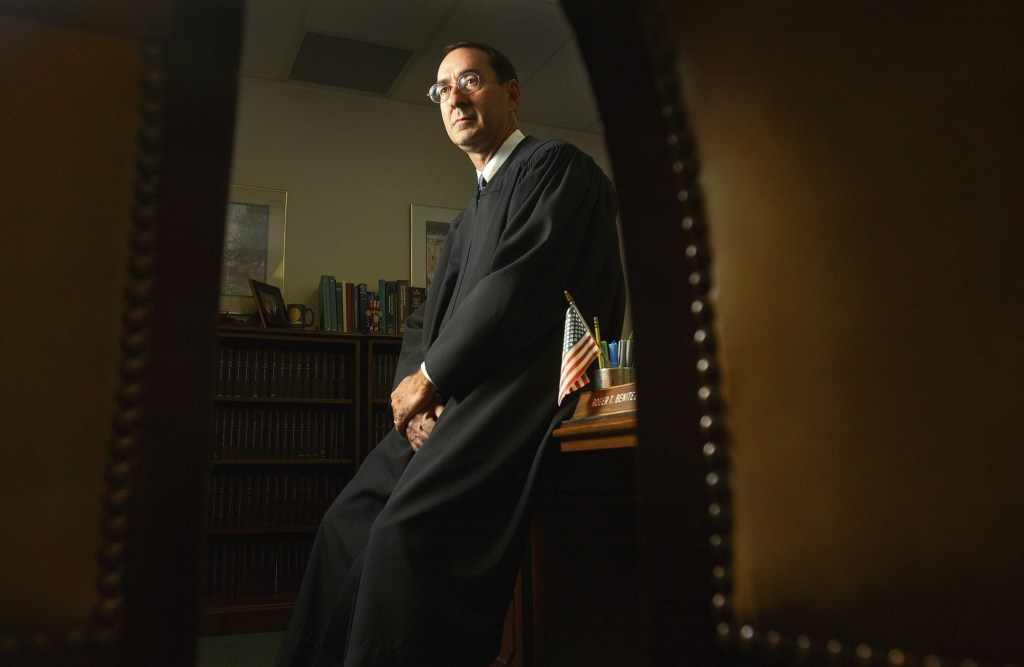
U.S. District Judge Roger Benitez, who drew both criticism and adoration for frequently striking down California’s gun laws, has retired after nearly 22 years.
Benitez, 75, retired April 2, attributing the decision to his age, health and desire to spend more time with his children and grandchildren. He is now working as an arbiter and mediator for ADR Services.
Nominated to the lifetime position by President George W. Bush, Benitez had served as a district judge since 2004, and before that as a U.S. magistrate judge in El Centro beginning in 2001. He went on semi-retired senior status and began taking a lighter caseload at the end of 2017.
It was while on senior status that Benitez rose to prominence, mostly for his gun-friendly rulings in Second Amendment cases that transformed the Southern District of California into a favorite venue for gun-rights groups to challenge state weapons laws. He also drew a rare judicial reprimand in 2024 for ordering a defendant’s teenage daughter to be handcuffed in his San Diego courtroom in an attempt to scare her straight.
His Second Amendment rulings — such as one that struck down California’s longstanding ban on assault weapons, in which Benitez compared the AR-15 rifle to a Swiss Army knife — drew the ire of those seeking to limit gun violence through legislation. That included Gov. Gavin Newsom, who once called Benitez a “stone-cold ideologue” and a “wholly owned subsidiary of the gun lobby and the National Rifle Association.”
Asked for his reaction to Benitez’s retirement, Newsom spokesperson Diana Crofts-Pelayo said in a statement: “We hope he has the retirement he deserves.” She did not elaborate when asked what kind of retirement the governor had in mind.
The newly retired judge, who never responded publicly to the criticism during his time on the bench, laughed heartily over the phone when told of Newsom’s comment, but declined to offer his own interpretation.
“I just followed the law,” Benitez said of his many rulings that California’s gun regulations violated the Second Amendment.
He pointed out that on one occasion, in a Second Amendment case dealing with billy clubs, he upheld the state ban when he believed that was the correct decision based on the Constitution and U.S. Supreme Court precedent. He later struck down the law after Supreme Court precedent changed.
“I believe that as a district judge, it is not my job to tell the Supreme Court that they’re wrong, or to try to limit what the Supreme Court has said or done,” Benitez said. “It’s not my job. I’m a district judge. I try cases. I look at the facts and make a decision based on the facts that are before me. And that’s what I’ve done.”
Fellow retired U.S. District Judge Larry Burns said Benitez handled the criticism the right way.
“He kept quiet, except among friends. He didn’t take the bait,” Burns said. “He handled those many criticisms with aplomb and dignity.”
On the other side of the criticism, Benitez was hailed as a hero and patriot by California gun enthusiasts, who nicknamed him “St. Benitez.” His likeness, complete with robes and a halo, and sometimes holding an AR-15 or a box of bullets, could be found on T-shirts, prayer candles, gun magazines and other items.
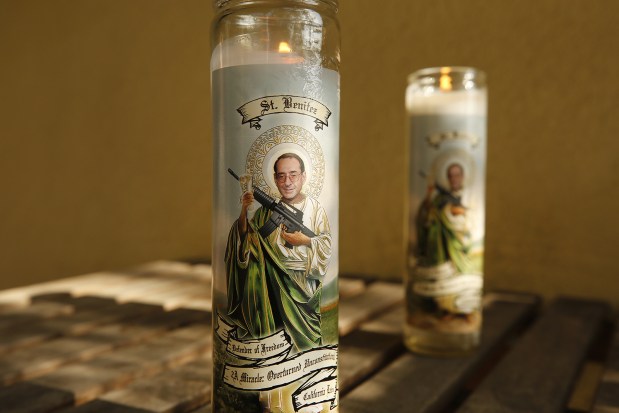 Prayer candles available online contain an image of federal Judge Roger T. Benitez as a haloed “St. Benitez,” holding an AR-15. (Al Seib/Los Angeles Times/TNS)
“I give the prayer candles away as Christmas presents,” Chuck Michel, president of the California Rifle and Pistol Association and an attorney who argued gun cases in front of Benitez, said in an interview. “He certainly has a very high standing in the Second Amendment community for faithfully applying Supreme Court precedent.”
Benitez said his wife purchased a few items featuring his saintly likeness, including a deck of cards and a T-shirt, mostly out of amusement. Benitez joked that he wished his mother “would have lived to see that her son was canonized.”
‘Unique view about our Constitution’
Benitez was born in 1950 in Cuba to what he described as a well-off family. Following the Cuban revolution of 1959, he and his brother were among the more than 14,000 Cuban children sent to the U.S. without their parents in Operation Peter Pan. His mother eventually came to the U.S., and the family of three ended up in El Centro.
His experience living in Cuba in the early years of the revolution of Fidel Castro and Ernesto “Che” Guevara “shaped my life to a great extent,” Benitez said. He used to tell his law clerks that he lived in a country that restricted free speech, the free practice of religion, due process and every other constitutional amendment that makes up the U.S. Bill of Rights.
“Of course that has changed my life, which I think one would expect,” Benitez said. “So I have a very unique view about our Constitution, the Bill of Rights, due process and how we should enforce those rights. It’s part of who I am. I can’t change that.”
Burns described Benitez as the epitome of the American Dream, saying he “overcame great hardships to achieve great things.”
At least some controversy has followed Benitez for most of his career on the federal bench. Following his 2003 nomination to the district court, the American Bar Association gave Benitez a rare “not qualified” rating. The ABA’s investigation found that lawyers and judges in San Diego and Imperial counties had deep concerns about Benitez’s judicial temperament and courtroom demeanor.
An investigation by the Union-Tribune and Los Angeles Times in 2021 found that during a 10-year stretch during Benitez’s time as a district judge, 14% of his decisions were reversed or vacated at the 9th U.S. Circuit Court of Appeals, a figure that was in the upper range of other similarly situated federal judges in the Southern District at the time. Another analysis found that Benitez gave the strictest sentences of all federal judges in San Diego.
Defense attorneys dubbed Benitez and Burns the “killer B’s,” according to Burns, who was also known as a harsh sentencer.
“Roger and I shared many of the same philosophies about the law, and one of those was that we believed consequences should follow for serious misconduct,” Burns said.
 “Saint Benitez” stickers of U.S. District Judge Roger Benitez for sale at Hiram’s Guns/Firearms Unknown in El Cajon on Aug. 3, 2021. (Kristian Carreon / U-T file)
Benitez said he believes his sentences were fair, but acknowledged that his philosophy differed from some judges when it came to honoring the length of prison terms that were sometimes agreed between prosecutors and defendants.
“That’s not their job, it’s our job as the judges,” Benitez said. “It’s very easy to follow along with that kind of an agreement, but I don’t think that’s my job. My job is to look at the unique facts of the case, the unique facts of the defendant and the circumstances of the offense.”
Benitez also acknowledged that he gave stricter sentences than other judges to drug offenders, believing longer sentences could act as a deterrent.
“I kind of think of it as a way of trying to solve a problem,” he said. “On the other hand, if the circumstances don’t require that I be a tough sentencer … no, I don’t think I’m a tough sentencer. I impose a sentence that I believe is warranted.”
One of the most controversial incidents in Benitez’s career occurred in 2023 during a parole violation hearing for a defendant he’d previously sentenced, when he ordered a U.S. marshal to briefly handcuff the man’s 13-year-old daughter. Benitez later told a judicial panel investigating the incident that it was a teaching moment meant to scare the girl away from using drugs. It prompted a rare misconduct finding by the 9th Circuit and its 11-judge Judicial Council, which found that he “engaged in abusive or harassing behavior” that exceeded his authority and could have a chilling effect on the public attending court hearings.
Benitez said during an interview last week that he couldn’t discuss that incident in detail, in part because there was confidential information in the father’s pre-sentence report that influenced his decision that day and that he can’t disclose now.
“I did what I thought at the time was what I needed to do; the 9th Circuit did what they thought they needed to do,” Benitez said. “That’s all I can say.”
In general, Benitez rejected the idea that he was a controversial figure, reiterating that he tried at all times to follow the law.
“If someone wants to label me as controversial, fine, but the law itself, by its very nature, is controversial, right?” he said. “It’s adversarial. That’s the whole process … I don’t want to be controversial, you know? I want to be happy. I want to get along. I want to be your best friend, but my job doesn’t necessarily allow me to do that.”
‘He’ll be missed’
In his most recent high-profile and controversial set of rulings, Benitez sided with two Escondido Union School District teachers and local parents in ruling that parents have a constitutional right to be informed if their child changes their gender presentation at school, and that schools can’t hide that information from parents.
The 9th Circuit issued a stay of that ruling, but the Supreme Court last month reversed the stay in a 6-3 decision and reinstated Benitez’s original ruling.
“Parents have a fundamental right to decide the custody, care and control of their children, including things that may affect their health and well-being,” Benitez said last week of his rulings in that case. “I think that parents generally love their kids. They want to do what’s best for their kids. And I think that they should be given the first opportunity to make decisions about their kids. And that’s not just my personal opinion, that’s what the Supreme Court has said. So that’s why I decided the case the way I did.”
That case, like many of his Second Amendment cases, remains under appeal. Also like the Second Amendment cases, it’s likely to end up being one of the defining aspects of his legacy.
Another part of that legacy will be the local rule change that came about from his handling of so many Second Amendment cases. Between 2019 and 2021, he struck down a state law banning gun magazines that hold more than 10 bullets, one that required background checks for ammunition purchases and the state law banning assault rifles. He was later assigned several other weapons cases and ruled in each one that the state law in question violated the Second Amendment.
Federal court cases are assigned randomly, but a quirk in the local court rules at the time allowed attorneys to transfer related cases to the same judge without giving attorneys on the other side a chance to contest the transfer. The court changed that rule in May 2023.
Even so, the San Diego federal court remained a popular venue for such cases, in part on the chance that it would be randomly assigned to Benitez.
Michel, the California Rifle and Pistol Association president, said Second Amendment advocates will now have to turn to more traditional ways of looking at venues and weighing their odds of getting a favorable judge.
“There’s nothing special about the San Diego district anymore,” Michel said. “He’ll be missed. I wish him well, and he’ll be missed.”